 5 to 3
Show notes
What Is a Genome? Genome vs Chromosome vs Gene, Animated
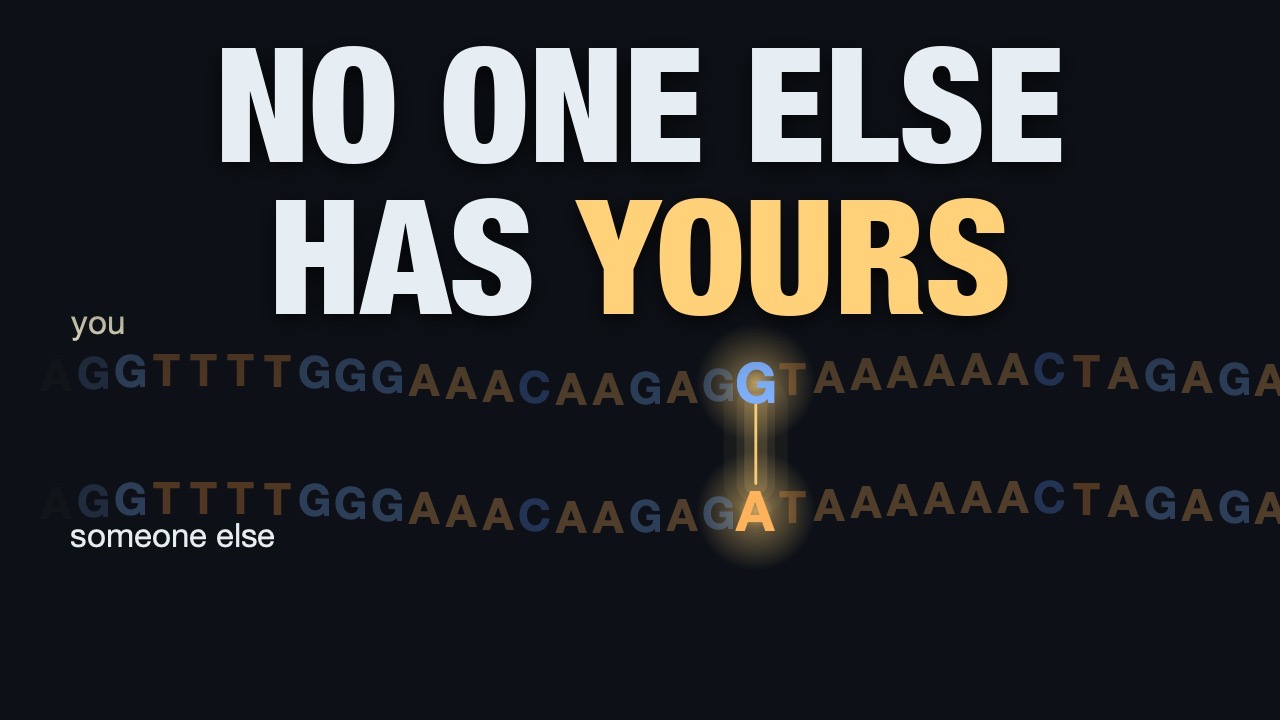
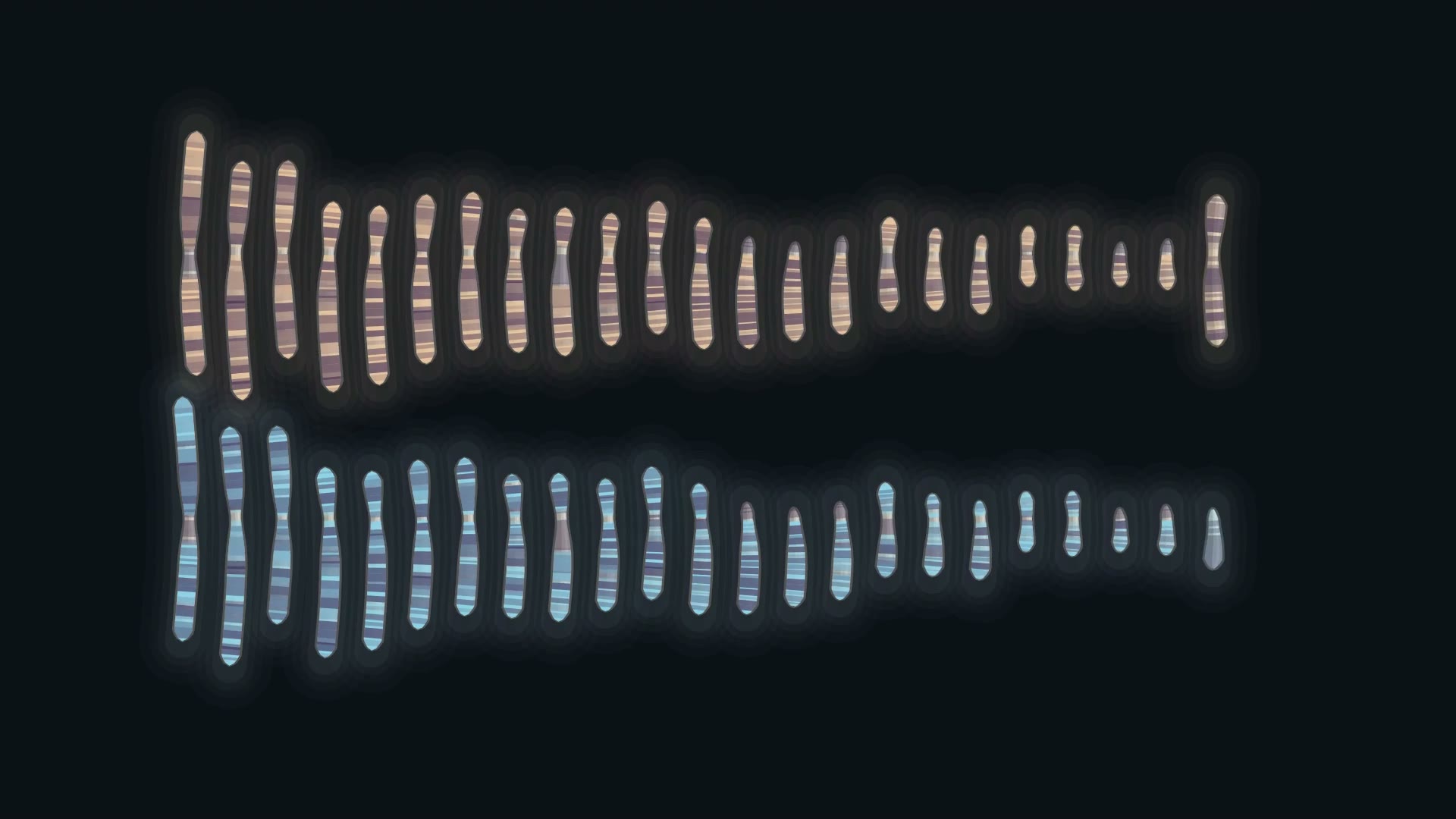
What is a genome? Your genome is the complete sequence of all your DNA: about six billion base pairs. This video goes from one base pair of your DNA out to all of it, then through its parts: forty-six chromosomes, twenty-three from your mother and twenty-three from your father, from about 250 million base pairs down to about 45 million; about twenty thousand genes, stretches of DNA with the instructions for making proteins, two copies of each; and the base pairs themselves, A with T and C with G across the two strands. The order of those base pairs is your DNA sequence, which DNA sequencing reads, and no one else alive has exactly the same one. Almost every cell of your body carries this same genome; a nerve cell and a skin cell differ because each switches on a different set of genes.
The video is coming soon to the channel.
Vocabulary
In the order the video explains them. Tap a term for its definition and every video it appears in.
Genome0:14
The complete sequence of all your DNA: in a person, about six billion base pairs, in forty-six chromosomes.
Appears in
- Why DNA Only Grows in One Direction (5′ to 3′ Explained)5:24
- Why Half Your DNA Is Copied Backwards (DNA Replication Animated)12:41
- The Mysterious Squares on Chromosome 10:11
- Point Mutations and Frameshift Mutations, Explained6:18
- Complementation Test Explained Step by Step3:57
- Why Labs Are Abandoning ChIP-seq0:00
- cut_and_tag_plant0:00
- What is your DNA actually made of? #Shorts0:03
- How do scientists read mummy DNA? #Shorts0:17
- What Is Fiber-seq? Fiber-seq Explained5:30
- What Actually Makes Up the Human Genome?0:00
- What Actually Makes Up the Human Genome?0:00
- What Is a Genome? Genome vs Chromosome vs Gene, Animated this video0:14
- Why Does Sex Exist? Meiosis Explained0:29
- The 10 Types of DNA Mutations Explained in 5 Minutes1:41
- What Is a Pangenome Graph? Pangenome Graphs Explained0:00
- PCR Explained0:04
- Next Generation Sequencing Explained (NGS Animation)0:20
- Template Strand and Coding Strand: Sense vs Antisense DNA, Animated1:29
Chromosome0:21
One of the enormous pieces of DNA your genome comes in. You have forty-six, twenty-three from your mother and twenty-three from your father, from about 250 million base pairs (the largest) to about 45 million (the smallest).
Appears in
- Why Half Your DNA Is Copied Backwards (DNA Replication Animated)0:36
- The Mysterious Squares on Chromosome 10:00
- Complementation Test Explained Step by Step1:44
- Why Labs Are Abandoning ChIP-seq0:33
- cut_and_tag_plant4:14
- Why are calico cats almost always female? #Shorts0:05
- What is your DNA actually made of? #Shorts0:03
- What Is Fiber-seq? Fiber-seq Explained1:09
- What Actually Makes Up the Human Genome?0:08
- What Actually Makes Up the Human Genome?0:55
- What Is a Genome? Genome vs Chromosome vs Gene, Animated this video0:21
- Why Does Sex Exist? Meiosis Explained0:00
- How Your Cells Divide: Mitosis in 5 Minutes0:40
- The 10 Types of DNA Mutations Explained in 5 Minutes2:54
- What Is a Pangenome Graph? Pangenome Graphs Explained1:39
- Next Generation Sequencing Explained (NGS Animation)5:14
- Template Strand and Coding Strand: Sense vs Antisense DNA, Animated0:58
Gene0:39
A stretch of DNA along a chromosome with the instructions for making a protein. Most are thousands to tens of thousands of base pairs long; you have about twenty thousand, two copies of each, one from each parent.
Appears in
- Why DNA Only Grows in One Direction (5′ to 3′ Explained)4:50
- Why Does Life Need Both? (DNA vs RNA Animated)0:33
- What Turns a Gene On? (Transcription Animated)0:45
- How Does a Cell Read a Gene’s Message? (Translation Animated)0:45
- The Mysterious Squares on Chromosome 15:02
- Point Mutations and Frameshift Mutations, Explained0:00
- Complementation Test Explained Step by Step0:00
- Why Labs Are Abandoning ChIP-seq5:41
- cut_and_tag_plant1:48
- Why are calico cats almost always female? #Shorts0:42
- What is your DNA actually made of? #Shorts0:11
- How does death cap poison kill? (animated) #Shorts0:22
- Single Cell RNA Sequencing Explained: The Cells of a Plant Root #Shorts0:09
- Scientists found DNA building blocks on an asteroid #Shorts0:14
- What Is Fiber-seq? Fiber-seq Explained0:06
- What Actually Makes Up the Human Genome?0:08
- What Actually Makes Up the Human Genome?0:55
- What Is a Genome? Genome vs Chromosome vs Gene, Animated this video0:39
- Why Does Sex Exist? Meiosis Explained2:01
- The 10 Types of DNA Mutations Explained in 5 Minutes2:59
- What Is a Pangenome Graph? Pangenome Graphs Explained0:13
- PCR Explained0:00
- Next Generation Sequencing Explained (NGS Animation)1:55
- Template Strand and Coding Strand: Sense vs Antisense DNA, Animated0:09
Nucleotide0:58
One link in each of DNA's two strands, carrying one of four bases: A, C, G or T.
Appears in
- Why DNA Only Grows in One Direction (5′ to 3′ Explained)0:50
- Why Half Your DNA Is Copied Backwards (DNA Replication Animated)3:45
- Why Does Life Need Both? (DNA vs RNA Animated)1:09
- What Turns a Gene On? (Transcription Animated)6:17
- How Does a Cell Read a Gene’s Message? (Translation Animated)5:50
- Point Mutations and Frameshift Mutations, Explained0:42
- What Is Fiber-seq? Fiber-seq Explained4:34
- What Actually Makes Up the Human Genome?2:15
- What Actually Makes Up the Human Genome?3:28
- What Is a Genome? Genome vs Chromosome vs Gene, Animated this video0:58
- The 10 Types of DNA Mutations Explained in 5 Minutes1:17
- PCR Explained0:47
- Next Generation Sequencing Explained (NGS Animation)2:42
Base pair0:58
Two bases paired across DNA's two strands: A with T, or C with G. Your genome is about six billion base pairs.
Appears in
- Why Half Your DNA Is Copied Backwards (DNA Replication Animated)0:28
- What Turns a Gene On? (Transcription Animated)5:57
- The Mysterious Squares on Chromosome 10:00
- Point Mutations and Frameshift Mutations, Explained0:18
- Why Labs Are Abandoning ChIP-seq4:03
- cut_and_tag_plant3:56
- What Is Fiber-seq? Fiber-seq Explained1:44
- What Actually Makes Up the Human Genome?2:53
- What Actually Makes Up the Human Genome?0:48
- What Is a Genome? Genome vs Chromosome vs Gene, Animated this video0:58
- How Your Cells Divide: Mitosis in 5 Minutes0:40
- The 10 Types of DNA Mutations Explained in 5 Minutes0:00
- What Is a Pangenome Graph? Pangenome Graphs Explained1:39
- ryugu_bases3:12
- Next Generation Sequencing Explained (NGS Animation)4:19
DNA sequence1:13
The order of the base pairs along the DNA. No one else alive has exactly the same sequence as you.
Appears in
- What Turns a Gene On? (Transcription Animated)2:43
- The Mysterious Squares on Chromosome 11:22
- What Is a Genome? Genome vs Chromosome vs Gene, Animated this video1:13
- The 10 Types of DNA Mutations Explained in 5 Minutes0:46
- What Is a Pangenome Graph? Pangenome Graphs Explained3:04
DNA sequencing1:13
Reading the order of the base pairs in DNA, base pair by base pair.
Appears in
- What Actually Makes Up the Human Genome?7:29
- What Is a Genome? Genome vs Chromosome vs Gene, Animated this video1:13
- Next Generation Sequencing Explained (NGS Animation)5:59
Study frame
The whole picture in one labelled frame, to save or print.
Review questions
What is a genome, and how big is yours?
Answer
The complete sequence of all your DNA: about six billion base pairs.
How many chromosomes do you have, and where do they come from?
Answer
Forty-six: twenty-three from your mother and twenty-three from your father. They are numbered roughly from largest, about 250 million base pairs, to smallest, about 45 million.
What is a gene, and how many copies of each do you carry?
Answer
A stretch of DNA along a chromosome with the instructions for making a protein. You have about twenty thousand genes, two copies of each, one from each parent.
Which bases pair across DNA's two strands?
Answer
A pairs with T, and C pairs with G. Each pair is a base pair.
A nerve cell and a skin cell carry the same genome. Why are they different?
Answer
Each one switches on a different set of genes.
Chapters
- 0:00 What is a genome? The definition
- 0:20 Chromosomes: 46 pieces of DNA
- 0:38 What is a gene?
- 0:57 What is a base pair?
- 1:13 What is a DNA sequence?
- 1:28 The same genome in every cell
Sources
11 sources. Each was checked against its record (Crossref, PubMed, the Protein Data Bank, or the textbook edition) and against the claim it supports.
Textbooks
- Alberts B, Johnson A, Lewis J, Raff M, Roberts K, Walter P (2002). Molecular Biology of the Cell, 4th ed. New York: Garland Science. Free on NCBI Bookshelf: www.ncbi.nlm.nih.gov/books/NBK21054/ (46 chromosomes, one copy of each from each parent; the four bases, A with T and G with C; the order of the nucleotides is the sequence; genes code for proteins; cell types differ in the genes they use, not in their DNA; red blood cells lack DNA)
- Clark MA, Choi J, Douglas M (2018). Biology 2e. OpenStax, Rice University. ISBN 9781947172524. openstax.org/details/books/biology-2e (base pairs: adenine with thymine, guanine with cytosine)
Genome data
- Chromosome lengths and the six billion base pairs: T2T-CHM13v2.0 (UCSC hs1), github.com/marbl/CHM13 ; Nurk S et al. (2022). The complete sequence of a human genome. Science 376:44-53. doi.org/10.1126/science.abj6987
- The Y chromosome in T2T-CHM13v2.0 (from HG002): Rhie A et al. (2023). The complete sequence of a human Y chromosome. Nature 621:344-354. doi.org/10.1038/s41586-023-06457-y
- The base pairs read on screen (one person's two copies of chromosome 11, around the beta-globin gene): T2T-HG002 Q100 v1.1, github.com/marbl/hg002 ; Hansen NF et al. (2026). A complete diploid human genome benchmark for personalized genomics. Cell 189:4857-4875.e31. doi.org/10.1016/j.cell.2026.06.016
- Gene map on chromosome 11: RefSeq Liftoff v5.2 annotation of T2T-CHM13v2.0 (chm13v2.0_RefSeq_Liftoff_v5.2.gff3.gz), s3-us-west-2.amazonaws.com/human-pangenomics/T2T/CHM13/assemblies/annotation/chm13v2.0_RefSeq_Liftoff_v5.2.gff3.gz ; Shumate A, Salzberg SL (2021). Liftoff: accurate mapping of gene annotations. Bioinformatics 37:1639-1643. doi.org/10.1093/bioinformatics/btaa1016 ; O'Leary NA et al. (2016). Reference sequence (RefSeq) database at NCBI: current status, taxonomic expansion, and functional annotation. Nucleic Acids Research 44:D733-D745. doi.org/10.1093/nar/gkv1189
- About twenty thousand protein-coding genes: Mudge JM et al. (2025). GENCODE 2025: reference gene annotation for human and mouse. Nucleic Acids Research 53:D966-D975. doi.org/10.1093/nar/gkae1078 (GENCODE 47: 19,433 protein-coding genes; T2T-CHM13: 19,969, Nurk et al. 2022)
- Genes a nerve cell and a skin cell switch on (illustrative marker genes): Human Protein Atlas v25.1, single cell type data, v25.proteinatlas.org/ ; Karlsson M et al. (2021). A single-cell type transcriptomics map of human tissues. Science Advances 7:eabh2169. doi.org/10.1126/sciadv.abh2169 (the 2021 paper has skin keratinocytes but no brain samples; the neuron data come from later Atlas releases)
Papers
- Identical twins differ at a handful of spots: Jonsson H et al. (2021). Differences between germline genomes of monozygotic twins. Nature Genetics 53:27-34. doi.org/10.1038/s41588-020-00755-1
Structures drawn
- Beta-globin, the protein of the gene the video follows (PDB 4HHB, human deoxyhaemoglobin; one beta chain drawn): Fermi G, Perutz MF, Shaanan B, Fourme R (1984). The crystal structure of human deoxyhaemoglobin at 1.74 Å resolution. Journal of Molecular Biology 175:159-174. doi.org/10.1016/0022-2836(84)90472-8
- Nucleosomes in the opening pull-back (PDB 1KX5, nucleosome core particle; Xenopus laevis histones): Davey CA, Sargent DF, Luger K, Maeder AW, Richmond TJ (2002). Solvent mediated interactions in the structure of the nucleosome core particle at 1.9 Å resolution. Journal of Molecular Biology 319:1097-1113. doi.org/10.1016/S0022-2836(02)00386-8