 5 to 3
Show notes
Complementation Test Explained Step by Step
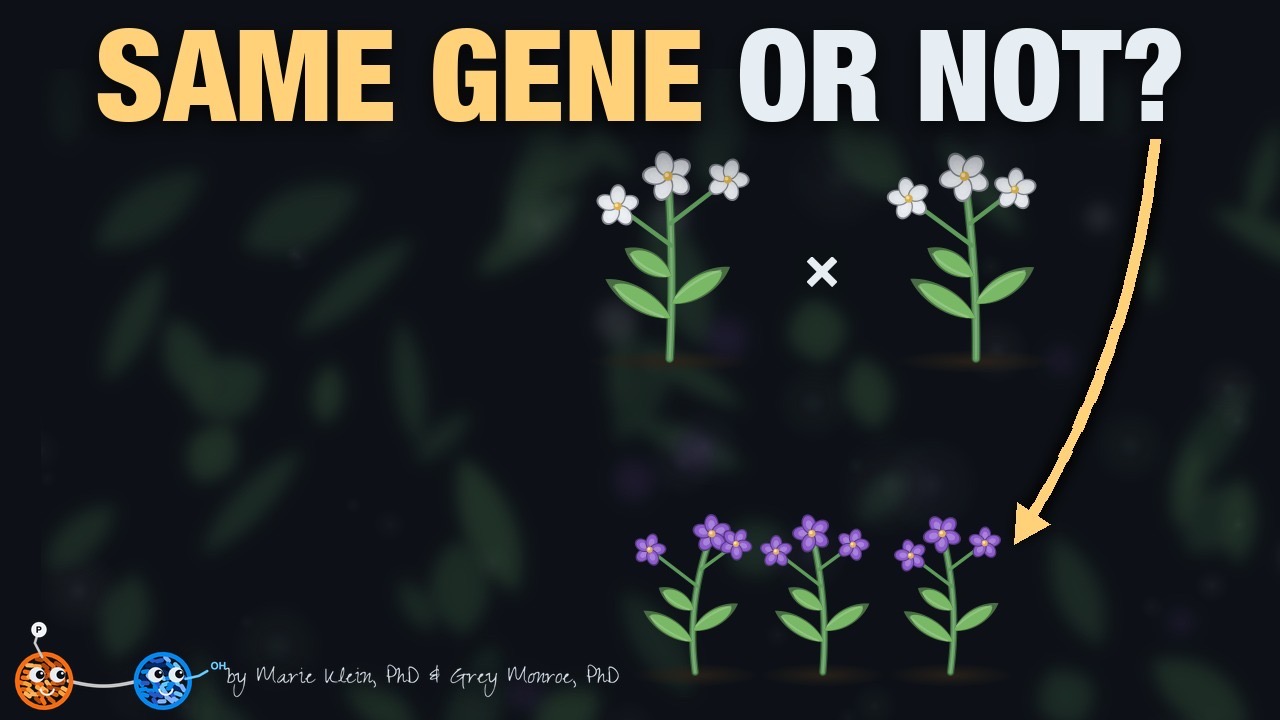
What is a complementation test, and how does it tell whether two mutants that look the same are mutated in the same gene or in different genes? This video walks through it step by step on a plant example. Two white-flowered mutants of a purple-flowered plant are crossed. The purple pigment is made in two steps, an enzyme encoded by gene A and then an enzyme encoded by gene B, so knocking out either gene gives white flowers. The mutations must be recessive, and each mutant is usually homozygous. If the mutations are in different genes, every offspring inherits a working copy of each gene, one from each parent; one working copy usually makes enough enzyme, so the flowers are purple. The mutations complement each other: nonallelic mutations. If both mutations are in gene A, every offspring inherits two mutant copies of gene A, the pathway stays blocked and the flowers are white. The mutations fail to complement, so they are most likely in the same gene: allelic mutations. In a mutant screen, every mutant is crossed with every other and the results go into a complementation table, read one row at a time; each set of mutations that fail to complement one another is a complementation group, usually one gene. The video ends on the real screen behind it: in 1973 Leland Hartwell and his colleagues sorted a hundred and forty-eight yeast cell division cycle mutants into thirty-two genes by complementation, work that led to a share of the 2001 Nobel Prize.
The video is coming soon to the channel.
Vocabulary
In the order the video explains them. Tap a term for its definition and every video it appears in.
Complementation test0:00
A cross between two mutants with the same phenotype that tells whether they are mutated in the same gene or in different genes. Offspring with the wild-type phenotype mean the mutations complement, in different genes; mutant offspring mean they fail to complement, most likely in the same gene.
Appears in
- Complementation Test Explained Step by Step this video0:00
Wild type0:53
The normal phenotype or allele of a species: in the video's plant, purple flowers.
Appears in
- Complementation Test Explained Step by Step this video0:53
Recessive mutation1:28
A mutation whose phenotype shows only when both copies of the gene carry it. Loss-of-function mutations are usually recessive because one working copy makes enough of the gene's product. A complementation test needs recessive mutations.
Appears in
- Complementation Test Explained Step by Step this video1:28
Homozygous1:28
Having the same allele on both copies of a gene: here, both copies carry the mutation.
Appears in
- Complementation Test Explained Step by Step this video1:28
Complementation2:10
When two mutants crossed together give offspring with the wild-type phenotype, because each parent supplies a working copy of the gene the other lacks. Mutations that complement are in different genes.
Appears in
- Complementation Test Explained Step by Step this video2:10
Nonallelic mutations2:10
Mutations in different genes. They complement each other in a complementation test.
Appears in
- Complementation Test Explained Step by Step this video2:10
Allelic mutations2:40
Mutations in the same gene, which make them alleles of that gene. They fail to complement each other: the offspring of the cross still show the mutant phenotype.
Appears in
- Complementation Test Explained Step by Step this video2:40
Complementation table2:50
The results of crossing every mutant from a screen with every other: a plus sign for a cross whose offspring were wild type (the two complement), a minus sign for mutant offspring (they fail to complement).
Appears in
- Complementation Test Explained Step by Step this video2:50
Complementation group3:38
A set of mutations that all fail to complement one another. Each complementation group is usually one gene.
Appears in
- Complementation Test Explained Step by Step this video3:38
Review questions
Two white-flowered mutants are crossed and every offspring has purple flowers. What does that tell you?
Answer
The two mutations complement each other, so they are in different genes (nonallelic mutations): each parent supplied a working copy of the gene the other lacked.
Two white-flowered mutants are crossed and every offspring has white flowers. What does that tell you?
Answer
The mutations fail to complement, so they are most likely in the same gene (allelic mutations): every offspring inherits a mutant copy of that gene from each parent.
Why must the mutations in a complementation test be recessive?
Answer
The test reads whether one working copy from the other parent restores the wild type. A dominant mutation shows its phenotype even beside a working copy, so the offspring would look mutant either way.
Why does one working copy of a gene usually give a normal phenotype?
Answer
One working copy usually makes enough enzyme for the pathway to run, which is why loss-of-function mutations are usually recessive.
In a complementation table, mutant one fails to complement mutants two and four, and complements the rest. Which mutants share a gene with mutant one?
Answer
Mutants two and four: mutants one, two and four form one complementation group, usually one gene.
What did Hartwell's yeast screen find with complementation tests?
Answer
A hundred and forty-eight temperature-sensitive cell division cycle mutants fell into thirty-two complementation groups, each a single gene needed at its own step of the cell cycle.
Chapters
- 0:00 What is a complementation test?
- 0:52 One phenotype, two genes: a flower color pathway
- 1:27 Mutations in different genes complement
- 2:20 Mutations in the same gene fail to complement
- 2:50 Reading a complementation table
- 3:52 Hartwell's yeast cell cycle screen
Sources
3 sources. Each was checked against its record (Crossref, PubMed, the Protein Data Bank, or the textbook edition) and against the claim it supports.
Textbook
- Nickle T, Barrette-Ng I, eds. Online Open Genetics. LibreTexts, CC BY-SA 3.0 (original text by Michael Deyholos). bio.libretexts.org/Bookshelves/Genetics/Online_Open_Genetics_(Nickle_and_Barrette-Ng) (§4.6: the complementation test, two independently found mutants with the same phenotype, the two-enzyme purple pigment pathway and white-flowered mutants, crossing two homozygous recessive mutants, offspring with the wild-type phenotype mean the mutations complement and are in different genes, mutant offspring mean the same gene, allelic and nonallelic mutations; §3.3: one wild-type copy is usually enough, which is why loss-of-function mutations are recessive)
Paper
- Hartwell LH, Mortimer RK, Culotti J, Culotti M (1973). Genetic control of the cell division cycle in yeast: V. Genetic analysis of cdc mutants. Genetics 74:267-286. doi.org/10.1093/genetics/74.2.267 (148 temperature-sensitive cell division cycle mutants of Saccharomyces cerevisiae; complementation sorted these recessive mutations into 32 groups, each a single gene; all mutations in the same gene give essentially the same arrested cell shape; Figure 1 and Table 3, the arrest shapes and group sizes drawn in the video)
Prize
- The Nobel Prize in Physiology or Medicine 2001, Leland H. Hartwell, R. Timothy Hunt and Paul M. Nurse, "for their discoveries of key regulators of the cell cycle". www.nobelprize.org/prizes/medicine/2001/summary/