 5 to 3
Show notes
PCR Explained
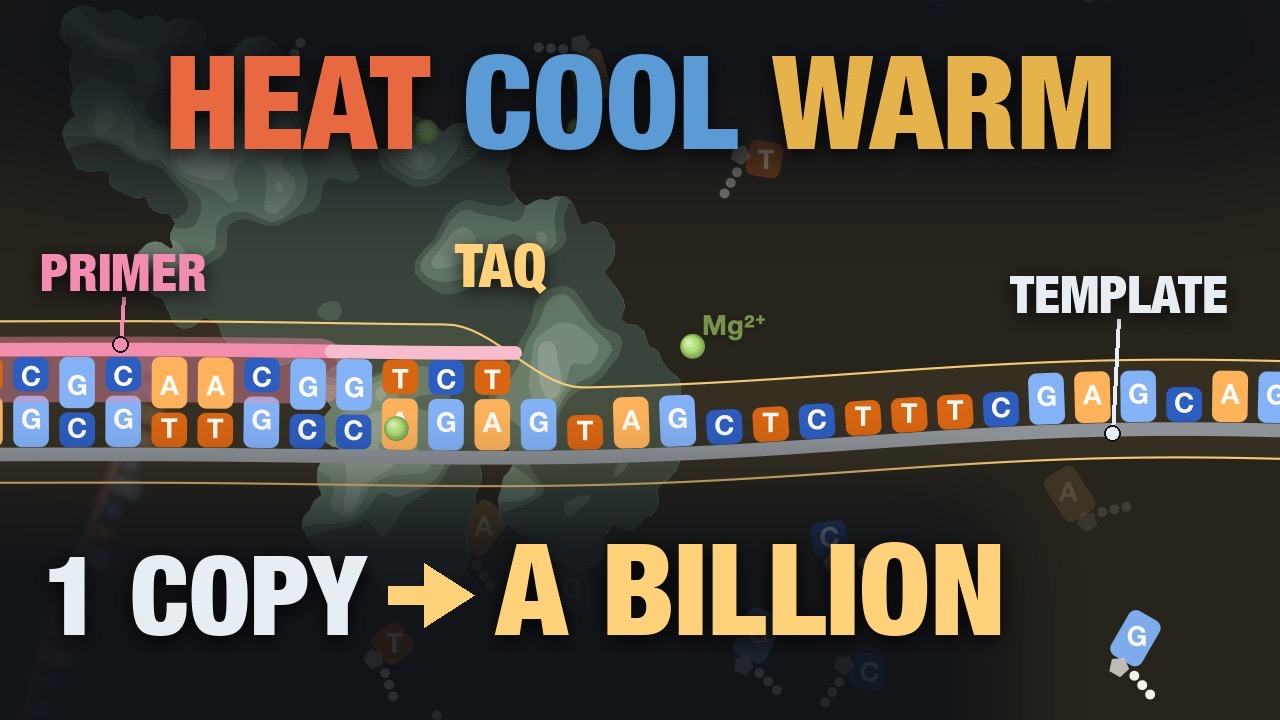
How does PCR work? This video walks the polymerase chain reaction step by step: the four ingredients in the tube (your DNA, two primers, nucleotides and a DNA polymerase, with magnesium), then the three steps of every cycle in a thermal cycler: denaturing at about 95 degrees, annealing at about 55, extension at about 72. It shows how the forward and reverse primers mark the two ends of the target, why Taq polymerase from a hot-spring bacterium is used, why from cycle three on the copies are exactly the target, primer to primer, how doubling every cycle turns one copy into about a billion in thirty cycles, and how a gel shows that a PCR worked.
The video is coming soon to the channel.
Vocabulary
In the order the video explains them. Tap a term for its definition and every video it appears in.
PCR (polymerase chain reaction)
A method that makes millions of copies of one specific piece of DNA, the target sequence, by repeating a cycle of three temperatures that doubles it each time.
Appears in
Term cardPrimer
A short piece of DNA, about twenty nucleotides, that pairs with one end of the target sequence; the polymerase builds a new strand from its 3′ end. PCR uses two, one for each end.
Appears in
- Why DNA Only Grows in One Direction (5′ to 3′ Explained)7:36
- Why Half Your DNA Is Copied Backwards (DNA Replication Animated)4:03
- Why Labs Are Abandoning ChIP-seq3:16
- cut_and_tag_plant3:03
Forward and reverse primer
The forward primer has the same sequence as the start of the top strand, so it pairs with the bottom strand; the reverse primer matches the start of the bottom strand at the other end and pairs with the top strand. Their 3′ ends face each other across the target.
Appears in
Nucleotides
The loose building blocks of DNA, A, C, G and T, that the polymerase joins into new strands.
Appears in
- Why DNA Only Grows in One Direction (5′ to 3′ Explained)1:27
- Why Half Your DNA Is Copied Backwards (DNA Replication Animated)4:25
- Why Does Life Need Both? (DNA vs RNA Animated)1:09
- What Turns a Gene On? (Transcription Animated)6:17
- How Does a Cell Read a Gene’s Message? (Translation Animated)8:26
- Point Mutations and Frameshift Mutations, Explained0:42
- What Actually Makes Up the Human Genome?2:15
- What Actually Makes Up the Human Genome?3:28
- What Is a Genome? Genome vs Chromosome vs Gene, Animated0:58
DNA polymerase
The enzyme that joins nucleotides into new DNA, pairing each with the template; it needs magnesium to work.
Appears in
- Why DNA Only Grows in One Direction (5′ to 3′ Explained)0:23
- Why Half Your DNA Is Copied Backwards (DNA Replication Animated)3:45
- Why Does Life Need Both? (DNA vs RNA Animated)5:51
- What Turns a Gene On? (Transcription Animated)6:45
- Why Does Sex Exist? Meiosis Explained4:05
- Next Generation Sequencing Explained (NGS Animation)2:42
Thermal cycler
The machine that takes the PCR tube through the three temperatures of each cycle, over and over.
Appears in
Denaturing
The first step of a PCR cycle: heating to about 95 degrees so the two strands of the DNA come apart.
Appears in
Annealing
The second step: cooling to around 55 degrees so single strands pair up again; the primers, far more numerous than the long strands, stick to their matching spots first.
Appears in
Extension
The third step: warming to about 72 degrees, where Taq builds a new strand from each primer.
Appears in
Taq polymerase
The DNA polymerase of a bacterium from the hot springs of Yellowstone; it survives the 95-degree step, cycle after cycle.
Appears in
Gel electrophoresis
A way to sort DNA pieces by size; a PCR that worked shows one bright band at the target's size beside a ladder of known sizes.
Appears in
Review questions
What are the four key ingredients of a PCR, and what does each do?
Answer
Your DNA (the sample that holds the target), two primers (mark the two ends of the target), nucleotides (the building blocks) and a DNA polymerase (joins them into new DNA, with magnesium).
Name the three steps of a PCR cycle and their rough temperatures.
Answer
Denaturing at about 95 degrees (the strands come apart), annealing at about 55 degrees (primers bind), extension at about 72 degrees (Taq builds the new strands).
Why does PCR use Taq polymerase?
Answer
The denaturing step at 95 degrees destroys most enzymes; Taq, from a hot-spring bacterium, survives the heat cycle after cycle.
In the first cycle the new strands run long. When do copies that are exactly the target first appear?
Answer
In cycle two the first strands that run primer to primer are made; in cycle three they are copied, giving the first double strands that are just the target, end to end.
How do you check that a PCR worked?
Answer
Run a little of the reaction on a gel beside a ladder of known sizes: a reaction that worked shows one bright band at the target's size; a failed one shows none.
Chapters
- 0:00 PCR explained: what you'll learn
- 0:37 What goes in the tube: the PCR ingredients
- 1:25 PCR steps: denaturing, annealing and extension
- 3:17 Why every copy is exactly the target sequence
- 4:00 Recap, and checking a PCR on a gel
Sources
15 sources. Each was checked against its record (Crossref, PubMed, the Protein Data Bank, or the textbook edition) and against the claim it supports.
History
- The Nobel Prize in Chemistry 1993: Kary B. Mullis, "for his invention of the polymerase chain reaction (PCR) method" (shared with Michael Smith). NobelPrize.org. www.nobelprize.org/prizes/chemistry/1993/summary/
- Mullis KB (1990). The unusual origin of the polymerase chain reaction. Scientific American 262:56-65. doi.org/10.1038/scientificamerican0490-56
- Saiki RK, Scharf S, Faloona F, Mullis KB, Horn GT, Erlich HA, Arnheim N (1985). Enzymatic amplification of β-globin genomic sequences and restriction site analysis for diagnosis of sickle cell anemia. Science 230:1350-1354. doi.org/10.1126/science.2999980
- Saiki RK, Gelfand DH, Stoffel S, Scharf SJ, Higuchi R, Horn GT, Mullis KB, Erlich HA (1988). Primer-directed enzymatic amplification of DNA with a thermostable DNA polymerase. Science 239:487-491. doi.org/10.1126/science.2448875
Thermus aquaticus and Taq polymerase
- Brock TD, Freeze H (1969). Thermus aquaticus gen. n. and sp. n., a nonsporulating extreme thermophile. Journal of Bacteriology 98:289-297. doi.org/10.1128/jb.98.1.289-297.1969
- Chien A, Edgar DB, Trela JM (1976). Deoxyribonucleic acid polymerase from the extreme thermophile Thermus aquaticus. Journal of Bacteriology 127:1550-1557. doi.org/10.1128/jb.127.3.1550-1557.1976
Primers
- Dieffenbach CW, Lowe TM, Dveksler GS (1993). General concepts for PCR primer design. PCR Methods and Applications (now Genome Research) 3:S30-S37. doi.org/10.1101/gr.3.3.s30
Protocols
- New England Biolabs. PCR Protocol for Taq DNA Polymerase with Standard Taq Buffer (M0273). www.neb.com/en-us/protocols/0001/01/01/taq-dna-polymerase-with-standard-taq-buffer-m0273 (read 2026-10-08 from the Wayback snapshot of 2025-07-20)
- Thermo Scientific. Taq DNA Polymerase (recombinant), #EP0402, product manual MAN0012027. assets.thermofisher.com/TFS-Assets/LSG/manuals/MAN0012027_TaqDNAPolymerase_recombinant_5_UuL_500U_UG.pdf (read 2026-10-08 from the Wayback snapshot of 2023-05-26)
Textbooks
- Alberts B, Johnson A, Lewis J, Raff M, Roberts K, Walter P (2002). Molecular Biology of the Cell, 4th ed. New York: Garland Science. Free on NCBI Bookshelf: www.ncbi.nlm.nih.gov/books/NBK21054/ (Isolating, Cloning, and Sequencing DNA, with PCR and gel electrophoresis: www.ncbi.nlm.nih.gov/books/NBK26837/)
- Brown TA (2002). Genomes, 2nd ed. Oxford: Wiley-Liss. Free on NCBI Bookshelf: www.ncbi.nlm.nih.gov/books/NBK21128/ (Studying DNA, the polymerase chain reaction: www.ncbi.nlm.nih.gov/books/NBK21129/)
Sequence data
- The template: 1,101 base pairs of Arabidopsis thaliana FLC and its flank, chromosome 5 (NCBI RefSeq NC_003076.8, complement 3178700-3179800): www.ncbi.nlm.nih.gov/nuccore/NC_003076.8 ; Lamesch P et al. (2012). The Arabidopsis Information Resource (TAIR): improved gene annotation and new tools. Nucleic Acids Research 40:D1202-D1210. doi.org/10.1093/nar/gkr1090
Structures drawn
- Taq polymerase with DNA (PDB 1TAU; Thermus aquaticus DNA polymerase I): Eom SH, Wang J, Steitz TA (1996). Structure of Taq polymerase with DNA at the polymerase active site. Nature 382:278-281. doi.org/10.1038/382278a0
- An ordinary polymerase unravelled by heat, drawn from human DNA polymerase epsilon (PDB 9F6D): Roske JJ, Yeeles JTP (2024). Structural basis for processive daughter-strand synthesis and proofreading by the human leading-strand DNA polymerase Pol ε. Nature Structural & Molecular Biology 31:1921-1931. doi.org/10.1038/s41594-024-01370-y
Images
- Grand Prismatic Spring, Midway Geyser Basin, Yellowstone National Park, from the air (traced into the hot-spring drawing). Photo: Jim Peaco, National Park Service, public domain. commons.wikimedia.org/wiki/File:Grand_prismatic_spring.jpg
