 5 to 3
Show notes
What Actually Makes Up the Human Genome?
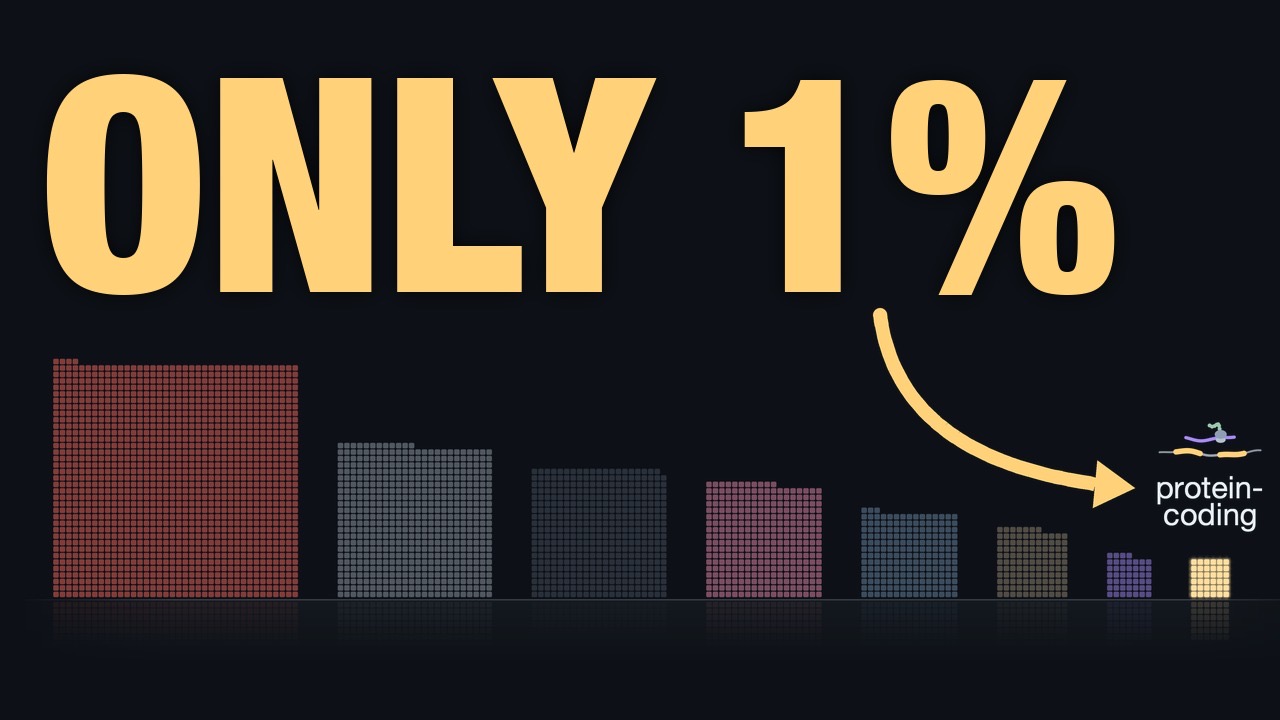
What does your genome do? This video goes through every part of your genome, what each part does and how much of it each part takes up. Only about one percent codes for proteins. You have about twenty thousand protein-coding genes: RNA polymerase transcribes a gene into an RNA message, the introns are cut out and the exons joined (splicing), and the ribosome translates the message into protein; introns take up about eighteen percent, and splicing a message in different ways lets one gene make more than one protein. Over twenty-one thousand genes make only RNA, most of them long non-coding RNAs; their exons are about one and a half percent. Regulatory sequences, such as promoters and enhancers, are where transcription factors grab hold to switch genes on; about two million of them have been mapped, about a tenth of your genome. Almost half is jumping genes (transposons), discovered by Barbara McClintock in maize; mutations have broken almost all of their copies. Centromere and telomere repeats, about six percent, help share out chromosomes when a cell divides and protect their ends. About four percent is untranslated regions, short repeats and broken gene copies, and about fourteen percent matches no known kind of DNA and has not been functionally characterized yet. Knowing these parts matters in medicine: more than nine in ten DNA changes linked to common diseases sit outside the protein code, and over half of those sit in regulatory sequences.
The video is coming soon to the channel.
Vocabulary
In the order the video explains them. Tap a term for its definition and every video it appears in.
Exon1:53
One of the pieces of a gene kept in its RNA message. In a protein-coding gene, the exons spell out the protein; added up, the protein-coding sequence is about one percent of your genome.
Appears in
- How Does a Cell Read a Gene’s Message? (Translation Animated)1:12
- Point Mutations and Frameshift Mutations, Explained5:16
- What Actually Makes Up the Human Genome?1:06
- What Actually Makes Up the Human Genome? this video1:53
Intron1:59
A stretch of a gene between its exons, cut out of the gene's message. Introns take up about eighteen percent of your genome, and many hold regulatory sequences.
Appears in
- How Does a Cell Read a Gene’s Message? (Translation Animated)1:12
- Point Mutations and Frameshift Mutations, Explained0:32
- What Actually Makes Up the Human Genome?1:11
- What Actually Makes Up the Human Genome? this video1:59
Splicing1:59
Cutting the introns out of a gene's message and joining the exons together. Splicing a message in different ways lets one gene make more than one protein.
Appears in
- How Does a Cell Read a Gene’s Message? (Translation Animated)1:12
- What Actually Makes Up the Human Genome?1:11
- What Actually Makes Up the Human Genome? this video1:59
Regulatory sequence4:23
A short stretch of DNA where proteins grab hold to tell a gene when to turn on, in which cells and how much. About two million have been mapped, about a tenth of your genome.
Appears in
- What Actually Makes Up the Human Genome?2:47
- What Actually Makes Up the Human Genome? this video4:23
Transcription factor4:30
A protein that grabs hold of a regulatory sequence; each kind grabs its own short pattern of base pairs.
Appears in
- What Turns a Gene On? (Transcription Animated)1:40
- Why Labs Are Abandoning ChIP-seq6:49
- cut_and_tag_plant6:46
- What Is Fiber-seq? Fiber-seq Explained8:38
- What Actually Makes Up the Human Genome?2:53
- What Actually Makes Up the Human Genome? this video4:30
- Template Strand and Coding Strand: Sense vs Antisense DNA, Animated1:19
Promoter4:37
A regulatory sequence at a gene's start, where the cell begins reading the gene.
Appears in
- What Turns a Gene On? (Transcription Animated)0:50
- Why Labs Are Abandoning ChIP-seq0:33
- cut_and_tag_plant1:09
- What Is Fiber-seq? Fiber-seq Explained0:06
- What Actually Makes Up the Human Genome?3:01
- What Actually Makes Up the Human Genome? this video4:37
- Template Strand and Coding Strand: Sense vs Antisense DNA, Animated1:13
Enhancer4:43
A regulatory sequence that can sit thousands of base pairs from its gene; the DNA loops to bring the enhancer to the gene's promoter.
Appears in
- What Is Fiber-seq? Fiber-seq Explained0:06
- What Actually Makes Up the Human Genome?3:06
- What Actually Makes Up the Human Genome? this video4:43
Transposon (jumping gene)5:20
A stretch of DNA that can move to a new spot, most often by making a copy of itself; also called a transposable element. Copies built up over millions of years make up almost half of your genome, and mutations have broken almost all of them.
Appears in
- Why Labs Are Abandoning ChIP-seq1:48
- cut_and_tag_plant1:48
- What Actually Makes Up the Human Genome?3:41
- What Actually Makes Up the Human Genome? this video5:20
- The 10 Types of DNA Mutations Explained in 5 Minutes2:59
Centromere7:21
The spot on each chromosome, usually near the middle, where a unit about 170 base pairs long repeats thousands of times: the handle the cell pulls on when it divides, so each new cell gets a full set of chromosomes.
Appears in
- The Mysterious Squares on Chromosome 18:02
- What Actually Makes Up the Human Genome?4:55
- What Actually Makes Up the Human Genome? this video7:21
- Why Does Sex Exist? Meiosis Explained2:47
- How Your Cells Divide: Mitosis in 5 Minutes1:19
- What Is a Pangenome Graph? Pangenome Graphs Explained5:43
Telomere7:57
The repeat at each end of a chromosome, the six bases TTAGGG over and over for thousands of base pairs: a cap that protects the end, so the cell doesn't mistake it for broken DNA.
Appears in
- What Actually Makes Up the Human Genome?5:14
- What Actually Makes Up the Human Genome? this video7:57
Untranslated regions (UTRs)8:35
The parts of exons at either end of a gene's message that aren't translated into protein. They help control how long a message lasts and how much protein is made from it; about two percent of your genome.
Appears in
- How Does a Cell Read a Gene’s Message? (Translation Animated)8:26
- What Actually Makes Up the Human Genome?5:29
- What Actually Makes Up the Human Genome? this video8:35
Long non-coding RNA (lncRNA)
An RNA more than two hundred nucleotides long that doesn't code for a protein. Most genes that make only RNA make long non-coding RNAs; only a minority have known jobs so far, such as the one that silences one of the two X chromosomes in female cells.
Appears in
Term cardReview questions
How much of your genome codes for proteins, and what is the other ninety-nine percent called?
Answer
About one percent. The rest is called non-coding DNA.
What happens to the introns of a gene's message, and why can introns matter?
Answer
They are cut out and the exons joined together (splicing). Splicing a message in different ways lets one gene make more than one protein, and many introns hold regulatory sequences.
What are promoters and enhancers, and how does an enhancer far from a gene act on it?
Answer
Regulatory sequences where transcription factors grab hold. A promoter sits at a gene's start; an enhancer can sit thousands of base pairs away, and the DNA loops to bring the enhancer to the promoter.
What is the biggest part of your genome, and can it still move?
Answer
Jumping genes (transposons), almost half. Mutations have broken almost all of their copies, so in you almost all of them stopped jumping long ago.
What do centromeres and telomeres do?
Answer
The centromere is the handle the cell pulls on when it divides, so each new cell gets a full set of chromosomes; the telomere caps each end so the cell doesn't mistake it for broken DNA.
Chapters
- 0:00 What's in your genome: only 1% codes for protein
- 0:43 Protein-coding genes: exons, introns and splicing
- 1:48 Non-coding RNA genes and long non-coding RNA
- 2:36 Regulatory sequences: promoters and enhancers
- 3:32 Jumping genes (transposons): almost half
- 4:30 Centromeres, telomeres and the rest
- 6:17 Recap: what your genome does
Sources
42 sources. Each was checked against its record (Crossref, PubMed, the Protein Data Bank, or the textbook edition) and against the claim it supports.
Textbooks
- Alberts B, Johnson A, Lewis J, Raff M, Roberts K, Walter P (2002). Molecular Biology of the Cell, 4th ed. New York: Garland Science. Free on NCBI Bookshelf: www.ncbi.nlm.nih.gov/books/NBK21054/ (what a gene is; RNA polymerase transcribes a gene into RNA and the ribosome translates it; exons, introns and splicing; most of a human gene is introns; alternative splicing; ribosomal, transfer and small nuclear RNAs; transcription factors and regulatory DNA; the centromere and kinetochore; telomeres; untranslated regions; only a few percent of the genome codes for proteins)
- Clark MA, Choi J, Douglas M (2018). Biology 2e. OpenStax, Rice University. ISBN 9781947172524. openstax.org/details/books/biology-2e (promoters; enhancers are binding sites for transcription factors and can sit far from the gene; the DNA bends to bring enhancer and promoter together)
Genome data (the sorted piles)
- Genome assembly: T2T-CHM13v2.0 (UCSC hs1), github.com/marbl/CHM13 ; Nurk S et al. (2022). The complete sequence of a human genome. Science 376:44-53. doi.org/10.1126/science.abj6987
- Genes, exons, introns, untranslated regions, RNA-only genes and pseudogenes: RefSeq Liftoff v5.2 annotation of T2T-CHM13v2.0 (chm13v2.0_RefSeq_Liftoff_v5.2.gff3.gz), s3-us-west-2.amazonaws.com/human-pangenomics/T2T/CHM13/assemblies/annotation/chm13v2.0_RefSeq_Liftoff_v5.2.gff3.gz ; Shumate A, Salzberg SL (2021). Liftoff: accurate mapping of gene annotations. Bioinformatics 37:1639-1643. doi.org/10.1093/bioinformatics/btaa1016 ; O'Leary NA et al. (2016). Reference sequence (RefSeq) database at NCBI: current status, taxonomic expansion, and functional annotation. Nucleic Acids Research 44:D733-D745. doi.org/10.1093/nar/gkv1189 (our counts of distinct gene names on chromosomes 1-22, X and Y: 19,748 protein-coding genes; 21,523 genes that make only RNA, 17,730 of them long non-coding RNA genes)
- About twenty thousand protein-coding genes: Mudge JM et al. (2025). GENCODE 2025: reference gene annotation for human and mouse. Nucleic Acids Research 53:D966-D975. doi.org/10.1093/nar/gkae1078 (GENCODE 47: 19,433 protein-coding genes; T2T-CHM13: 19,969, Nurk et al. 2022)
- Transposons and other repeats: RepeatMasker 4.1.2p1 annotation of T2T-CHM13v2.0 (chm13v2.0_RepeatMasker_4.1.2p1.2022Apr14.bed), s3-us-west-2.amazonaws.com/human-pangenomics/T2T/CHM13/assemblies/annotation/chm13v2.0_RepeatMasker_4.1.2p1.2022Apr14.bed ; Hoyt SJ et al. (2022). From telomere to telomere: the transcriptional and epigenetic state of human repeat elements. Science 376:eabk3112. doi.org/10.1126/science.abk3112 (transposable elements are 46.0% of CHM13)
- Centromeric satellites and telomeres: chm13v2.0_censat_v2.1.bed and chm13v2.0_telomere.bed, s3-us-west-2.amazonaws.com/human-pangenomics/T2T/CHM13/assemblies/annotation/ ; Altemose N et al. (2022). Complete genomic and epigenetic maps of human centromeres. Science 376:eabl4178. doi.org/10.1126/science.abl4178 (alpha satellite, a repeat of ~171 base pair units; satellites are 6.2% of CHM13)
- Regulatory sequences: ENCODE Registry V4 candidate cis-regulatory elements, GRCh38 (downloads.wenglab.org/Registry-V4/GRCh38-cCREs.bed), placed on CHM13 with UCSC's hg38ToHs1 chain (hgdownload.soe.ucsc.edu/goldenPath/hg38/liftOver/hg38ToHs1.over.chain.gz; 99.5% placed); classes kept: PLS, pELS, dELS, CA-CTCF, CA-H3K4me3, CA-TF, TF. Moore JE et al. (2026). An expanded registry of candidate cis-regulatory elements. Nature. doi.org/10.1038/s41586-025-09909-9 (2.37 million human candidate elements; our count: 1,176,007 of the 2,092,490 kept lie at least half inside an intron)
Papers
- Genes that make only RNA: Mattick JS et al. (2023). Long non-coding RNAs: definitions, functions, challenges and recommendations. Nature Reviews Molecular Cell Biology 24:430-447. doi.org/10.1038/s41580-022-00566-8 (long non-coding RNAs are non-coding transcripts of more than 200 nucleotides; only a minority have confident annotations; XIST in X chromosome dosage compensation)
- The enhancer shown, beta-globin HS2: Ney PA, Sorrentino BP, McDonagh KT, Nienhuis AW (1990). Tandem AP-1-binding sites within the human beta-globin dominant control region function as an inducible enhancer in erythroid cells. Genes & Development 4:993-1006. doi.org/10.1101/gad.4.6.993
- Barbara McClintock's discovery: McClintock B (1950). The origin and behavior of mutable loci in maize. Proceedings of the National Academy of Sciences 36:344-355. doi.org/10.1073/pnas.36.6.344 ; The Nobel Prize in Physiology or Medicine 1983: Barbara McClintock, "for her discovery of mobile genetic elements". NobelPrize.org. www.nobelprize.org/prizes/medicine/1983/summary/
- Jumping genes as parasites of the genome: Orgel LE, Crick FHC (1980). Selfish DNA: the ultimate parasite. Nature 284:604-607. doi.org/10.1038/284604a0 ; Doolittle WF, Sapienza C (1980). Selfish genes, the phenotype paradigm and genome evolution. Nature 284:601-603. doi.org/10.1038/284601a0
- A jumping gene that landed in a blood-clotting gene caused hemophilia: Kazazian HH, Wong C, Youssoufian H, Scott AF, Phillips DG, Antonarakis SE (1988). Haemophilia A resulting from de novo insertion of L1 sequences represents a novel mechanism for mutation in man. Nature 332:164-166. doi.org/10.1038/332164a0
- How the biggest family of transposons (LINE-1) jumps: transcribed by the cell's RNA polymerase, translated by its ribosomes into proteins that stay with their own RNA, one of which (an endonuclease and reverse transcriptase) nicks the DNA at a new spot and copies the RNA into DNA there; textbook-level (Grey 2026-11-13): Alberts et al. (2002), above, chapter 5, "A Large Fraction of the Human Genome Is Composed of Nonretroviral Retrotransposons", www.ncbi.nlm.nih.gov/books/NBK26845/ . LINE elements as the largest transposon class in the genome is our count (LINE 18.2% vs SINE 10.8%, Genome data above).
- Jumping genes as a source of genetic novelty and a field of research: Wells JN, Feschotte C (2020). A field guide to eukaryotic transposable elements. Annual Review of Genetics 54:539-561. doi.org/10.1146/annurev-genet-040620-022145
- Those giant satellite blocks only read in full in the newest, complete genomes, which turned up repeats no one had seen before, and still largely unexplored: Hoyt SJ et al. (2022), above ("We identified previously unknown satellite arrays"); Altemose N, Miga KH, Maggioni M, Willard HF (2014). Genomic characterization of large heterochromatic gaps in the human genome assembly. PLoS Computational Biology 10:e1003628. doi.org/10.1371/journal.pcbi.1003628 (HSat2,3: "the largest gaps in the human genome assembly ... the sequence composition and potential biological functions of these regions remain largely unexplored").
- Jumping genes stopped jumping long ago, broken by mutations; old virus-like copies about 8%: Lander ES et al. (2001). Initial sequencing and analysis of the human genome. Nature 409:860-921. doi.org/10.1038/35057062
- Telomere repeat TTAGGG: Moyzis RK, Buckingham JM, Cram LS, Dani M, Deaven LL, Jones MD, Meyne J, Ratliff RL, Wu JR (1988). A highly conserved repetitive DNA sequence, (TTAGGG)n, present at the telomeres of human chromosomes. Proceedings of the National Academy of Sciences 85:6622-6626. doi.org/10.1073/pnas.85.18.6622
- DNA of no known kind may be ancient, worn-down jumping genes: de Koning APJ, Gu W, Castoe TA, Batzer MA, Pollock DD (2011). Repetitive elements may comprise over two-thirds of the human genome. PLoS Genetics 7:e1002384. doi.org/10.1371/journal.pgen.1002384
- Finding which DNA does something, and why it matters for disease: Kellis M et al. (2014). Defining functional DNA elements in the human genome. Proceedings of the National Academy of Sciences 111:6131-6138. doi.org/10.1073/pnas.1318948111
- Disease-linked DNA changes outside the protein code and in regulatory DNA: Maurano MT et al. (2012). Systematic localization of common disease-associated variation in regulatory DNA. Science 337:1190-1195. doi.org/10.1126/science.1222794 (~93% of disease- and trait-associated variants lie in noncoding sequence; 57.1% of noncoding ones lie within DNase I hypersensitive sites, regulatory DNA)
- Maize, nearly 85% jumping genes: Schnable PS et al. (2009). The B73 maize genome: complexity, diversity, and dynamics. Science 326:1112-1115. doi.org/10.1126/science.1178534
Structures drawn
- Beta-globin, the protein of the gene the video follows (PDB 4HHB, human deoxyhaemoglobin): Fermi G, Perutz MF, Shaanan B, Fourme R (1984). The crystal structure of human deoxyhaemoglobin at 1.74 Å resolution. Journal of Molecular Biology 175:159-174. doi.org/10.1016/0022-2836(84)90472-8
- RNA polymerase II (PDB 5FLM, transcribing mammalian RNA polymerase II; Bos taurus): Bernecky C, Herzog F, Baumeister W, Plitzko JM, Cramer P (2016). Structure of transcribing mammalian RNA polymerase II. Nature 529:551-554. doi.org/10.1038/nature16482
- The small ribosome and the transfer RNA (PDB 6Y0G, human ribosome in the classical-PRE state): Bhaskar V et al. (2020). Dynamics of uS19 C-terminal tail during the translation elongation cycle in human ribosomes. Cell Reports 31:107473. doi.org/10.1016/j.celrep.2020.03.037
- The table of RNA classes (each card's shape is its Rfam family's consensus secondary structure, laid out flat with ViennaRNA's NAView layout; families RF00001 5S rRNA, RF00005 tRNA, RF00003 U1 snRNA, RF00027 let-7 microRNA precursor, RF00012 U3 snoRNA, RF00017 metazoan SRP RNA, RF00009 nuclear RNase P RNA, RF00024 vertebrate telomerase RNA, RF00100 7SK RNA, RF00019 Y RNA, RF00006 vault RNA; seed alignments fetched 2026-11-15 from rfam.org): Kalvari I et al. (2020). Rfam 14: expanded coverage of metagenomic, viral and microRNA families. Nucleic Acids Research 49:D192-D200. doi.org/10.1093/nar/gkaa1047
- The ribosome cut-away with its RNA core (PDB 9H3G, Arabidopsis thaliana 80S ribosome): Ko D et al. (2026). Recruitment of bifunctional regulator thermospermine to methylated ribosomes directs xylem fate. Science 391:694-699. doi.org/10.1126/science.adx2867
- Splicing machines, U1 snRNP (PDB 4PJO, human): Kondo Y, Oubridge C, van Roon AMM, Nagai K (2015). Crystal structure of human U1 snRNP, a small nuclear ribonucleoprotein particle, reveals the mechanism of 5′ splice site recognition. eLife 4:e04986. doi.org/10.7554/eLife.04986
- Splicing machines, U2 snRNP (from PDB 5YZG, human catalytic step I spliceosome): Zhan X, Yan C, Zhang X, Lei J, Shi Y (2018). Structure of a human catalytic step I spliceosome. Science 359:537-545. doi.org/10.1126/science.aar6401
- The LINE-1 proteins in the jumping sequence, ORF2p (PDB 8UW3, human LINE-1 ORF2 protein engaged with template RNA): Thawani A, Florez Ariza AJ, Nogales E, Collins K (2024). Template and target-site recognition by human LINE-1 in retrotransposition. Nature 626:186-193. doi.org/10.1038/s41586-023-06933-5
- ORF1p (PDB 2YKO, human LINE-1 ORF1p trimer): Khazina E, Truffault V, Büttner R, Schmidt S, Coles M, Weichenrieder O (2011). Trimeric structure and flexibility of the L1ORF1 protein in human L1 retrotransposition. Nature Structural & Molecular Biology 18:1006-1014. doi.org/10.1038/nsmb.2097
- Transcription factor on the CCAAT box, NF-Y (PDB 4AWL, human): Nardini M, Gnesutta N, Donati G, Gatta R, Forni C, Fossati A, Vonrhein C, Moras D, Romier C, Bolognesi M, Mantovani R (2013). Sequence-specific transcription factor NF-Y displays histone-like DNA binding and H2B-like ubiquitination. Cell 152:132-143. doi.org/10.1016/j.cell.2012.11.047
- TATA-binding protein on the TATA box (PDB 1CDW, human): Nikolov DB, Chen H, Halay ED, Hoffman A, Roeder RG, Burley SK (1996). Crystal structure of a human TATA box-binding protein/TATA element complex. Proceedings of the National Academy of Sciences 93:4862-4867. doi.org/10.1073/pnas.93.10.4862
- The bZIP dimers on the HS2 enhancer's two sites (PDB 1FOS, human c-Fos:c-Jun on DNA): Glover JNM, Harrison SC (1995). Crystal structure of the heterodimeric bZIP transcription factor c-Fos-c-Jun bound to DNA. Nature 373:257-261. doi.org/10.1038/373257a0
Images traced
- Spotted maize kernels: traced from "PLoS Mu transposon in maize.jpg", photo by Damon Lisch, from Gross L (2006), PLoS Biology 4:e353; CC BY 2.5, Wikimedia Commons. commons.wikimedia.org/wiki/File:PLoS_Mu_transposon_in_maize.jpg (the spots are Mutator transposons, not McClintock's Ac/Ds elements; shown as a spotted maize cob)
- The 2000 White House announcement (Craig Venter, President Bill Clinton, Francis Collins, 26 June 2000): photo by the National Human Genome Research Institute (NHGRI), public domain; Wikimedia Commons, commons.wikimedia.org/wiki/File:IHGSC_Human_Genome_Project_Draft_Completion_Announcement_-_June_2000.jpg (from www.flickr.com/photos/genomegov/51186090775/).
- Nerve cell (the ending): traced from "Neuron - Nerve Cell 01" by Doctor Jana (docjana.com), CC BY 4.0, Wikimedia Commons. commons.wikimedia.org/wiki/File:Neuron_-_Nerve_Cell_01.png
- Skin cells (the ending): traced from "Melanosome distribution in keratinocytes in different skin types", Bento-Lopes L, Cabaço LC, Charneca J, Neto MV, Seabra MC, Barral DC (2023), International Journal of Molecular Sciences 24:11289; CC BY 4.0, Wikimedia Commons. commons.wikimedia.org/wiki/File:Melanosome_distribution_in_keratinocytes_in_different_skin_types.png
- Fruit fly: silhouette by Andy Wilson, PhyloPic, CC0. www.phylopic.org/images/58eda733-f5dd-4a4d-8008-c85a333570b0
- Onion: traced from a photo by Alex Lomas, CC BY 2.0, Wikimedia Commons. commons.wikimedia.org/wiki/File:Allium_cepa_(2944502550).jpg
- Coast redwood: silhouette by Guillaume Dera, PhyloPic, CC0. www.phylopic.org/images/a734407b-333f-4015-a3b9-3959c74ee132


Notes
- Calico cat (X inactivation makes the patches; textbook: Alberts et al. 2002, above): photo "Calico Cat Napping on Wooden Fence" by TechnoKittyCat, CC0, Wikimedia Commons. commons.wikimedia.org/wiki/File:Calico_Cat_Napping_on_Wooden_Fence.jpg
