 5 to 3
Show notes
Why Does Sex Exist? Meiosis Explained
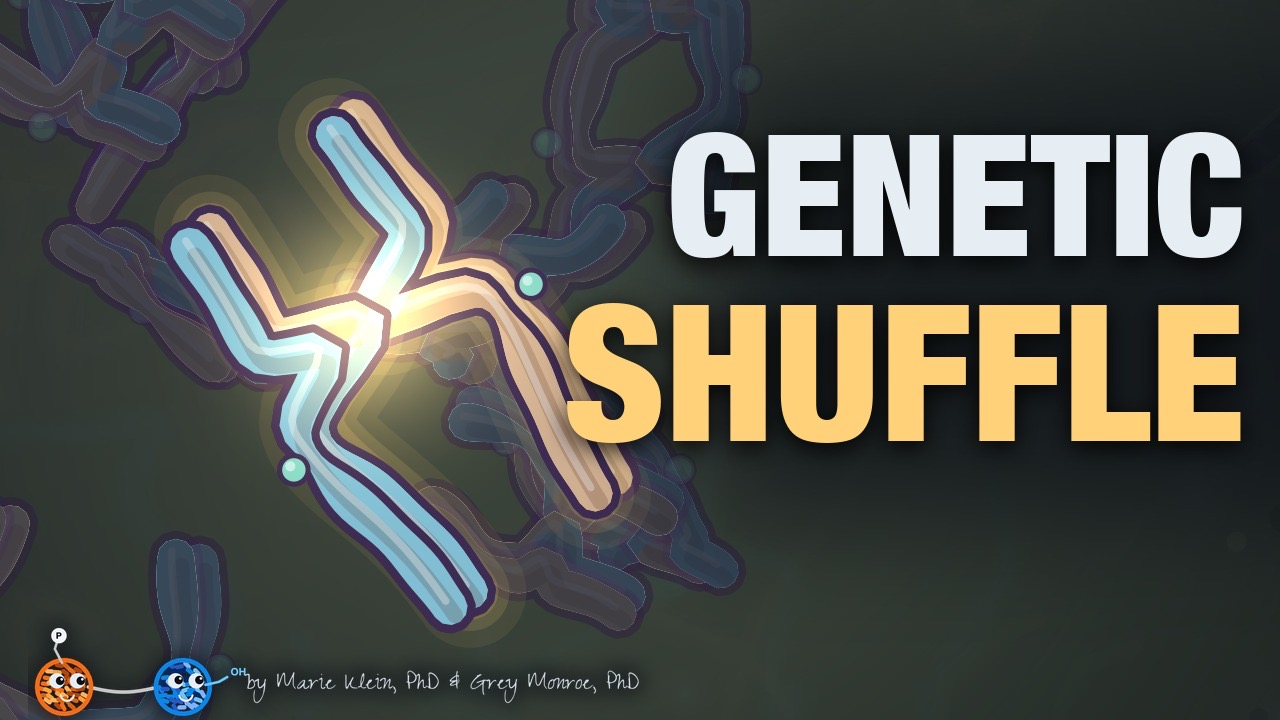
Life can copy itself: a cell copies its chromosomes and splits in two by mitosis. So why do so many organisms reproduce sexually, through a stranger division called meiosis? This video follows meiosis in a moth orchid, Phalaenopsis pulcherrima, inside the pollen precursor cells of a young flower bud. Each cell carries two sets of nineteen chromosomes (it is diploid), one from each of its parents. Meiosis copies the chromosomes once and divides twice, so each cell it makes carries one set (haploid). After DNA replication, each chromosome pairs with its homologous partner, held by the synaptonemal complex. The cell breaks its own DNA on purpose and repairs the breaks from the partner chromosome; at some breaks the repair makes two Holliday junctions, and cutting them makes a crossover. In meiosis one the partners separate (segregation), each pair on its own (independent assortment); in meiosis two the sister chromatids separate. Fertilization joins two halves into a new combination. Why reproduce this way? It makes new combinations every generation, brings good mutations together, and keeps a species a moving target for parasites; which matters most is still debated.
The video is coming soon to the channel.
Vocabulary
In the order the video explains them. Tap a term for its definition and every video it appears in.
Mitosis0:00
The ordinary division of a eukaryotic cell: it copies its chromosomes and splits into two identical cells. Single-celled organisms like the green alga Chlorella multiply this way.
Appears in
- Why Does Sex Exist? Meiosis Explained this video0:00
- How Your Cells Divide: Mitosis in 5 Minutes0:00
Meiosis0:29
The cell division of sexual reproduction: it copies the chromosomes once, then divides twice, so each cell it makes carries one set of chromosomes instead of two, reshuffled into new combinations.
Appears in
- Why Does Sex Exist? Meiosis Explained this video0:29
- How Your Cells Divide: Mitosis in 5 Minutes4:14
Homologous chromosomes2:01
The two chromosomes of a pair, one from each parent. They carry the same genes in the same places, though often in different versions.
Appears in
- Why Does Sex Exist? Meiosis Explained this video2:01
Diploid2:08
A cell with two sets of chromosomes, one from each parent.
Appears in
- Complementation Test Explained Step by Step3:57
- Why Does Sex Exist? Meiosis Explained this video2:08
Haploid2:08
A cell with one set of chromosomes, like the cells meiosis makes.
Appears in
- Complementation Test Explained Step by Step3:57
- Why Does Sex Exist? Meiosis Explained this video2:08
Sister chromatids2:47
The two identical copies of a chromosome made when the cell replicates its DNA, held together at the centromere.
Appears in
- Why Half Your DNA Is Copied Backwards (DNA Replication Animated)11:13
- Why Does Sex Exist? Meiosis Explained this video2:47
- How Your Cells Divide: Mitosis in 5 Minutes1:11
Centromere2:47
The place where a chromosome's two sister chromatids are held together.
Appears in
- The Mysterious Squares on Chromosome 18:02
- What Actually Makes Up the Human Genome?4:55
- What Actually Makes Up the Human Genome?7:21
- Why Does Sex Exist? Meiosis Explained this video2:47
- How Your Cells Divide: Mitosis in 5 Minutes1:19
- What Is a Pangenome Graph? Pangenome Graphs Explained5:43
Synaptonemal complex3:18
A protein ladder that holds partner (homologous) chromosomes side by side during meiosis, about a tenth of a micrometer apart.
Appears in
- Why Does Sex Exist? Meiosis Explained this video3:18
Holliday junction4:39
A point where the strands of two DNA molecules cross from one to the other, made while a break is repaired from the partner chromosome. Named for Robin Holliday, who proposed it in 1964.
Appears in
- Why Does Sex Exist? Meiosis Explained this video4:39
Crossing over4:50
The exchange of DNA between partner chromosomes in meiosis: enzymes cut the Holliday junctions so the two molecules trade arms, and a chromatid carries its own chromosome's DNA up to the crossover and the partner's past it.
Appears in
- Why Does Sex Exist? Meiosis Explained this video4:50
Segregation6:26
In meiosis one, the separation of the two partners of each pair to opposite ends of the cell, so each end gets one chromosome of every pair, never both.
Appears in
- Why Does Sex Exist? Meiosis Explained this video6:26
Independent assortment6:33
Each pair lines up on its own in meiosis one, so which way one pair goes says nothing about another. With nineteen pairs that gives over half a million combinations; in people, with twenty-three pairs, over eight million.
Appears in
- Why Does Sex Exist? Meiosis Explained this video6:33
Fertilization7:37
A sperm cell and an egg join, and their two halves make one diploid cell again, with a combination of chromosomes that never existed before.
Appears in
- Why Does Sex Exist? Meiosis Explained this video7:37
Review questions
How is meiosis different from mitosis?
Answer
Mitosis copies the chromosomes once and divides once, making two identical cells. Meiosis copies them once and divides twice, making cells with one set of chromosomes, reshuffled into new combinations.
What are homologous chromosomes?
Answer
The two chromosomes of a pair, one from each parent, carrying the same genes in the same places.
Why does the cell break its own DNA in meiosis?
Answer
Repairing the breaks from the partner chromosome makes crossovers, which swap DNA between the partners and, in most species, hold each pair together so the partners can be pulled to opposite ends.
How many chromosome combinations can independent assortment make in an organism with 19 pairs? And in people?
Answer
Over half a million (2 to the 19th, 524,288) with 19 pairs; over eight million with 23 pairs in people, before crossing over adds any more.
What happens in meiosis one and in meiosis two?
Answer
In meiosis one the partners of each pair are pulled to opposite ends (segregation) while the sister chromatids stay together; in meiosis two the sister chromatids are pulled apart.
Chapters
- 0:00 Why do organisms reproduce sexually?
- 1:41 Diploid and haploid: homologous chromosomes
- 2:41 DNA replication and synapsis
- 3:25 Crossing over: DNA breaks and Holliday junctions
- 5:20 Why does crossing over happen?
- 6:14 Meiosis I: segregation and independent assortment
- 6:59 Meiosis II and fertilization
- 7:48 Why does sex exist?
Sources
28 sources. Each was checked against its record (Crossref, PubMed, the Protein Data Bank, or the textbook edition) and against the claim it supports.
Textbook
- Clark MA, Choi J, Douglas M (2018). Biology 2e. OpenStax, Rice University. ISBN 9781947172524. openstax.org/details/books/biology-2e (chromosomes, diploid and haploid, homologous chromosomes, replication before meiosis, synapsis, crossing over, segregation, independent assortment and the 8 million combinations in people, pollen and ovule, fertilization, nearly all eukaryotes reproduce sexually) [Clark2018-bo]
The orchid cross and its biology
- Badriah DS, Pramanik D, Kartikaningrum S, et al. (2024). Progeny evaluation from the crossing of novelty-type Phalaenopsis I Hsin Bee x Phalaenopsis pulcherrima var. champorensis. Sains Malaysiana 53:249-265. doi.org/10.17576/jsm-2024-5302-02 (the 40 sibling flowers; P. pulcherrima var. champorensis the male parent; Phalaenopsis 2n = 38) [Badriah2024-su]
- Zhang Z, Gale SW, Li JH, Fischer GA, Ren MX, Song XQ (2019). Pollen-mediated gene flow ensures connectivity among spatially discrete sub-populations of Phalaenopsis pulcherrima, a tropical food-deceptive orchid. BMC Plant Biology 19. doi.org/10.1186/s12870-019-2179-y (P. pulcherrima is diploid, 2n = 38) [Zhang2019-jw]
- Wu T, Zhao X, Yang S, et al. (2022). Induction of 2n pollen with colchicine during microsporogenesis in Phalaenopsis. Breeding Science 72:275-284. doi.org/10.1270/jsbbs.21100 (meiosis runs in young flower buds; pollen stays in tetrads) [Wu2022-op]
- Brown RC, Lemmon BE (1991). Pollen development in orchids 1. Cytoskeleton and the control of division plane in irregular patterns of cytokinesis. Protoplasma 163:9-18. doi.org/10.1007/BF01323402 (no wall after meiosis I, as is common in orchids; moth-orchid tetrads mostly rhomboidal or tetrahedral) [Brown1991-fn]
- Scott RJ, Spielman M, Dickinson HG (2004). Stamen structure and function. The Plant Cell 16:S46-S60. doi.org/10.1105/tpc.017012 (most eudicots form no walls until the end of meiosis II) [Scott2004-cv]
- Drews GN, Koltunow AMG (2011). The female gametophyte. The Arabidopsis Book 9:e0155. doi.org/10.1199/tab.0155 (ovule and embryo sac, the egg's position) [Drews2011-op]
Crossing over
- Hunter N (2015). Meiotic recombination: the essence of heredity. Cold Spring Harbor Perspectives in Biology a016618. doi.org/10.1101/cshperspect.a016618 (programmed breaks, the repair model, at least one crossover per pair, unconnected partners cannot orient, pairing and the synaptonemal complex depend on recombination in most organisms) [Hunter2015-ql]
- Wang Y, Copenhaver GP (2018). Meiotic recombination: mixing it up in plants. Annual Review of Plant Biology 69:577-609. doi.org/10.1146/annurev-arplant-042817-040431 (SPO11 breaks, resection, strand invasion, double Holliday junctions, non-crossover repair; about 150-250 breaks but about 10 crossovers per Arabidopsis meiosis; ZYP1) [Wang2018-hx]
- Wang Y, van Rengs WMJ, Zaidan MWAM, Underwood CJ (2021). Meiosis in crops: from genes to genomes. Journal of Experimental Botany 72:6091-6109. doi.org/10.1093/jxb/erab217 (SPO11 in plants; MLH1-MLH3 resolves double Holliday junctions as crossovers) [Wang2021-xn]
- Dunce JM, Dunne OM, Ratcliff M, et al. (2018). Structural basis of meiotic chromosome synapsis through SYCP1 self-assembly. Nature Structural & Molecular Biology 25:557-569. doi.org/10.1038/s41594-018-0078-9 (the synaptonemal complex holds partner axes 100 nm apart; PDB 6F5X, 6F62, 6F63, 6F64) [Dunce2018-mc]
Why crossovers, and where meiosis came from
- Lenormand T, Engelstädter J, Johnston SE, Wijnker E, Haag CR (2016). Evolutionary mysteries in meiosis. Philosophical Transactions of the Royal Society B 371:20160001. doi.org/10.1098/rstb.2016.0001 (crossovers hold partners together for segregation; many species lack crossovers in one sex; recombination is older than meiosis; the open question of why meiotic recombination evolved) [Lenormand2016-xw]
- Lee L, Rosin LF (2024). Uncharted territories: solving the mysteries of male meiosis in flies. PLOS Genetics 20:e1011185. doi.org/10.1371/journal.pgen.1011185 (male fruit flies make no breaks and no crossovers; their partners are held by SNM, MNM, UNO and TEF) [Lee2024-jx]
- Wilkins AS, Holliday R (2009). The evolution of meiosis from mitosis. Genetics 181:3-12. doi.org/10.1534/genetics.108.099762 (the origin of meiosis is unresolved; recombination predates eukaryotes; the pairing-fidelity hypothesis) [Wilkins2009-pj]
Why sex
- McDonald MJ, Rice DP, Desai MM (2016). Sex speeds adaptation by altering the dynamics of molecular evolution. Nature 531:233-236. doi.org/10.1038/nature17143 (sexual yeast populations adapted faster; recombination brings together beneficial mutations that would otherwise compete and keeps harmful ones from fixing) [McDonald2016-ru]
- Felsenstein J (1974). The evolutionary advantage of recombination. Genetics 78:737-756. doi.org/10.1093/genetics/78.2.737 (the Fisher-Muller argument; harmful mutations build up more readily without recombination) [Felsenstein1974-an]
- Gibson AK, Delph LF, Lively CM (2017). The two-fold cost of sex: experimental evidence from a natural system. Evolution Letters 1:6-15. doi.org/10.1002/evl3.1 (the cost of sex; the Red Queen: parasites select against common genotypes) [Gibson2017-wv]
- Neiman M, Lively CM, Meirmans S (2017). Why sex? A pluralist approach revisited. Trends in Ecology & Evolution 32:589-600. doi.org/10.1016/j.tree.2017.05.004 (why sexual reproduction predominates is still debated) [Neiman2017-vd]
Protein structures drawn
- Yu Y, Wang J, Liu K, et al. (2024; issue 2025). Cryo-EM structures of the Spo11 core complex bound to DNA. Nature Structural & Molecular Biology 32:113-124. doi.org/10.1038/s41594-024-01382-8 (SPO11, budding yeast, PDB 8URQ) [Yu2024-zr]
- Luo SC, Yeh HY, Lan WH, et al. (2021). Identification of fidelity-governing factors in human recombinases DMC1 and RAD51 from cryo-EM structures. Nature Communications 12. doi.org/10.1038/s41467-020-20258-1 (DMC1 filament, human, PDB 7C9C) [Luo2021-ex]
- Shi Y, Hellinga HW, Beese LS (2017). Interplay of catalysis, fidelity, threading, and processivity in the exo- and endonucleolytic reactions of human exonuclease I. Proceedings of the National Academy of Sciences 114:6010-6015. doi.org/10.1073/pnas.1704845114 (EXO1, human, PDB 5V06) [Shi2017-cg]
- Lancey C, Tehseen M, Raducanu VS, et al. (2020). Structure of the processive human Pol δ holoenzyme. Nature Communications 11. doi.org/10.1038/s41467-020-14898-6 (DNA polymerase delta, human, PDB 6TNZ) [Lancey2020-qf]
- Tumbale PP, Jurkiw TJ, Schellenberg MJ, Riccio AA, O'Brien PJ, Williams RS (2019). Two-tiered enforcement of high-fidelity DNA ligation. Nature Communications 10. doi.org/10.1038/s41467-019-13478-7 (DNA ligase I, human, PDB 6P09) [Tumbale2019-ke]
- Dai J, Sanchez A, Adam C, et al. (2021). Molecular basis of the dual role of the Mlh1-Mlh3 endonuclease in MMR and in meiotic crossover formation. Proceedings of the National Academy of Sciences 118. doi.org/10.1073/pnas.2022704118 (MLH1-MLH3, budding yeast, PDB 6RMN) [Dai2021-my]
- Jones ML, Baris Y, Taylor MRG, Yeeles JTP (2021). Structure of a human replisome shows the organisation and interactions of a DNA replication machine. The EMBO Journal 40. doi.org/10.15252/embj.2021108819 (CMG helicase, PDB 7PFO) [Jones2021-cn]
- Roske JJ, Yeeles JTP (2024). Structural basis for processive daughter-strand synthesis and proofreading by the human leading-strand DNA polymerase Pol ε. Nature Structural & Molecular Biology 31:1921-1931. doi.org/10.1038/s41594-024-01370-y (DNA polymerase epsilon, PDB 9F6D) [Roske2024-vj]
- Alushin GM, Lander GC, Kellogg EH, Zhang R, Baker D, Nogales E (2014). High-resolution microtubule structures reveal the structural transitions in αβ-tubulin upon GTP hydrolysis. Cell 157:1117-1129. doi.org/10.1016/j.cell.2014.03.053 (microtubule, 3D kinetochore shot) [Alushin2014-zj]
- Ciferri C, Pasqualato S, Screpanti E, et al. (2008). Implications for kinetochore-microtubule attachment from the structure of an engineered Ndc80 complex. Cell 133:427-439. doi.org/10.1016/j.cell.2008.03.020 (Ndc80, 3D kinetochore shot) [Ciferri2008-yc]