 5 to 3
Show notes
The Mysterious Squares on Chromosome 1
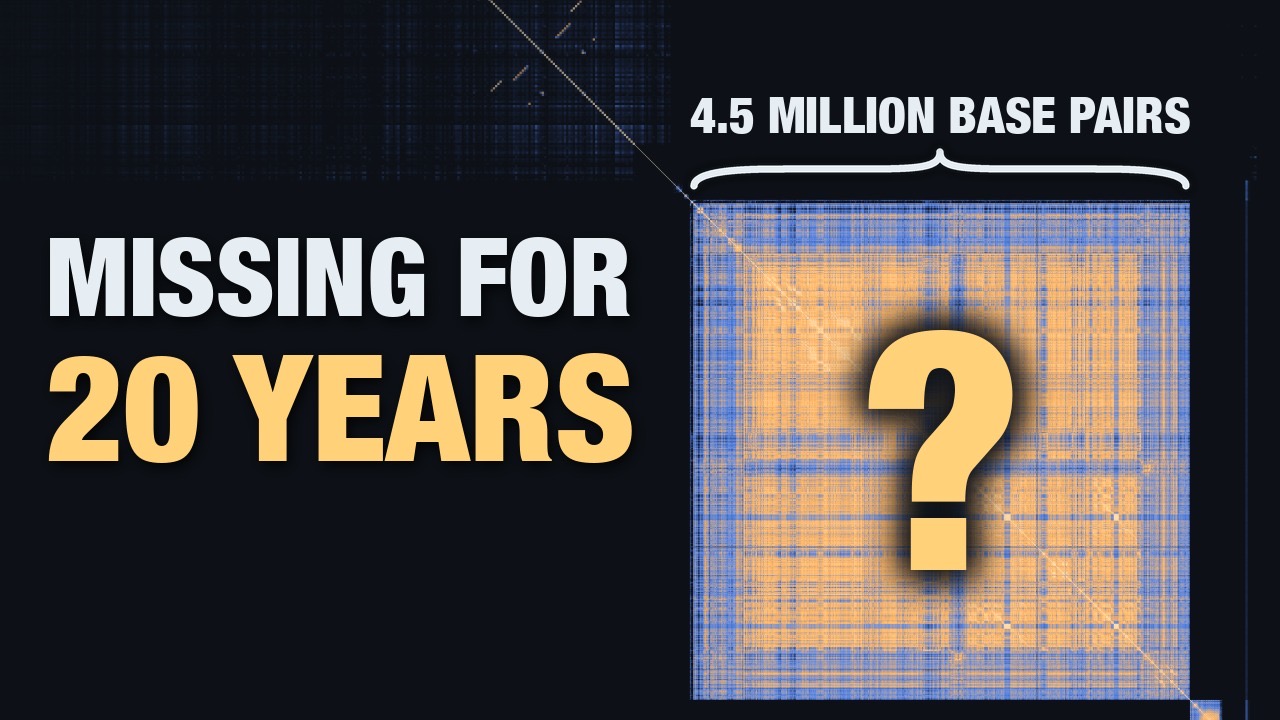
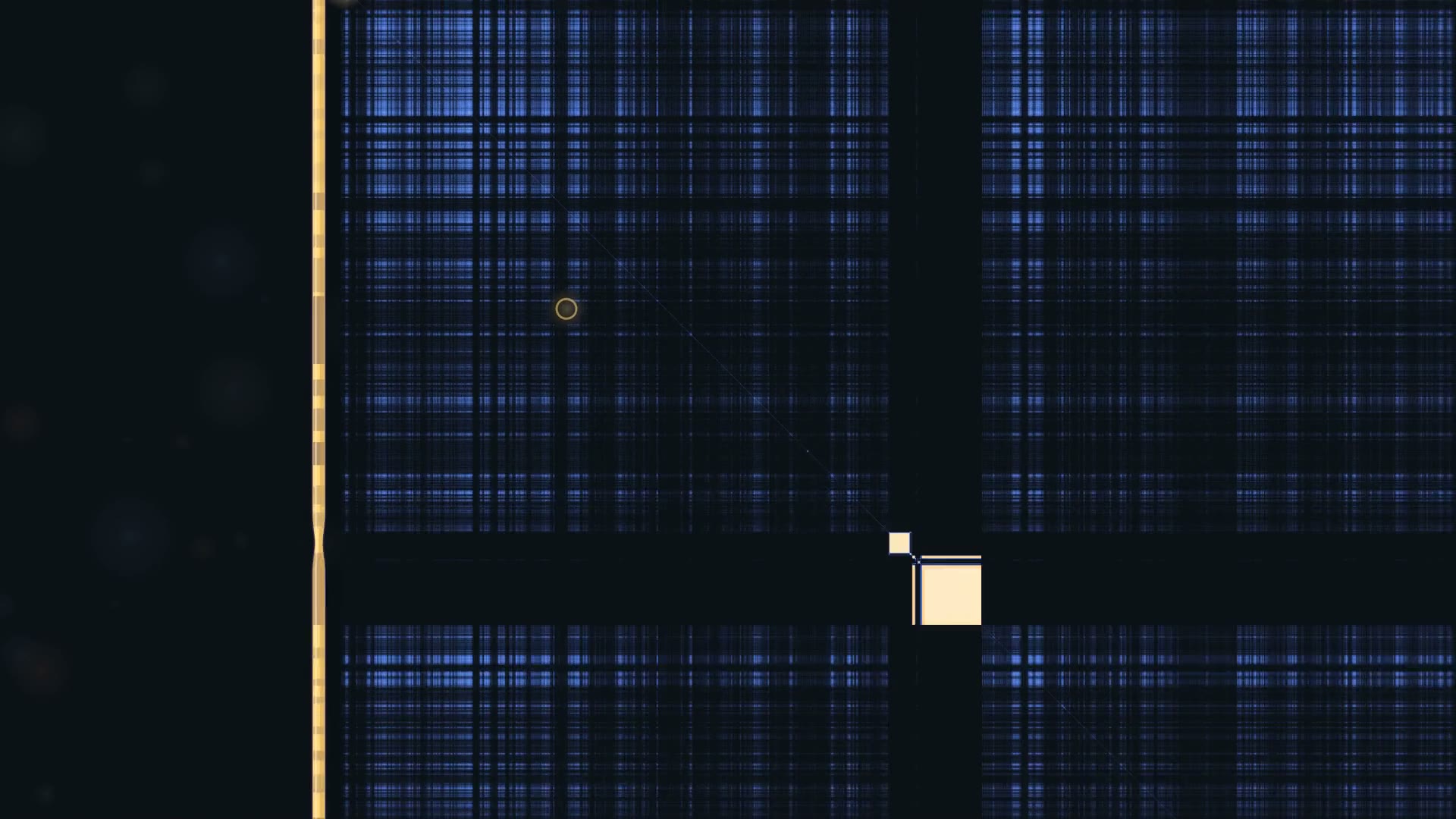
Human chromosome 1, all 248 million base pairs, compared with itself. We cut it into 12,419 windows of 20,000 base pairs, count each window's k-mers (12-mers, each sharing a box with its reverse complement) and colour every pixel by the cosine similarity of two windows. Most of the map is dark, because ordinary DNA is mostly unique sequence. Tandem arrays light up as bright blocks, like the 5S ribosomal RNA genes, copied 107 times head to tail. Two giant squares stand out: 4.5 million base pairs of alpha satellite, a unit of about 171 base pairs grouped into larger blocks copied thousands of times, where chromosome 1's centromere forms; and 13 million base pairs of human satellite 2, grown from the five-base repeat CATTC, which unpacks and is read into RNA in many cancers. Their DNA is so repetitive that short sequencing reads from inside them cannot be placed, so they were missing from the human reference genome for twenty years, until much longer reads completed the genome in 2022. The video ends with the same kind of map for complete genomes of Arabidopsis, pistachio, maize and gorilla.
The video is coming soon to the channel.
Vocabulary
In the order the video explains them. Tap a term for its definition and every video it appears in.
k-mer1:29
A short run of DNA, k bases long: a 3-mer is three bases, a 12-mer twelve. Two stretches of DNA that share many k-mers have sequence in common.
Appears in
- The Mysterious Squares on Chromosome 1 this video1:29
- What Is a Pangenome Graph? Pangenome Graphs Explained9:50
Reverse complement2:11
A sequence read backwards with A swapped for T and C for G (ACG becomes CGT). Counting a k-mer with its reverse complement lets a stretch copied in backwards still match the original.
Appears in
- The Mysterious Squares on Chromosome 1 this video2:11
- What Is a Pangenome Graph? Pangenome Graphs Explained5:20
- Template Strand and Coding Strand: Sense vs Antisense DNA, Animated2:11
Cosine similarity2:37
How alike two vectors of k-mer counts are in their proportions: one means the same k-mers in the same proportions, zero means they share none.
Appears in
- The Mysterious Squares on Chromosome 1 this video2:37
Tandem array4:05
A short unit of DNA repeated head to tail. Every window inside it matches every other, so on the map it fills a bright square.
Appears in
- The Mysterious Squares on Chromosome 1 this video4:05
Alpha satellite5:34
The repeat at every human centromere: a unit of about 171 base pairs, in several versions that line up in a set order into a larger block, which is copied thousands of times.
Appears in
- The Mysterious Squares on Chromosome 1 this video5:34
Satellite DNA5:37
Highly repeated DNA, named from early experiments: spun in a centrifuge, it settled into a small band of its own, a satellite beside the main band of DNA.
Appears in
- The Mysterious Squares on Chromosome 1 this video5:37
Human satellite 2 (HSat2)6:59
A satellite that began as the five-base repeat CATTC; on chromosome 1 it is mostly a 1.77-kilobase unit copied end to end, 13 million base pairs of dense heterochromatin next to the centromere.
Appears in
- The Mysterious Squares on Chromosome 1 this video6:59
Centromere8:02
The place where a chromosome is held when a cell divides; on chromosome 1 it forms on the alpha-satellite array.
Appears in
- The Mysterious Squares on Chromosome 1 this video8:02
- What Actually Makes Up the Human Genome?4:55
- What Actually Makes Up the Human Genome?7:21
- Why Does Sex Exist? Meiosis Explained2:47
- How Your Cells Divide: Mitosis in 5 Minutes1:19
- What Is a Pangenome Graph? Pangenome Graphs Explained5:43
Kinetochore8:22
A large protein machine that assembles on the centromere and grips one of the fibres that pull the two copies of a chromosome apart.
Appears in
- The Mysterious Squares on Chromosome 1 this video8:22
- How Your Cells Divide: Mitosis in 5 Minutes1:53
Study frame
The whole picture in one labelled frame, to save or print.
Review questions
What does one pixel of the map show?
Answer
How similar the DNA sequences of two 20,000-base-pair windows of chromosome 1 are: the cosine similarity of their 12-mer counts.
Why does the map use 12-mers rather than 3-mers?
Answer
3-mers are so short that they turn up everywhere by chance (two unrelated windows score 0.98); the same 12-mer rarely turns up in two windows by chance (the same windows score 0.04).
Why does a tandem array fill a bright square?
Answer
Its unit repeats head to tail, so every window in it matches every other.
Why were the two giant squares missing from the human reference genome for twenty years?
Answer
Their DNA is so repetitive that a short sequencing read from inside them matches thousands of places equally well, so it cannot be placed. Much longer reads finally read through them in 2022.
Why are the edges of the alpha-satellite square dimmer than its middle?
Answer
New versions of the block expand in the middle of the array; the copies at the edges are older and have had longer to become different.
What happens at the centromere when a cell divides?
Answer
A kinetochore assembles on spools carrying a special histone and grips a fibre; when the fibres pull, the two copies of each chromosome move apart, one into each new cell.
Chapters
- 0:00 Chromosome 1 compared with itself
- 0:11 The complete human genome: why the squares took 20 years to find
- 1:01 How to read a self-similarity map
- 1:28 What are k-mers? How the map is made
- 3:37 Build a repeat: duplications and tandem repeats on the map
- 4:35 Tandem repeats: the 5S ribosomal RNA genes
- 5:18 Alpha satellite DNA: the first square
- 6:59 Human satellite 2: the second square
- 8:02 What does a centromere do? Kinetochores and cell division
- 10:02 Centromeres and giant repeats across the tree of life
Sources
26 sources. Each was checked against its record (Crossref, PubMed, the Protein Data Bank, or the textbook edition) and against the claim it supports.
Textbooks
- Bergtrom G. Basic Cell and Molecular Biology. LibreTexts (CC BY 4.0), section 14.2 (repetitive DNA, satellite DNA in density-gradient centrifugation). bio.libretexts.org/Bookshelves/Cell_and_Molecular_Biology/Book%3A_Basic_Cell_and_Molecular_Biology_(Bergtrom)
- Nickle T, Barrette-Ng I (eds.). Online Open Genetics. LibreTexts (CC BY-SA 3.0), the chromosomes chapter (satellite DNA). bio.libretexts.org/Bookshelves/Genetics/Online_Open_Genetics_(Nickle_and_Barrette-Ng)
- Alberts B, Johnson A, Lewis J, Raff M, Roberts K, Walter P (2002). Molecular Biology of the Cell, 4th edition. New York: Garland Science. Sections "Chromosomal DNA and Its Packaging in the Chromatin Fiber" (www.ncbi.nlm.nih.gov/books/NBK26834/), "Mitosis" (www.ncbi.nlm.nih.gov/books/NBK26934/) and "The Initiation and Completion of DNA Replication in Chromosomes" (www.ncbi.nlm.nih.gov/books/NBK26826/). NCBI Bookshelf: www.ncbi.nlm.nih.gov/books/NBK21054/
Papers · Centromeres and satellite DNA
- Altemose N, Logsdon GA, Bzikadze AV, et al. (2022). Complete genomic and epigenetic maps of human centromeres. Science 376:eabl4178. doi.org/10.1126/science.abl4178
- Altemose N, Miga KH, Maggioni M, Willard HF (2014). Genomic Characterization of Large Heterochromatic Gaps in the Human Genome Assembly. PLoS Comput Biol 10:e1003628. doi.org/10.1371/journal.pcbi.1003628
- Uralsky LI, Shepelev VA, Alexandrov AA, Yurov YB, Rogaev EI, Alexandrov IA (2019). Classification and monomer-by-monomer annotation dataset of suprachromosomal family 1 alpha satellite higher-order repeats in hg38 human genome assembly. Data Brief 24:103708. doi.org/10.1016/j.dib.2019.103708
- Shepelev VA, Uralsky LI, Alexandrov AA, Yurov YB, Rogaev EI, Alexandrov IA (2015). Annotation of suprachromosomal families reveals uncommon types of alpha satellite organization in pericentromeric regions of hg38 human genome assembly. Genomics Data 5:139–146. doi.org/10.1016/j.gdata.2015.05.035
Papers · Centromeres and complete genomes beyond humans (the ending, added 2026-11-02)
- Naish M, Alonge M, Wlodzimierz P, et al. (2021). The genetic and epigenetic landscape of the Arabidopsis centromeres. Science 374:eabi7489. doi.org/10.1126/science.abi7489
- Liu J, Seetharam AS, Chougule K, et al. (2020). Gapless assembly of maize chromosomes using long-read technologies. Genome Biol 21:121. doi.org/10.1186/s13059-020-02029-9
Papers · The centromere's proteins (draft 10)
- Yatskevich S, Muir KW, Bellini D, et al. (2022). Structure of the human inner kinetochore bound to a centromeric CENP-A nucleosome. Science 376:844–852. doi.org/10.1126/science.abn3810 (PDB 7R5R, 7R5V)
- Ciferri C, Pasqualato S, Screpanti E, et al. (2008). Implications for kinetochore-microtubule attachment from the structure of an engineered Ndc80 complex. Cell 133:427–439. doi.org/10.1016/j.cell.2008.03.020 (PDB 2VE7)
- Alushin GM, Lander GC, Kellogg EH, et al. (2014). High-resolution microtubule structures reveal the structural transitions in αβ-tubulin upon GTP hydrolysis. Cell 157:1117–1129. doi.org/10.1016/j.cell.2014.03.053 (PDB 3J6F)
- Davey CA, Sargent DF, Luger K, et al. (2002). Solvent mediated interactions in the structure of the nucleosome core particle at 1.9 Å resolution. J Mol Biol 319:1097–1113. doi.org/10.1016/S0022-2836(02)00386-8 (PDB 1KX5)
Papers · Giant repeats across the tree of life (draft 10)
- Adaskaveg JA, Lee C, Wei Y, et al. (2025). In a nutshell: pistachio genome and kernel development. New Phytol 246:1032–1048. doi.org/10.1111/nph.70060
- Chen J, Wang Z, Tan K, et al. (2023). A complete telomere-to-telomere assembly of the maize genome. Nat Genet 55:1221–1231. doi.org/10.1038/s41588-023-01419-6
- Yoo D, Rhie A, Hebbar P, et al. (2025). Complete sequencing of ape genomes. Nature 641:401–418. doi.org/10.1038/s41586-025-08816-3
Papers · Human satellite 2 in cancer
- Bersani F, Lee E, Kharchenko PV, Xu AW, Liu M, Xega K, MacKenzie OC, Brannigan BW, Wittner BS, Jung H, Ramaswamy S, Park PJ, Maheswaran S, Ting DT, Haber DA (2015). Pericentromeric satellite repeat expansions through RNA-derived DNA intermediates in cancer. Proc Natl Acad Sci USA 112:15148–15153. doi.org/10.1073/pnas.1518008112
- Hall LL, Byron M, Carone DM, Whitfield TW, Pouliot GP, Fischer A, Jones P, Lawrence JB (2017). Demethylated HSATII DNA and HSATII RNA Foci Sequester PRC1 and MeCP2 into Cancer-Specific Nuclear Bodies. Cell Rep 18:2943–2956. doi.org/10.1016/j.celrep.2017.02.072
Papers · Ribosomal RNA genes
- Ciganda M, Williams N (2011). Eukaryotic 5S rRNA biogenesis. WIREs RNA 2:523–533. doi.org/10.1002/wrna.74
- Sørensen PD, Lomholt B, Frederiksen S, Tommerup N (1991). Fine mapping of human 5S rRNA genes to chromosome 1q42.11→q42.13. Cytogenet Cell Genet 57:26–29. doi.org/10.1159/000133107
- Sørensen PD, Frederiksen S (1991). Characterization of human 5S rRNA genes. Nucleic Acids Res 19:4147–4151. doi.org/10.1093/nar/19.15.4147
Papers · The complete human genome
- Nurk S, Koren S, Rhie A, et al. (2022). The complete sequence of a human genome. Science 376:44–53. doi.org/10.1126/science.abj6987
Papers · The map
- Vollger MR, Kerpedjiev P, Phillippy AM, Eichler EE (2022). StainedGlass: interactive visualization of massive tandem repeat structures with identity heatmaps. Bioinformatics 38:2049–2051. doi.org/10.1093/bioinformatics/btac018
Data
- RCSB PDB 9H3G (Arabidopsis thaliana 80S ribosome; primary citation Ko et al. 2026, Science, doi.org/10.1126/science.adx2867, hub key Ko2026-uw), the ribosome drawn in the 5S beat.
- T2T-CHM13v2.0 genome (UCSC hs1) and its "CenSat Annotation" track. UCSC Genome Browser: genome.ucsc.edu/cgi-bin/hgTracks?db=hs1 (track rows fetched 2026-11-01 via api.genome.ucsc.edu/).
- Arabidopsis thaliana Col-0, Col-CC community-consensus assembly (GenBank GCA_028009825.2; chromosome 1 = CP116280.1; Dong X, Wijfjes R, Schneeberger K, submitted 2022-12-23): the sequence of our Arabidopsis map in the ending. www.ncbi.nlm.nih.gov/datasets/genome/GCA_028009825.2/