 5 to 3
Show notes
Template Strand and Coding Strand: Sense vs Antisense DNA, Animated
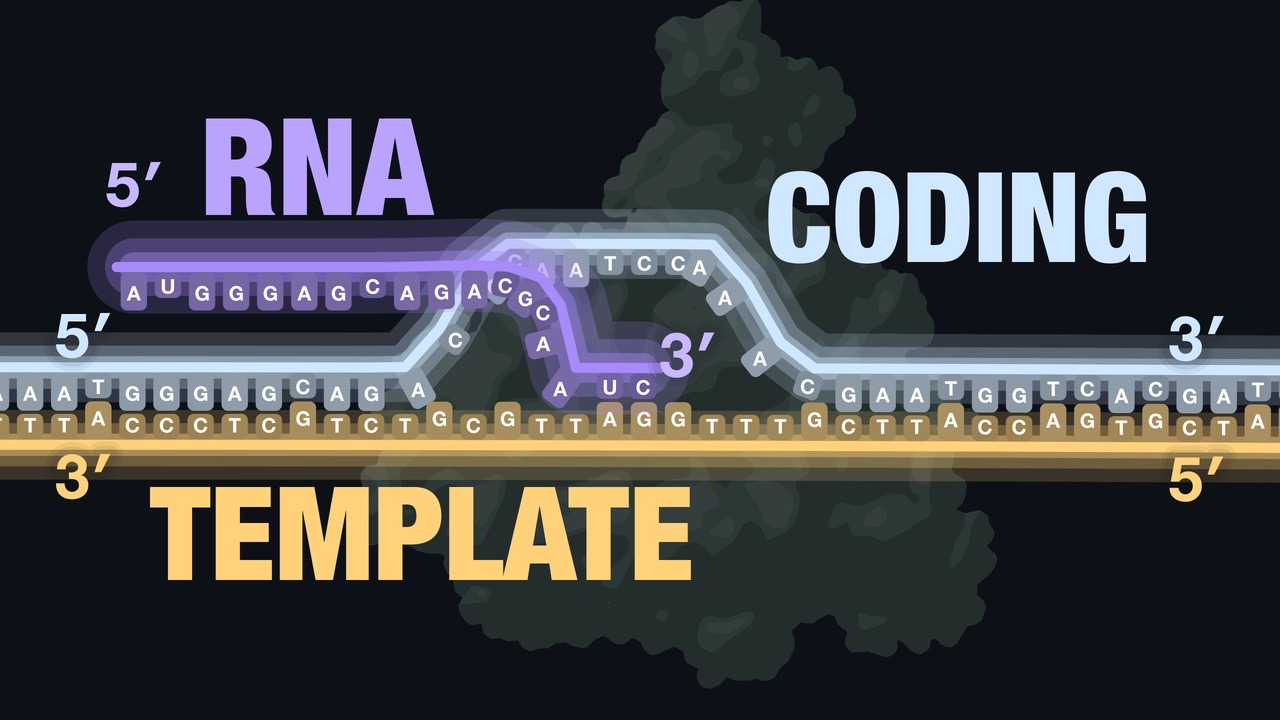
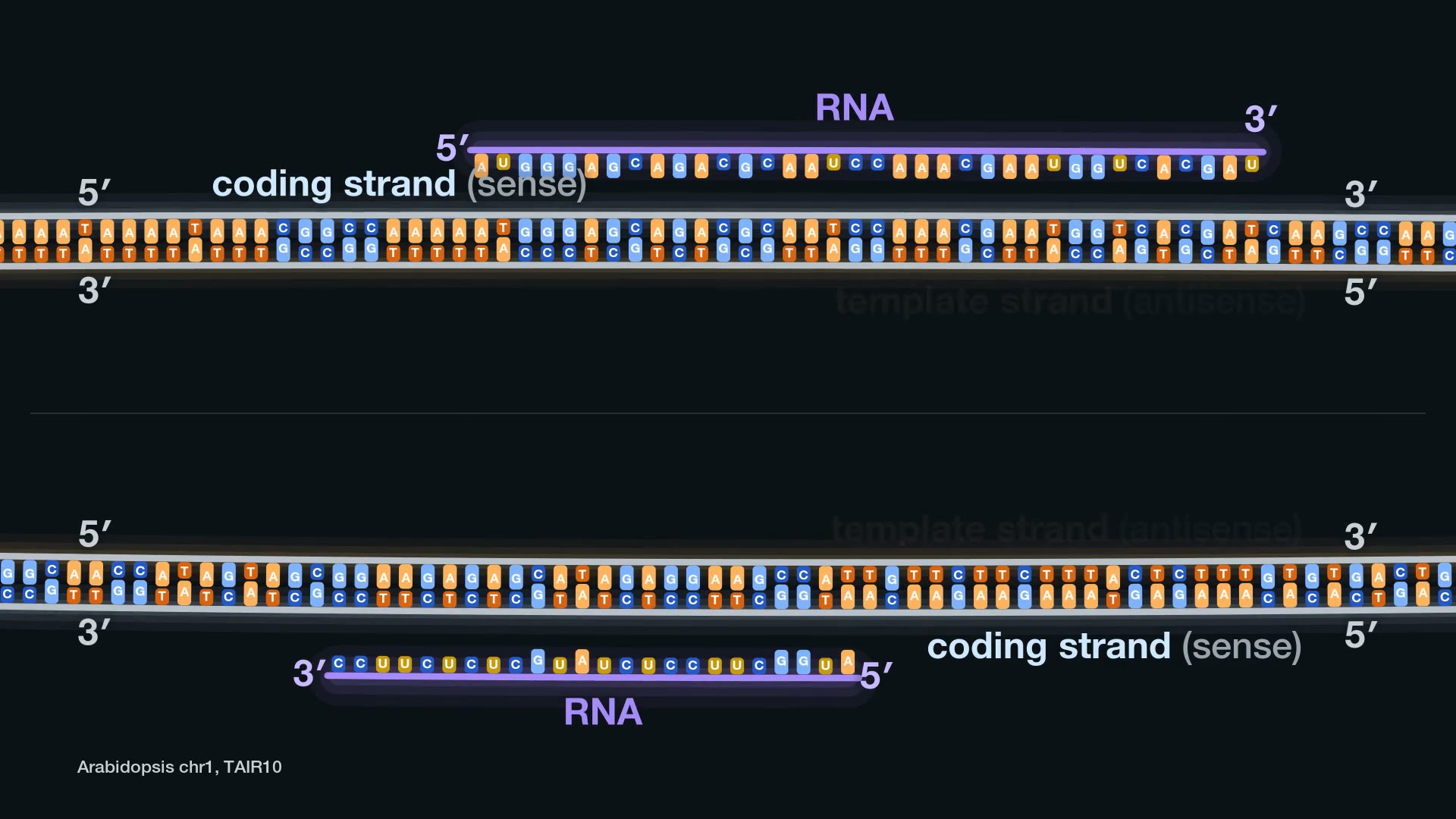
Which DNA strand does RNA polymerase read, and which one matches the RNA? This video shows transcription on real genes on Arabidopsis chromosome 1: the polymerase reads the template strand and builds the RNA five prime to three prime, so the RNA matches the coding strand, with U for T. A neighbouring gene faces the other way and is read from the other strand; its promoter, where transcription factors seat the polymerase, sets the direction. Then what plus and minus strand mean in a genome annotation, and why a minus-strand gene's RNA is the reverse complement of the written sequence.
The video is coming soon to the channel.
Vocabulary
In the order the video explains them. Tap a term for its definition and every video it appears in.
Template strand0:37
The DNA strand RNA polymerase reads, base by base, to build the RNA. Also called the antisense strand (some books swap sense and antisense).
Appears in
- What Turns a Gene On? (Transcription Animated)6:55
- Template Strand and Coding Strand: Sense vs Antisense DNA, Animated this video0:37
Transcription0:37
Making RNA from a gene: RNA polymerase reads the template strand and builds the RNA as its complement.
Appears in
- What Turns a Gene On? (Transcription Animated)0:13
- Why Labs Are Abandoning ChIP-seq6:49
- cut_and_tag_plant6:46
- What Is Fiber-seq? Fiber-seq Explained8:38
- What Actually Makes Up the Human Genome?2:53
- What Actually Makes Up the Human Genome?2:21
- Template Strand and Coding Strand: Sense vs Antisense DNA, Animated this video0:37
RNA polymerase0:37
The machine that reads the template strand of a gene and builds RNA from five prime to three prime.
Appears in
- What Turns a Gene On? (Transcription Animated)0:13
- Point Mutations and Frameshift Mutations, Explained0:32
- How does death cap poison kill? (animated) #Shorts0:22
- What Actually Makes Up the Human Genome?1:01
- What Actually Makes Up the Human Genome?1:48
- Template Strand and Coding Strand: Sense vs Antisense DNA, Animated this video0:37
Coding strand0:49
The DNA strand the RNA matches, base for base, with U wherever DNA has T. Also called the sense strand.
Appears in
- What Turns a Gene On? (Transcription Animated)6:55
- Point Mutations and Frameshift Mutations, Explained2:14
- Template Strand and Coding Strand: Sense vs Antisense DNA, Animated this video0:49
Promoter1:13
The stretch of DNA just before a gene. Transcription factors grab it and seat RNA polymerase there facing into the gene, which sets the gene's direction and so its template strand.
Appears in
- What Turns a Gene On? (Transcription Animated)0:50
- Why Labs Are Abandoning ChIP-seq0:33
- cut_and_tag_plant1:09
- What Is Fiber-seq? Fiber-seq Explained0:06
- What Actually Makes Up the Human Genome?3:01
- What Actually Makes Up the Human Genome?4:37
- Template Strand and Coding Strand: Sense vs Antisense DNA, Animated this video1:13
Transcription factor1:19
A protein that grabs a gene's promoter and helps seat RNA polymerase there, facing into the gene.
Appears in
- What Turns a Gene On? (Transcription Animated)1:40
- Why Labs Are Abandoning ChIP-seq6:49
- cut_and_tag_plant6:46
- What Is Fiber-seq? Fiber-seq Explained8:38
- What Actually Makes Up the Human Genome?2:53
- What Actually Makes Up the Human Genome?4:30
- Template Strand and Coding Strand: Sense vs Antisense DNA, Animated this video1:19
Plus and minus strand1:37
In a genome annotation, a gene's strand: plus if it reads along the strand the reference genome writes out, minus if it reads along the other.
Appears in
- Template Strand and Coding Strand: Sense vs Antisense DNA, Animated this video1:37
Reverse complement2:11
A sequence's partners in reverse order: for a minus-strand gene, the written sequence is the template strand, so its RNA is the reverse complement of it, with U for T.
Appears in
- The Mysterious Squares on Chromosome 12:11
- What Is a Pangenome Graph? Pangenome Graphs Explained5:20
- Template Strand and Coding Strand: Sense vs Antisense DNA, Animated this video2:11
Study frame
The whole picture in one labelled frame, to save or print.
Review questions
RNA polymerase reads which strand, and in which direction does it build the RNA?
Answer
It reads the template strand and builds the RNA from five prime to three prime, as the template's complement.
Why does the RNA match the coding strand?
Answer
The RNA is the complement of the template strand, and so is the coding strand, so the two match base for base, except that the RNA has U wherever the DNA has T.
Two genes on one chromosome face opposite ways. Do they use the same strand as their template?
Answer
No. Each gene's promoter seats RNA polymerase facing into that gene, and the polymerase always builds RNA five prime to three prime, so a gene facing the other way is read from the other strand.
A gene is on the minus strand of a reference genome. How do you get its RNA from the written sequence?
Answer
The written sequence is its template strand, so take its reverse complement (partners in reverse order) and put U for T.
Chapters
- 0:00 What you'll learn: template vs coding strand
- 0:30 The template strand and the coding strand in transcription
- 0:57 A gene facing the other way: the promoter decides
- 1:37 Plus and minus strands in a genome annotation
- 2:14 Recap: what each strand does
Sources
11 sources. Each was checked against its record (Crossref, PubMed, the Protein Data Bank, or the textbook edition) and against the claim it supports.
Textbooks
- Alberts B, Johnson A, Lewis J, Raff M, Roberts K, Walter P (2002). Molecular Biology of the Cell, 4th ed. New York: Garland Science. Free on NCBI Bookshelf: www.ncbi.nlm.nih.gov/books/NBK21054/ (From DNA to RNA: www.ncbi.nlm.nih.gov/books/NBK26887/ ; DNA and chromosomes: www.ncbi.nlm.nih.gov/books/NBK26821/)
- Clark MA, Choi J, Douglas M (2018). Biology 2e. OpenStax, Rice University. ISBN 9781947172524 (section 15.2). openstax.org/details/books/biology-2e
- Jakubowski H, Flatt P. Fundamentals of Biochemistry III. LibreTexts. bio.libretexts.org/Bookshelves/Biochemistry/Fundamentals_of_Biochemistry_(Jakubowski_and_Flatt) (accessed 2026-11-02; uses "sense" and "antisense" the other way round)
- Lackie JM (2013). The Dictionary of Cell and Molecular Biology, 5th ed. Academic Press. ISBN 9780123849311. doi.org/10.1016/c2009-0-64239-2
- Ahern K, Rajagopal I, Tan T. Biochemistry Free For All. LibreTexts. bio.libretexts.org/Bookshelves/Biochemistry/Book%3A_Biochemistry_Free_For_All_(Ahern_Rajagopal_and_Tan) (accessed 2026-11-02)
Genome data
- Arabidopsis thaliana reference genome TAIR10, chromosome 1 (NCBI RefSeq NC_003070.9): www.ncbi.nlm.nih.gov/nuccore/NC_003070.9 ; Lamesch P et al. (2012). The Arabidopsis Information Resource (TAIR): improved gene annotation and new tools. Nucleic Acids Research 40:D1202-D1210. doi.org/10.1093/nar/gkr1090
- Arabidopsis gene annotation: Ensembl Plants release 63, Arabidopsis_thaliana.TAIR10.63.gtf (our count of protein-coding genes per strand). plants.ensembl.org/Arabidopsis_thaliana/
- Human gene annotation: GENCODE release 50 (basic annotation, GRCh38; our count of protein-coding genes per strand). Mudge JM et al. (2025). GENCODE 2025: reference gene annotation for human and mouse. Nucleic Acids Research 53:D966-D975. doi.org/10.1093/nar/gkae1078
- Transcription start site of RBCS1A: EPDnew (AT1G67090_1). Dreos R, Ambrosini G, Groux R, Cavin Périer R, Bucher P (2017). The eukaryotic promoter database in its 30th year: focus on non-vertebrate organisms. Nucleic Acids Research 45:D51-D55. doi.org/10.1093/nar/gkw1069
Structures drawn
- RNA polymerase II transcribing (PDB 5FLM): Bernecky C, Herzog F, Baumeister W, Plitzko JM, Cramer P (2016). Structure of transcribing mammalian RNA polymerase II. Nature 529:551-554. doi.org/10.1038/nature16482
- TATA-binding protein on DNA (PDB 1CDW): Nikolov DB, Chen H, Halay ED, Hoffman A, Roeder RG, Burley SK (1996). Crystal structure of a human TATA box-binding protein/TATA element complex. PNAS 93:4862-4867. doi.org/10.1073/pnas.93.10.4862