 5 to 3
Show notes
What Is Fiber-seq? Fiber-seq Explained
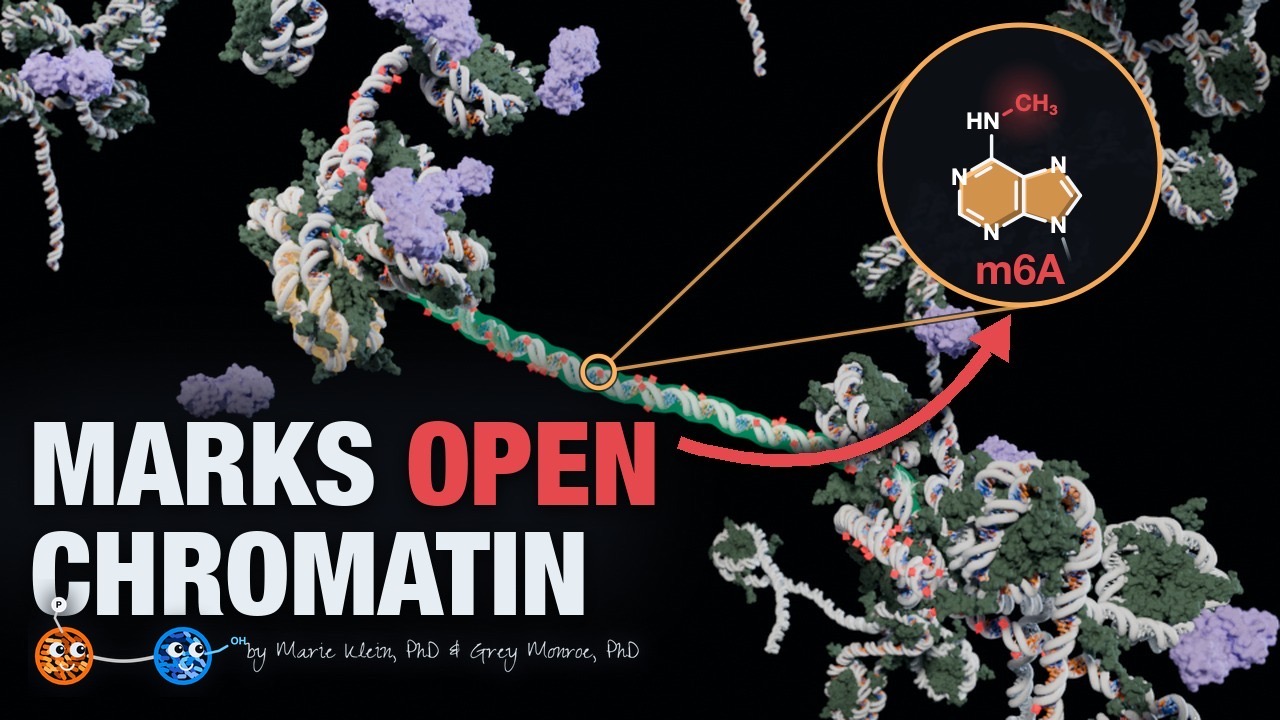
What is Fiber-seq? Fiber-seq maps chromatin accessibility one long DNA molecule at a time. An enzyme, the adenine methyltransferase Hia5, marks the adenines it can reach in the cell's chromatin, while DNA wrapped on nucleosomes, or held by another protein, stays unmarked: a stencil of where the proteins sat. Long-read sequencing then reads each molecule whole, its marks along with its sequence, so each read becomes a map of one fiber: where its nucleosomes sat, and where it was open. The video follows real data, 94 DNA molecules from the human cell line GM12878 across the start of the SNRPN gene, where the average looks half open but each molecule is either open or closed: on one haplotype of chromosome 15, 44 of 47 molecules are open; on the other, only 2 of 47. It walks through the bench (permeabilized cells, Hia5 with its methyl donor SAM, about ten minutes at twenty-five degrees Celsius, stopped with SDS, high-molecular-weight DNA extracted and read on a PacBio or a nanopore sequencer with no PCR), how PacBio sees m6A in the polymerase's kinetics, and the analysis: fibertools calls m6A into each read's BAM record, unmarked stretches become nucleosome footprints, the marked stretches between them become MSPs, and the confident regulatory ones become FIREs, counted per haplotype as percent actuation. It ends with what Fiber-seq is used for and how it differs from ATAC-seq and DNase-seq, which pool short fragments from many molecules into one signal.
The video is coming soon to the channel.
Vocabulary
In the order the video explains them. Tap a term for its definition and every video it appears in.
Fiber-seq0:00
A method that maps chromatin accessibility one long DNA molecule at a time: an enzyme marks the adenines it can reach in the cell's chromatin, and long-read sequencing reads each molecule whole, its marks along with its sequence.
Appears in
- What Is Fiber-seq? Fiber-seq Explained this video0:00
Haplotype1:09
One version of a chromosome, inherited from one parent, defined by the alleles it carries. Because Fiber-seq reads are long, they carry those alleles, so each molecule can be sorted to its haplotype.
Appears in
- What Is Fiber-seq? Fiber-seq Explained this video1:09
- What Is a Pangenome Graph? Pangenome Graphs Explained3:10
Nucleosome1:44
The unit of chromatin: DNA wrapped around a protein core, about 147 base pairs of DNA per nucleosome. DNA wrapped on a nucleosome is protected from the Fiber-seq enzyme and stays unmarked.
Appears in
- Why Labs Are Abandoning ChIP-seq2:29
- cut_and_tag_plant2:22
- What Is Fiber-seq? Fiber-seq Explained this video1:44
Linker DNA1:44
The DNA between nucleosomes. In Fiber-seq it gets marked, and on the GM12878 fibers most linkers are about forty base pairs.
Appears in
- Why Labs Are Abandoning ChIP-seq4:03
- cut_and_tag_plant3:56
- What Is Fiber-seq? Fiber-seq Explained this video1:44
Accessible chromatin1:53
DNA that is open, free of nucleosomes, where a regulatory element is active. Regulatory regions, such as promoters and enhancers, do their work there, so mapping it predicts where they are.
Appears in
- What Is Fiber-seq? Fiber-seq Explained this video1:53
Phasing2:22
Sorting reads by the haplotype they come from. Each Fiber-seq read spans, on average, at least one heterozygous variant, so every fiber can be phased.
Appears in
- What Is Fiber-seq? Fiber-seq Explained this video2:22
- Next Generation Sequencing Explained (NGS Animation)5:14
Hia53:05
The enzyme Fiber-seq uses: an adenine methyltransferase that adds a methyl group to adenines, making m6A. It isn't sequence-specific: it marks whichever adenines it can reach.
Appears in
- What Is Fiber-seq? Fiber-seq Explained this video3:05
m6A3:05
An adenine carrying a methyl group, the mark Fiber-seq adds. Human and plant DNA carry very little m6A of their own, so in their cells nearly all the m6A in a Fiber-seq read was added by the enzyme.
Appears in
- What Is Fiber-seq? Fiber-seq Explained this video3:05
S-adenosylmethionine (SAM)3:13
The methyl donor: the methyl groups Hia5 adds come from SAM, added along with the enzyme.
Appears in
- What Is Fiber-seq? Fiber-seq Explained this video3:13
Interpulse duration4:34
On PacBio, the gap between the flashes of successive nucleotides as the polymerase adds them. At a methylated adenine the polymerase pauses, so the gap stretches.
Appears in
- What Is Fiber-seq? Fiber-seq Explained this video4:34
fibertools5:00
Software with a convolutional neural network that reads the polymerase's kinetics around each adenine and calls it m6A or not, writing the calls into each read's BAM record.
Appears in
- What Is Fiber-seq? Fiber-seq Explained this video5:00
MM and ML tags5:09
Fields of a read's BAM record: the MM tag lists where each m6A sits, and the ML tag how confident each call is.
Appears in
- What Is Fiber-seq? Fiber-seq Explained this video5:09
Nucleosome footprint5:36
A stretch of a read with no marks for at least seventy-five base pairs. Together, the footprints give that single molecule's nucleosome positioning. They should come out about the size of one nucleosome.
Appears in
- What Is Fiber-seq? Fiber-seq Explained this video5:36
MSP (methyltransferase-sensitive patch)6:19
A marked stretch between footprints. Most are linkers between nucleosomes; some are wider, where a regulatory element is open.
Appears in
- What Is Fiber-seq? Fiber-seq Explained this video6:19
FIRE (Fiber-seq Inferred Regulatory Element)6:37
An MSP that a machine-learning model scores confidently as a regulatory element: the open sites called on each molecule.
Appears in
- How do fireflies glow? (animated) #Shorts0:46
- What Is Fiber-seq? Fiber-seq Explained this video6:37
Percent actuation7:06
At a site, the share of fibers with a FIRE: how often that element is open.
Appears in
- What Is Fiber-seq? Fiber-seq Explained this video7:06
Imprinting7:46
Using the copy of a gene inherited from one parent only. SNRPN is imprinted: cells use the father's copy, while the mother's copy is methylated and silenced.
Appears in
- What Is Fiber-seq? Fiber-seq Explained this video7:46
ATAC-seq and DNase-seq8:51
Other ways to map open DNA, with short reads: an enzyme cuts the DNA wherever it's open, the short fragments are sequenced, and piled up they give one signal per site, pooled from many different molecules.
Appears in
- What Is Fiber-seq? Fiber-seq Explained this video8:51
Review questions
How does Fiber-seq record which DNA was open?
Answer
In permeabilized cells, the enzyme Hia5 adds methyl groups to the adenines it can reach, making m6A. DNA wrapped around a nucleosome, or held by another protein, is protected and stays unmarked, while open DNA and the linkers get marked: a stencil of where the proteins sat.
Why does Fiber-seq read the DNA with no PCR?
Answer
Amplified DNA wouldn't carry the marks, so the native molecules are read directly by long-read sequencing, on a PacBio or a nanopore sequencer, their marks along with their bases.
How does PacBio sequencing reveal an m6A?
Answer
Each nucleotide flashes as the polymerase adds it, and at a methylated adenine the polymerase pauses, so the interpulse duration stretches. fibertools reads these kinetics around each adenine and calls it m6A or not.
What are nucleosome footprints, MSPs and FIREs?
Answer
A stretch with no marks for at least seventy-five base pairs is a nucleosome footprint. The marked stretches between footprints are MSPs; most are linkers, some are wider where a regulatory element is open. The MSPs a model scores confidently are FIREs.
What standard check tells you whether a sample was marked well?
Answer
The footprints should come out the size of one nucleosome, close to 147 base pairs. If the enzyme marked too little, neighbouring nucleosomes merge into long footprints; if it marked too much, they come out short. So a peak far from 147 flags a sample that was under- or over-methylated.
At the SNRPN site that looks half open on average, what do single molecules show?
Answer
No single molecule is half open: each is either open or closed. Phased by haplotype, 44 of 47 molecules are open on haplotype B and only 2 of 47 on haplotype A, and the closed haplotype is also the methylated one, because SNRPN is imprinted.
How does Fiber-seq differ from ATAC-seq and DNase-seq?
Answer
Those methods cut open DNA and sequence short fragments, which pile up into one signal per site, pooled from many molecules. A pooled signal can't say how many molecules were open, or what sat beside the open site on any one molecule; Fiber-seq reads each molecule whole, with its nucleosomes, its haplotype and its CpG methylation.
Chapters
- 0:00 What is Fiber-seq?
- 1:44 Chromatin accessibility: nucleosomes, linkers and open DNA
- 2:50 Marking open DNA: Hia5 adds m6A
- 4:02 Long-read sequencing of the m6A marks (PacBio, nanopore)
- 4:53 m6A calls, nucleosome footprints, MSPs and FIREs
- 6:59 Phasing each haplotype: percent actuation and imprinting
- 8:08 What Fiber-seq is used for; Fiber-seq vs ATAC-seq and DNase-seq
- 9:28 Fiber-seq recap
Sources
24 sources. Each was checked against its record (Crossref, PubMed, the Protein Data Bank, or the textbook edition) and against the claim it supports.
Data
- The fibers: GM12878 Fiber-seq FIRE release (Stergachis lab; Vollger et al. 2024), the 94 fibers spanning the SNURF-SNRPN promoter on chromosome 15, read from the lab's public data listed at fiberseq.github.io/ ("Data Access"); counts on screen marked "our count" or "our analysis" are ours, made from those fibers.
- The PacBio kinetics shown in the polymerase close-up: a Revio Fiber-seq read from the fibertools test data (Jha et al. 2024), github.com/fiberseq/fibertools-rs
- Gene model and reference: SNURF-SNRPN transcript NM_001394334.1 and RefSeq genes from the UCSC Genome Browser, hg38 (ncbiRefSeqCurated), and the hg38 gap and centromere tables for the genome-wide map, genome.ucsc.edu/
- Short-read tracks (GM12878, GRCh38): ENCODE DNase-seq ENCSR000EMT (file ENCFF960FMM, read-depth normalized signal) and ATAC-seq ENCSR095QNB (file ENCFF487LOB, fold change over control), www.encodeproject.org/
- ENCODE Project Consortium (2012). An integrated encyclopedia of DNA elements in the human genome. Nature 489(7414):57-74. doi.org/10.1038/nature11247 [Ref2012-wh] (the ENCODE phase the GM12878 DNase-seq experiment comes from)
- ENCODE Project Consortium, Abascal F, Acosta R, et al. (2020). Expanded encyclopaedias of DNA elements in the human and mouse genomes. Nature 583(7818):699-710. doi.org/10.1038/s41586-020-2493-4 [andAbascal2020-qb] (the ENCODE data, including the GM12878 ATAC-seq)
- Luo Y, Hitz BC, Gabdank I, et al. (2019). New developments on the Encyclopedia of DNA Elements (ENCODE) data portal. Nucleic Acids Research 48(D1):D882-D889. doi.org/10.1093/nar/gkz1062 [Luo2019-sn] (the portal the tracks were read from)
Fiber-seq
- Stergachis AB, Debo BM, Haugen E, Churchman LS, Stamatoyannopoulos JA (2020). Single-molecule regulatory architectures captured by chromatin fiber sequencing. Science 368(6498):1449-1454. doi.org/10.1126/science.aaz1646 [Stergachis2020-mj] (the method: nonspecific N6-adenine methyltransferases stencil each chromatin fiber onto its DNA, read by single-molecule long-read sequencing; the coordinated actuation of neighbouring regulatory elements; abstract)
- chromatin epigenome. bioRxiv (openRxiv). doi.org/10.1101/2024.06.14.599122 [Vollger2024-gt] (the GM12878 data;
- 189:6613-6629.e9 (2026), doi.org/10.1016/j.cell.2026.09.034 (checked on Crossref)
- Jha A, Bohaczuk SC, Mao Y, et al. (2024). DNA-m6A calling and integrated long-read epigenetic and genetic analysis with fibertools. Genome Research 34(11):1976-1986. doi.org/10.1101/gr.279095.124 [Jha2024-ls] (fibertools: a convolutional neural network calls m6A from PacBio kinetics; the calls written into the BAM record with the MM and ML tags, footprints and MSPs in tags of their own; nanopore reads; footprints near 147 bp; full text in the hub)
- Bubb KL, Hamm MO, Tullius TW, et al. (2025). The regulatory potential of transposable elements in maize. Nature Plants 11(6):1181-1192. doi.org/10.1038/s41477-025-02002-z [Bubb2025-ns] (the methyltransferase methylates accessible adenines; regulatory elements are accessible chromatin regions; short reads rarely map uniquely within transposable elements; m6A is extremely sparse in plant DNA)
Chromatin
- Alberts B, Johnson A, Lewis J, Raff M, Roberts K, Walter P (2002). Molecular Biology of the Cell, 4th edition. New York: Garland Science. NCBI Bookshelf: www.ncbi.nlm.nih.gov/books/NBK21054/ [Alberts2002-uw] (a nucleosome core of eight histones wraps about 146 base pairs of DNA, linker DNA between cores; remodeling complexes open nucleosomal DNA; regulatory DNA sequences control a gene's expression; DNA is in the nucleus)
- Henikoff S, Henikoff JG, Kaya-Okur HS, Ahmad K (2020). Efficient chromatin accessibility mapping in situ by nucleosome-tethered tagmentation. eLife 9. doi.org/10.7554/elife.63274 [Henikoff2020-yo] ("Chromatin accessibility mapping is a powerful approach to identify potential regulatory elements"; abstract)
- Davey CA, Sargent DF, Luger K, Maeder AW, Richmond TJ (2002). Solvent mediated interactions in the structure of the nucleosome core particle at 1.9 Å resolution. Journal of Molecular Biology 319(5):1097-1113. doi.org/10.1016/S0022-2836(02)00386-8 [Davey2002-bj] (PDB 1KX5, the nucleosome drawn and modelled in 3D; 147 bp of DNA)
m6A in genomes
- Kong Y, Cao L, Deikus G, et al. (2022). Critical assessment of DNA adenine methylation in eukaryotes using quantitative deconvolution. Science 375(6580):515-522. doi.org/10.1126/science.abe7489 [Kong2022-nj] ("no evidence of high 6mA in Drosophila, Arabidopsis, or human"; real 6mA in two protozoa)
- Mondo SJ, Dannebaum RO, Kuo RC, et al. (2017). Widespread adenine N6-methylation of active genes in fungi. Nature Genetics 49(6):964-968. doi.org/10.1038/ng.3859 [Mondo2017-uo] (abundant m6A in early-diverging fungi; abstract)
- Altemose N, Maslan A, Smith OK, et al. (2022). DiMeLo-seq: a long-read, single-molecule method for mapping protein–DNA interactions genome wide. Nature Methods 19(6):711-723. doi.org/10.1038/s41592-022-01475-6 [Altemose2022-ad] (the low abundance of m6A in human DNA)
Long-read sequencing
- Logsdon GA, Vollger MR, Eichler EE (2020). Long-read human genome sequencing and its applications. Nature Reviews Genetics 21(10):597-614. doi.org/10.1038/s41576-020-0236-x [Logsdon2020-me] (PacBio and nanopore read native, unamplified DNA, which keeps its base modifications; the SMRTbell and the polymerase's several passes)
- Wenger AM, Peluso P, Rowell WJ, et al. (2019). Accurate circular consensus long-read sequencing improves variant detection and assembly of a human genome. Nature Biotechnology 37(10):1155-1162. doi.org/10.1038/s41587-019-0217-9 [Wenger2019-bl] (HiFi reads)
Imprinting
- Lackie JM (2013). The Dictionary of Cell and Molecular Biology, 5th edition. Academic Press. ISBN 9780123849311. doi.org/10.1016/c2009-0-64239-2 [Lackie2013-dc] (genomic imprinting: parent-specific expression, imprinted genes silenced by methylation; SNRPN: deletion of the paternal copy leads to Prader-Willi syndrome)
Structures
- Hia5 (the Fiber-seq m6A methyltransferase): AlphaFold DB model AF-G9C944-F1 (UniProtKB G9C944), alphafold.ebi.ac.uk/entry/G9C944
- Jumper J, Evans R, Pritzel A, et al. (2021). Highly accurate protein structure prediction with AlphaFold. Nature 596:583-589. doi.org/10.1038/s41586-021-03819-2 [Jumper2021-zg] (the Hia5 model)
- Drozdz M, Piekarowicz A, Bujnicki JM, Radlinska M (2011). Novel non-specific DNA adenine methyltransferases. Nucleic Acids Research 40(5):2119-2130. doi.org/10.1093/nar/gkr1039 [Drozdz2011-xe] (Hia5, from a Mu-like prophage of Haemophilus influenzae biotype aegyptius, makes N6-methyladenine at nearly any adenine; abstract, PubMed)