 5 to 3
Show notes
Next Generation Sequencing Explained (NGS Animation)
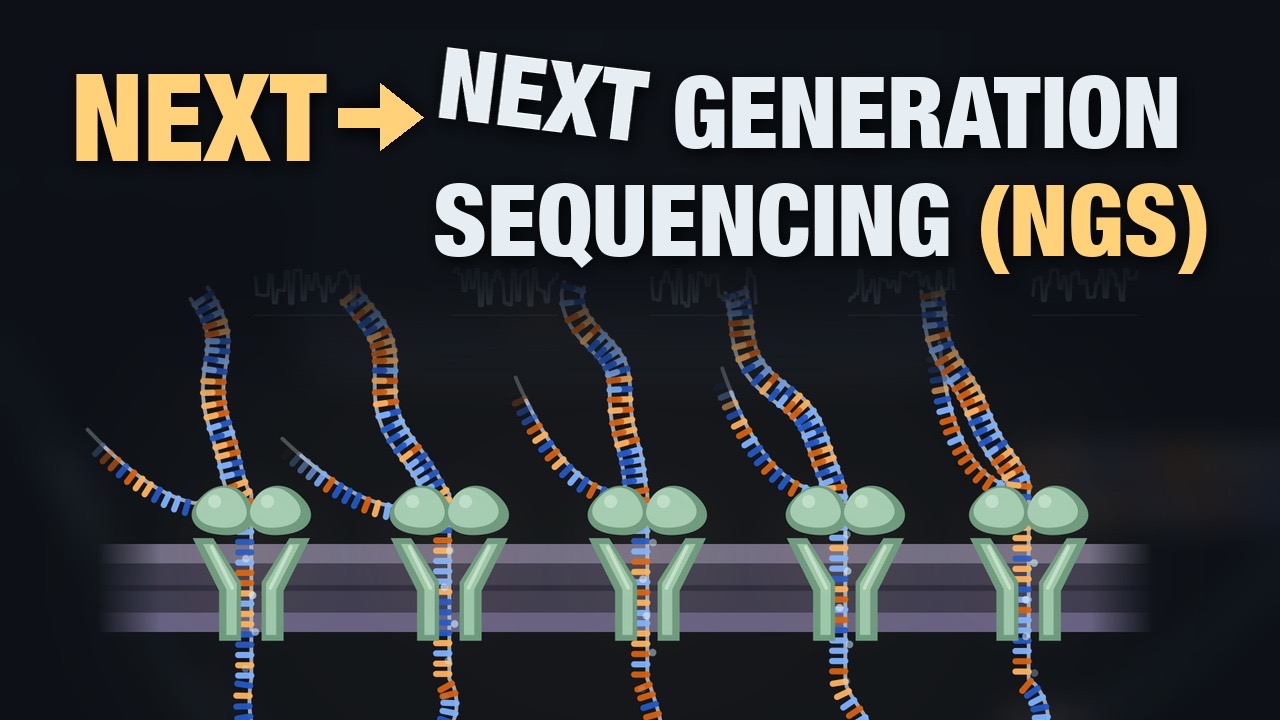
Next generation sequencing (NGS) breaks DNA into millions of pieces and reads them all in parallel; each piece's sequence is a read. If no one has read a species' genome before, the reads are fitted together where they overlap: assembly. Once a reference genome exists, each new read is matched to the place it came from: mapping, or alignment. Mapped reads show a genome's variants, and counting where reads land measures what a genome is doing. Any single read can carry errors, so each spot is read many times over: coverage. The technologies differ in three ways: how they see each base (light as DNA polymerase builds a new strand, in sequencing by synthesis and single-molecule real-time sequencing, or a changing current through a nanopore); whether they read copies or the original molecule, which keeps chemical marks like methylation; and read length, a few hundred base pairs for short reads, from over ten thousand to over a million for long reads. Long reads reach repeats, big changes between genomes and phasing; short reads read a lot of DNA cheaply and accurately.
The video is coming soon to the channel.
Vocabulary
In the order the video explains them. Tap a term for its definition and every video it appears in.
Next generation sequencing (NGS)0:41
Technologies that break DNA into millions of pieces and read them all in parallel.
Appears in
- Next Generation Sequencing Explained (NGS Animation) this video0:41
Sequencing0:52
Reading the order of the bases in DNA.
Appears in
- The Mysterious Squares on Chromosome 10:41
- Why Labs Are Abandoning ChIP-seq0:06
- cut_and_tag_plant0:00
- Single Cell RNA Sequencing Explained: The Cells of a Plant Root #Shorts0:20
- What Is Fiber-seq? Fiber-seq Explained4:10
- What Actually Makes Up the Human Genome?7:29
- What Is a Genome? Genome vs Chromosome vs Gene, Animated1:13
- PCR Explained2:19
- Next Generation Sequencing Explained (NGS Animation) this video0:52
Read1:19
The sequence of one piece of DNA.
Appears in
- Why DNA Only Grows in One Direction (5′ to 3′ Explained)2:51
- Why Does Life Need Both? (DNA vs RNA Animated)0:47
- What Turns a Gene On? (Transcription Animated)0:10
- How Does a Cell Read a Gene’s Message? (Translation Animated)0:45
- The Mysterious Squares on Chromosome 10:41
- Point Mutations and Frameshift Mutations, Explained0:42
- Complementation Test Explained Step by Step3:11
- Why Labs Are Abandoning ChIP-seq0:26
- cut_and_tag_plant0:15
- How do scientists read mummy DNA? #Shorts0:00
- How does death cap poison kill? (animated) #Shorts0:22
- Single Cell RNA Sequencing Explained: The Cells of a Plant Root #Shorts0:20
- What Is Fiber-seq? Fiber-seq Explained0:26
- What Actually Makes Up the Human Genome?0:44
- What Actually Makes Up the Human Genome?1:31
- What Is a Pangenome Graph? Pangenome Graphs Explained0:13
- PCR Explained1:43
- ryugu_bases1:58
- Next Generation Sequencing Explained (NGS Animation) this video1:19
- Template Strand and Coding Strand: Sense vs Antisense DNA, Animated0:09
Assembly1:28
Fitting reads together where they overlap, like a jigsaw, to build a genome no one has read before.
Appears in
- How Does a Cell Read a Gene’s Message? (Translation Animated)4:37
- What Is a Pangenome Graph? Pangenome Graphs Explained0:45
- Next Generation Sequencing Explained (NGS Animation) this video1:28
Reference genome1:36
An assembled genome used by everyone who studies that species.
Appears in
- The Mysterious Squares on Chromosome 10:31
- Why Labs Are Abandoning ChIP-seq3:54
- cut_and_tag_plant3:46
- What Is Fiber-seq? Fiber-seq Explained5:30
- The 10 Types of DNA Mutations Explained in 5 Minutes1:41
- What Is a Pangenome Graph? Pangenome Graphs Explained1:39
- Next Generation Sequencing Explained (NGS Animation) this video1:36
- Template Strand and Coding Strand: Sense vs Antisense DNA, Animated1:41
Mapping (alignment)1:41
Matching each new read to the place in a reference genome it came from.
Appears in
- What Is Fiber-seq? Fiber-seq Explained0:06
- What Is a Pangenome Graph? Pangenome Graphs Explained6:09
- Next Generation Sequencing Explained (NGS Animation) this video1:41
Variant1:50
A place where a genome differs from the reference.
Appears in
- What Is Fiber-seq? Fiber-seq Explained2:22
- The 10 Types of DNA Mutations Explained in 5 Minutes1:17
- What Is a Pangenome Graph? Pangenome Graphs Explained2:30
- Next Generation Sequencing Explained (NGS Animation) this video1:50
Coverage2:26
The number of reads covering a spot in the genome. How much you need depends on the question.
Appears in
- Why Labs Are Abandoning ChIP-seq4:33
- cut_and_tag_plant4:25
- Next Generation Sequencing Explained (NGS Animation) this video2:26
Sequencing by synthesis3:04
Watching a new strand being built one base at a time on millions of pieces at once, each nucleotide carrying its own coloured tag, with a picture taken after each step.
Appears in
- Next Generation Sequencing Explained (NGS Animation) this video3:04
Single-molecule real-time sequencing3:17
Watching a single polymerase build a single strand, live, each base flashing as it joins.
Appears in
- Next Generation Sequencing Explained (NGS Animation) this video3:17
Nanopore sequencing3:29
A motor protein pulls one strand of DNA through a tiny pore; the bases inside the pore change the current through it, and software turns that current into a sequence.
Appears in
- Next Generation Sequencing Explained (NGS Animation) this video3:29
Short read / long read4:19
Short reads are a few hundred base pairs long, cheap and very accurate; long reads run from over ten thousand base pairs to over a million.
Appears in
- Next Generation Sequencing Explained (NGS Animation) this video4:19
Phasing5:14
Showing which copy of a chromosome, the mother's or the father's, each variant sits on.
Appears in
- What Is Fiber-seq? Fiber-seq Explained2:22
- Next Generation Sequencing Explained (NGS Animation) this video5:14
Review questions
What are the two ways reads are used?
Answer
Assembled where they overlap into a new genome, or mapped (aligned) to a reference genome.
Why is each spot read many times over?
Answer
Any single read can carry errors; coverage, the number of reads over a spot, makes each base reliable.
What are the three ways sequencing technologies differ?
Answer
How they see each base (light or current), whether they read copies or the original molecule, and read length.
Why can single-molecule methods see methylation when short-read methods cannot?
Answer
They read the original molecule, which carries its chemical marks; copies don't carry them.
Why do long reads reach parts of the genome short reads can't?
Answer
A short read from inside a repeat matches many places equally well; a long read runs through the repeat, anchored in unique sequence at both ends.
Chapters
- 0:00 What is next generation sequencing (NGS)?
- 0:50 How NGS works: library, reads, assembly and mapping
- 2:34 How each base is seen: sequencing by synthesis, PacBio, nanopore
- 3:39 Copies or the original molecule (DNA methylation)
- 4:10 Short reads vs long reads
- 5:24 Which sequencing do you need?
Sources
17 sources. Each was checked against its record (Crossref, PubMed, the Protein Data Bank, or the textbook edition) and against the claim it supports.
Papers
- Sanger et al. (1977). DNA sequencing with chain-terminating inhibitors. *Proceedings of the National Academy of Sciences*. doi.org/10.1073/pnas.74.12.5463
- Lander et al. (2001). Initial sequencing and analysis of the human genome. *Nature*. doi.org/10.1038/35057062
- Bentley et al. (2008). Accurate whole human genome sequencing using reversible terminator chemistry. *Nature*. doi.org/10.1038/nature07517
- Eid et al. (2009). Real-Time DNA Sequencing from Single Polymerase Molecules. *Science*. doi.org/10.1126/science.1162986
- Goodwin et al. (2016). Coming of age: ten years of next-generation sequencing technologies. *Nature Reviews Genetics*. doi.org/10.1038/nrg.2016.49
- Deamer et al. (2016). Three decades of nanopore sequencing. *Nature Biotechnology*. doi.org/10.1038/nbt.3423
- Jain et al. (2018). Nanopore sequencing and assembly of a human genome with ultra-long reads. *Nature Biotechnology*. doi.org/10.1038/nbt.4060
- Wenger et al. (2019). Accurate circular consensus long-read sequencing improves variant detection and assembly of a human genome. *Nat. Biotechnol.*. doi.org/10.1038/s41587-019-0217-9
- Logsdon et al. (2020). Long-read human genome sequencing and its applications. *Nature Reviews Genetics*. doi.org/10.1038/s41576-020-0236-x
- Hoyt et al. (2022). From telomere to telomere: The transcriptional and epigenetic state of human repeat elements. *Science*. doi.org/10.1126/science.abk3112
- Nurk et al. (2022). The complete sequence of a human genome. *Science*. doi.org/10.1126/science.abj6987
- UK Biobank Whole-Genome Sequencing Consortium (Carss et al.) (2025). Whole-genome sequencing of 490,640 UK Biobank participants. *Nature*. doi.org/10.1038/s41586-025-09272-9
Textbooks
- Alberts et al. (2002). Molecular Biology of the Cell 4th ed. *Garland Science*. Free on NCBI Bookshelf: www.ncbi.nlm.nih.gov/books/NBK21054/
Web sources
- The Nobel Prize in Chemistry 1980, NobelPrize.org (fetched 2026-11-02). www.nobelprize.org/prizes/chemistry/1980/summary/
- National Human Genome Research Institute. The Cost of Sequencing a Human Genome (fact sheet). www.genome.gov/about-genomics/fact-sheets/Sequencing-Human-Genome-cost
- National Human Genome Research Institute. DNA Sequencing Costs: Data. www.genome.gov/about-genomics/fact-sheets/DNA-Sequencing-Costs-Data
- University of Minnesota Genomics Center. Human Whole Genome Sequencing with Analysis ("Offering the $221 human genome", fetched 2026-10-27). genomics.umn.edu/service/human-whole-genome-sequencing