 5′ to 3′ explained
YouTube channel
Show notes
Why DNA Only Grows in One Direction (5′ to 3′ Explained)
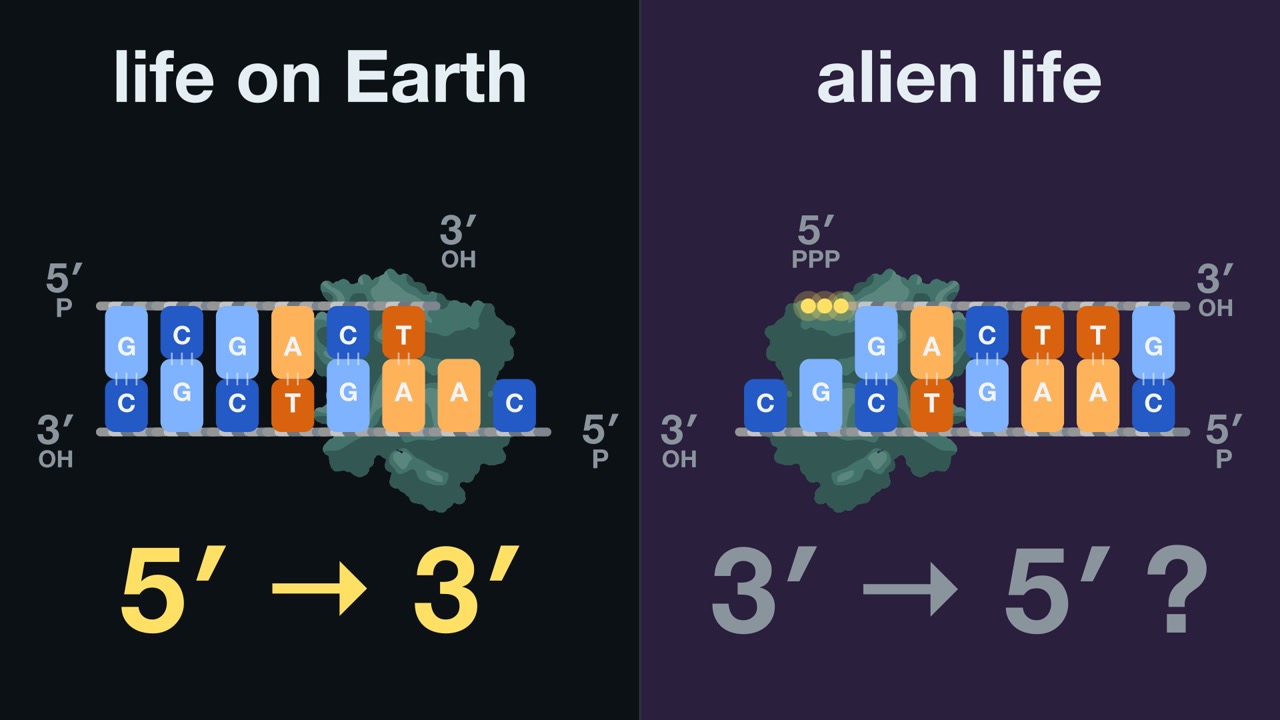
Why does DNA only grow from its 5′ end to its 3′ end, and could life have built it the other way?
The video is coming soon to the channel.
Chapters
- 0:00 Intro
- 0:46 Building a strand
- 3:28 Two ways to build a strand
- 4:45 Where did it come from?
- 5:24 Copying without mistakes
- 7:47 Two limits, one reason
Sources
22 sources. Each was checked against its record (Crossref, PubMed, the Protein Data Bank, or the textbook edition) and against the claim it supports.
Textbooks
- Ahern K, Rajagopal I, Tan T. Biochemistry Free For All. LibreTexts (section 7.3, DNA replication). bio.libretexts.org/Bookshelves/Biochemistry/Book%3A_Biochemistry_Free_For_All_(Ahern_Rajagopal_and_Tan) (accessed 2026-10-20)
- Alberts B, Johnson A, Lewis J, Raff M, Roberts K, Walter P (2002). Molecular Biology of the Cell, 4th ed. New York: Garland Science. Free on NCBI Bookshelf: www.ncbi.nlm.nih.gov/books/NBK21054/ (DNA Replication Mechanisms: www.ncbi.nlm.nih.gov/books/NBK26850/ ; Catalysis and the Use of Energy by Cells: www.ncbi.nlm.nih.gov/books/NBK26838/)
- Clark MA, Choi J, Douglas M (2018). Biology 2e. OpenStax, Rice University. ISBN 9781947172524 (sections 3.5, 7.4, 14.2-14.6, 15). openstax.org/details/books/biology-2e
- Jakubowski H, Flatt P. Fundamentals of Biochemistry III. LibreTexts (section 8.1.3, Synthesis and structure of DNA: bio.libretexts.org/@go/page/14963). bio.libretexts.org/Bookshelves/Biochemistry/Fundamentals_of_Biochemistry_(Jakubowski_and_Flatt) (accessed 2026-10-20)
- Parker N, Schneegurt M, Tu AHT, Lister P, Forster BM (2016). Microbiology. OpenStax, Rice University. ISBN 9781947172234 (section 10.2). openstax.org/details/books/microbiology
Papers
- Anantharaman V, Iyer LM, Aravind L (2010). Presence of a classical RRM-fold palm domain in Thg1-type 3′-5′ nucleic acid polymerases and the origin of the GGDEF and CRISPR polymerase domains. Biology Direct 5:43. doi.org/10.1186/1745-6150-5-43
- Hug LA, Baker BJ, Anantharaman K, Brown CT, Probst AJ, Castelle CJ, Butterfield CN, Hernsdorf AW, Amano Y, Ise K, Suzuki Y, Dudek N, Relman DA, Finstad KM, Amundson R, Thomas BC, Banfield JF (2016). A new view of the tree of life. Nature Microbiology 1:16048. doi.org/10.1038/nmicrobiol.2016.48 (tree data used under CC BY 4.0)
- Hyde SJ, Eckenroth BE, Smith BA, Eberley WA, Heintz NH, Jackman JE, Doublié S (2010). tRNA(His) guanylyltransferase (THG1), a unique 3′-5′ nucleotidyl transferase, shares unexpected structural homology with canonical 5′-3′ DNA polymerases. PNAS 107:20305-20310. doi.org/10.1073/pnas.1010436107
- IUPAC-IUB Joint Commission on Biochemical Nomenclature (1983). Abbreviations and symbols for the description of conformations of polynucleotide chains. Recommendations 1982. European Journal of Biochemistry 131:9-15. doi.org/10.1111/j.1432-1033.1983.tb07225.x
- Jackman JE, Gott JM, Gray MW (2012). Doing it in reverse: 3′-to-5′ polymerization by the Thg1 superfamily. RNA 18:886-899. doi.org/10.1261/rna.032300.112
- Jackman JE, Phizicky EM (2006). tRNAHis guanylyltransferase catalyzes a 3′-5′ polymerization reaction that is distinct from G-1 addition. PNAS 103:8640-8645. doi.org/10.1073/pnas.0603068103
- Kottur J, Nair DT (2018). Pyrophosphate hydrolysis is an intrinsic and critical step of the DNA synthesis reaction. Nucleic Acids Research 46:5875-5885. doi.org/10.1093/nar/gky402
- Lei L, Burton ZF (2021). Early Evolution of Transcription Systems and Divergence of Archaea and Bacteria. Frontiers in Molecular Biosciences 8:651134. doi.org/10.3389/fmolb.2021.651134
- Leipe DD, Aravind L, Koonin EV (1999). Did DNA replication evolve twice independently? Nucleic Acids Research 27:3389-3401. doi.org/10.1093/nar/27.17.3389
- Rao BS, Maris EL, Jackman JE (2011). tRNA 5′-end repair activities of tRNAHis guanylyltransferase (Thg1)-like proteins from Bacteria and Archaea. Nucleic Acids Research 39:1833-1842. doi.org/10.1093/nar/gkq976
- Roske JJ, Yeeles JTP (2024). Structural basis for processive daughter-strand synthesis and proofreading by the human leading-strand DNA polymerase Pol ε. Nature Structural & Molecular Biology 31:1921-1931. doi.org/10.1038/s41594-024-01370-y
- Schaaper RM (1993). Base selection, proofreading, and mismatch repair during DNA replication in Escherichia coli. Journal of Biological Chemistry 268:23762-23765. doi.org/10.1016/s0021-9258(20)80446-3
- Smith BA, Jackman JE (2014). Saccharomyces cerevisiae Thg1 uses 5′-pyrophosphate removal to control addition of nucleotides to tRNAHis. Biochemistry 53:1380-1391. doi.org/10.1021/bi4014648
- Werner F, Grohmann D (2011). Evolution of multisubunit RNA polymerases in the three domains of life. Nature Reviews Microbiology 9:85-98. doi.org/10.1038/nrmicro2507
Structures and data
- PDB 9F6D: Human DNA polymerase epsilon bound to DNA and PCNA (open conformation). Roske JJ, Yeeles JTP (2024). Nature Structural & Molecular Biology 31:1921-1931. doi.org/10.2210/pdb9f6d/pdb
- PDB 1BNA: Structure of a B-DNA dodecamer. Conformation and dynamics. Drew HR, Wing RM, Takano T, Broka C, Tanaka S, Itakura K, Dickerson RE (1981). PNAS 78:2179-2183. doi.org/10.2210/pdb1bna/pdb
- NCBI RefSeq NC_003076.8, Arabidopsis thaliana chromosome 5 (FLC transcription start region, c3179500-3179250; the DNA letters drawn). www.ncbi.nlm.nih.gov/nuccore/NC_003076.8