 5 to 3
Show notes
The 10 Types of DNA Mutations Explained in 5 Minutes
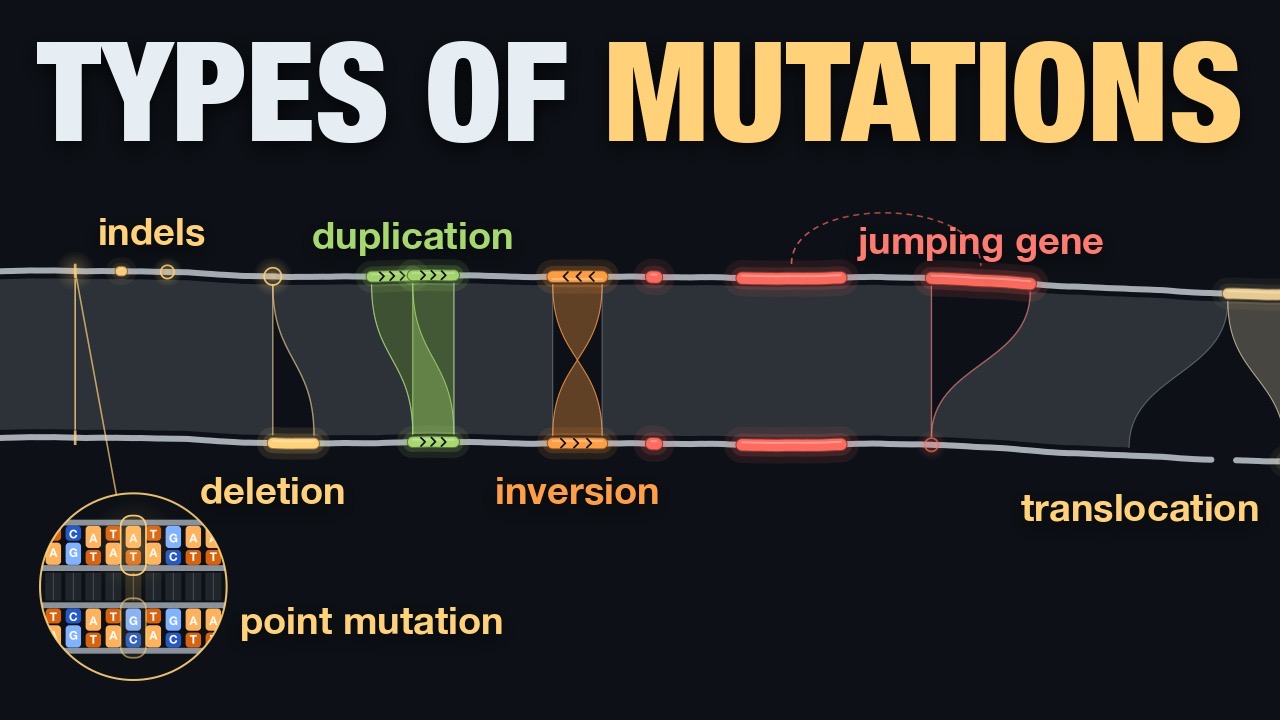
What are the types of mutations in DNA, and how common is each one? No two people have exactly the same DNA, and every difference began as a mutation: a change in the DNA sequence, copied every time the cell divides. This video goes through the kinds by size. The smallest changes a single base pair: a point mutation, also called a single nucleotide variant (SNV) or, in a population, a SNP. Against the reference genome a person differs at about four million single base pairs, nearly all inherited, and only about seventy-five are new. Next, a few base pairs added or lost: insertions and deletions, together called indels, about eight hundred thousand per person, under fifty base pairs. Changes of fifty base pairs or more are structural variants: deletions, duplications, inversions, translocations and jumping genes (transposons), about twenty-five thousand per person, few by count but covering more base pairs than all the point mutations. Biggest of all, a whole chromosome gained or lost: aneuploidy, such as a trisomy. Every new allele starts as a mutation, so all genetic variation, in every living thing, began as mutations.
The video is coming soon to the channel.
Vocabulary
In the order the video explains them. Tap a term for its definition and every video it appears in.
Mutation0:46
A change in the DNA sequence, copied every time the cell divides. A copying mistake or DNA damage that is not repaired can become one.
Appears in
- Why DNA Only Grows in One Direction (5′ to 3′ Explained)5:24
- Why Half Your DNA Is Copied Backwards (DNA Replication Animated)13:07
- Why Does Life Need Both? (DNA vs RNA Animated)5:23
- Point Mutations and Frameshift Mutations, Explained0:00
- Complementation Test Explained Step by Step1:28
- What Actually Makes Up the Human Genome?4:24
- What Actually Makes Up the Human Genome?6:30
- Why Does Sex Exist? Meiosis Explained8:32
- The 10 Types of DNA Mutations Explained in 5 Minutes this video0:46
Point mutation1:17
A change of a single base pair, also called a single base substitution. It is named by its change, such as a C to T, also written C:G to T:A, since the whole base pair changes.
Appears in
- Point Mutations and Frameshift Mutations, Explained1:59
- The 10 Types of DNA Mutations Explained in 5 Minutes this video1:17
Single nucleotide variant (SNV)1:17
Another name for a point mutation: one base pair that differs between two sequences.
Appears in
- The 10 Types of DNA Mutations Explained in 5 Minutes this video1:17
Single nucleotide polymorphism (SNP)1:17
What people often call a single nucleotide variant when they are talking about a population.
Appears in
- The 10 Types of DNA Mutations Explained in 5 Minutes this video1:17
Reference genome1:41
A standard human genome sequence that a person's genome is lined up against to find where it differs.
Appears in
- The Mysterious Squares on Chromosome 10:31
- Why Labs Are Abandoning ChIP-seq3:54
- cut_and_tag_plant3:46
- What Is Fiber-seq? Fiber-seq Explained5:30
- The 10 Types of DNA Mutations Explained in 5 Minutes this video1:41
- What Is a Pangenome Graph? Pangenome Graphs Explained1:39
- Next Generation Sequencing Explained (NGS Animation)1:36
- Template Strand and Coding Strand: Sense vs Antisense DNA, Animated1:41
Insertion2:17
Base pairs added to a DNA sequence. Small ones are a few base pairs; some, like jumping genes, are thousands.
Appears in
- The 10 Types of DNA Mutations Explained in 5 Minutes this video2:17
Deletion2:17
Base pairs lost from a DNA sequence, from a few to a whole stretch.
Appears in
- Point Mutations and Frameshift Mutations, Explained4:10
- The 10 Types of DNA Mutations Explained in 5 Minutes this video2:17
- What Is a Pangenome Graph? Pangenome Graphs Explained2:06
Indel2:17
An insertion or a deletion. Comparing two sequences, you often can't tell whether one gained base pairs or the other lost them, so both are called indels. Small indels are under fifty base pairs.
Appears in
- The 10 Types of DNA Mutations Explained in 5 Minutes this video2:17
- What Is a Pangenome Graph? Pangenome Graphs Explained2:53
Structural variant2:37
A change of fifty base pairs or more: a deletion, a duplication, an inversion, a translocation or an insertion such as a jumping gene. A person inherits about twenty-five thousand.
Appears in
- The 10 Types of DNA Mutations Explained in 5 Minutes this video2:37
- What Is a Pangenome Graph? Pangenome Graphs Explained4:38
Duplication2:46
A structural variant in which a whole stretch of DNA is copied an extra time.
Appears in
- The Mysterious Squares on Chromosome 18:56
- The 10 Types of DNA Mutations Explained in 5 Minutes this video2:46
Inversion2:50
A structural variant in which a whole stretch of DNA is turned around.
Appears in
- The 10 Types of DNA Mutations Explained in 5 Minutes this video2:50
- What Is a Pangenome Graph? Pangenome Graphs Explained5:20
Translocation2:54
A structural variant in which a whole stretch of DNA is moved to another chromosome.
Appears in
- The 10 Types of DNA Mutations Explained in 5 Minutes this video2:54
- What Is a Pangenome Graph? Pangenome Graphs Explained5:29
Transposon (jumping gene)2:59
A stretch of DNA, about three hundred to six thousand base pairs long in people, that copies itself into new places. The copy can land almost anywhere in the genome, even on another chromosome.
Appears in
- Why Labs Are Abandoning ChIP-seq1:48
- cut_and_tag_plant1:48
- What Actually Makes Up the Human Genome?3:41
- What Actually Makes Up the Human Genome?5:20
- The 10 Types of DNA Mutations Explained in 5 Minutes this video2:59
Aneuploidy3:27
A whole chromosome, millions of base pairs, gained or lost.
Appears in
- The 10 Types of DNA Mutations Explained in 5 Minutes this video3:27
Trisomy3:36
Three copies of a chromosome instead of two.
Appears in
- The 10 Types of DNA Mutations Explained in 5 Minutes this video3:36
Allele3:54
A version of a gene. Every new allele starts as a mutation; making eggs and sperm shuffles alleles into new combinations.
Appears in
- Complementation Test Explained Step by Step2:40
- What Is Fiber-seq? Fiber-seq Explained1:09
- The 10 Types of DNA Mutations Explained in 5 Minutes this video3:54
- What Is a Pangenome Graph? Pangenome Graphs Explained8:02
Study frame
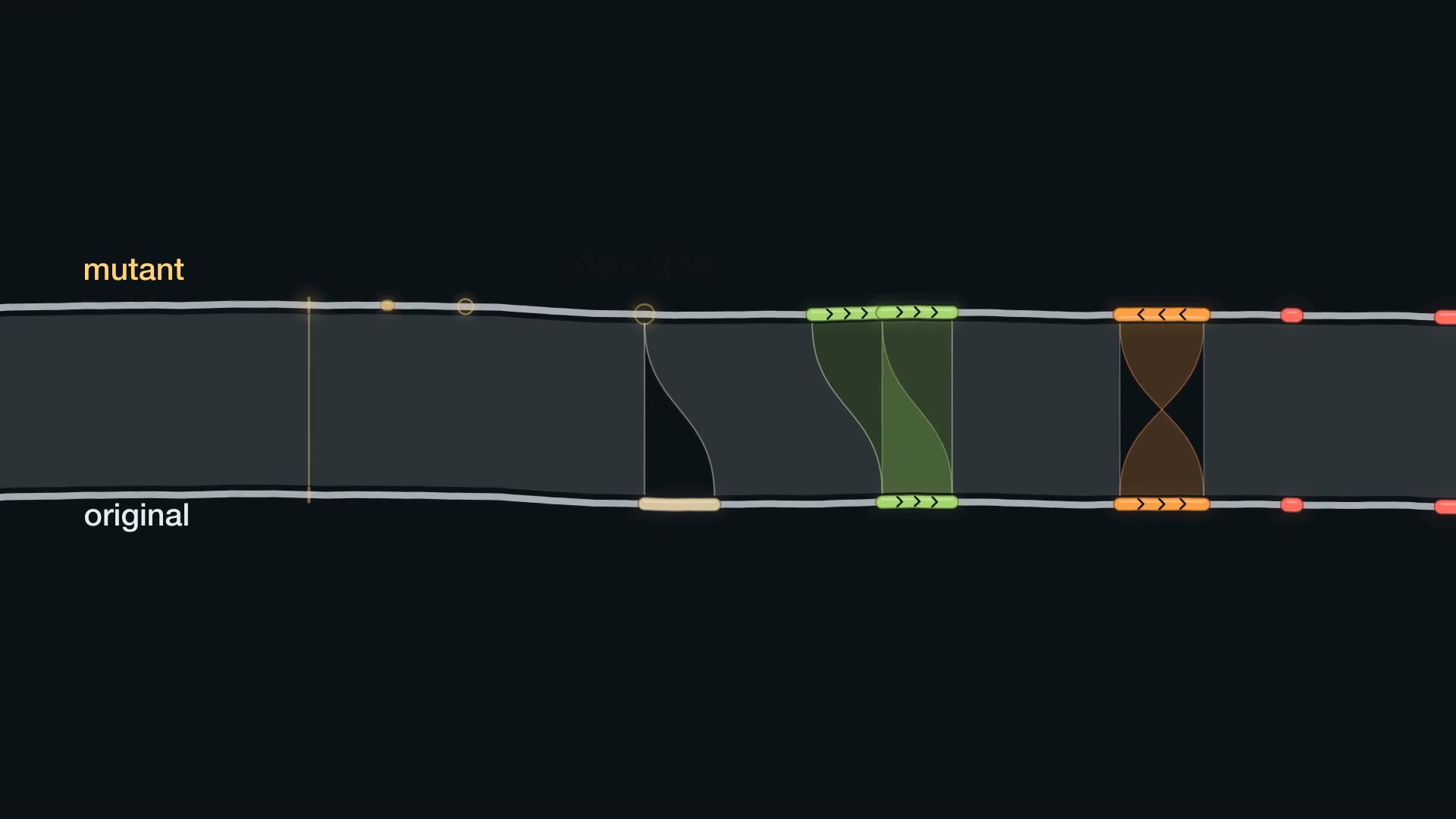
The whole picture in one labelled frame, to save or print.
Review questions
What is a mutation?
Answer
A change in the DNA sequence, copied every time the cell divides. A copying mistake or DNA damage that is not repaired can become one.
What is a point mutation, and what are its other names?
Answer
A change of a single base pair. It is also called a single base substitution or a single nucleotide variant (SNV); in a population, people often call it a SNP.
Why are insertions and deletions lumped together as indels?
Answer
Comparing two sequences, you often can't tell whether one gained base pairs or the other lost them.
What size of change counts as a structural variant, and what are its kinds?
Answer
Fifty base pairs or more: a deletion, a duplication, an inversion, a translocation, or an insertion such as a jumping gene.
Which kind of mutation is most common in a person's genome, and which covers the most base pairs?
Answer
Single base point mutations are by far the most common (about four million differences from the reference). Structural variants are few, about twenty-five thousand, but together they cover more base pairs than all the point mutations.
What are aneuploidy and trisomy?
Answer
Aneuploidy is a whole chromosome gained or lost. A trisomy is three copies of a chromosome instead of two.
Where do alleles come from?
Answer
Every new allele starts as a mutation; making eggs and sperm then shuffles alleles into new combinations.
Chapters
- 0:00 What you'll learn: types of mutations in DNA
- 0:54 Point mutations: SNVs and SNPs
- 2:06 Insertions and deletions (indels)
- 2:36 Structural variants: deletion, duplication, inversion, translocation
- 3:27 Aneuploidy and trisomy
- 3:40 Recap: all genetic variation began as mutations
Sources
11 sources. Each was checked against its record (Crossref, PubMed, the Protein Data Bank, or the textbook edition) and against the claim it supports.
Textbooks
- Alberts B, Johnson A, Lewis J, Raff M, Roberts K, Walter P (2002). Molecular Biology of the Cell, 4th ed. New York: Garland Science. Free on NCBI Bookshelf: www.ncbi.nlm.nih.gov/books/NBK21054/ (a diploid human cell holds about 6.4 billion base pairs; copying makes about one mistake per billion nucleotides copied; copying mistakes and damage become mutations only if left unrepaired, and almost all are repaired)
- Nickle T, Barrette-Ng I (eds.). Online Open Genetics. LibreTexts (CC BY-SA 3.0). bio.libretexts.org/Bookshelves/Genetics/Online_Open_Genetics_(Nickle_and_Barrette-Ng) (changes in DNA sequences are called mutations; a copying error that becomes permanent is inherited by the cell's descendants; most base pair changes have no effect on the phenotype; alleles come from mutation; a single nucleotide polymorphism, SNP; deletions, duplications and inversions change a segment of one chromosome, translocations involve two chromosomes; transposable elements, or jumping genes, are cut or copied and inserted into new places, almost anywhere in the genome; aneuploidy, the gain or loss of a chromosome; a trisomy, three copies instead of two; crossovers in meiosis reshuffle allele combinations)
- Clark MA, Choi J, Douglas M (2018). Biology 2e. OpenStax, Rice University. ISBN 9781947172524. openstax.org/details/books/biology-2e (gene variants that arise by mutation are called alleles; an added base is an insertion, a removed one a deletion; aneuploidy includes trisomy; chromosome number changes duplicate or lose whole chromosomes)
Papers
- How many differences one person carries, by kind, and the size classes: Ebert P, Audano PA, Zhu Q, Rodriguez-Martin B, et al. (2021). Haplotype-resolved diverse human genomes and integrated analysis of structural variation. Science 372:eabf7117. doi.org/10.1126/science.abf7117 (on average per person, against the reference: 3,895,274 single nucleotide variants, 794,406 indels and 24,653 structural variants; indels are 1 to 49 base pairs, structural variants 50 or more; jumping-gene insertions peak at 300 base pairs, Alu, and 6,000, L1)
- Most variants in one genome are common, and structural variants cover more bases: The 1000 Genomes Project Consortium, Auton A, Abecasis GR, et al. (2015). A global reference for human genetic variation. Nature 526:68-74. doi.org/10.1038/nature15393 (PMID 26432245) (just 1 to 4% of the variants in a typical genome are rare; "although >99.9% of variants consist of SNPs and short indels, structural variants affect more bases", about 20 million bases in a typical genome, a short-read count)
- About seventy-five new single base pair changes per person: Porubsky D, Dashnow H, Sasani TA, Logsdon GA, et al. (2025). Human de novo mutation rates from a four-generation pedigree reference. Nature 643:427-436. doi.org/10.1038/s41586-025-08922-2 (74.5 de novo single nucleotide variants per transmission)
- Sizes of jumping genes: Cordaux R, Batzer MA (2009). The impact of retrotransposons on human genome evolution. Nature Reviews Genetics 10:691-703. doi.org/10.1038/nrg2640 (PMID 19763152) (a full-length Alu element is about 300 base pairs)
- Hancks DC, Kazazian HH (2016). Roles for retrotransposon insertions in human disease. Mobile DNA 7:9. doi.org/10.1186/s13100-016-0065-9 (PMID 27158268) (a full-length LINE-1 is about 6,000 base pairs)
- Naming a point mutation by the whole base pair: Blokzijl F, de Ligt J, Jager M, Sasselli V, et al. (2016). Tissue-specific mutation accumulation in human adult stem cells during life. Nature 538:260-264. doi.org/10.1038/nature19768 (PMID 27698416) (writes changes as "C:G to T:A transitions")
Genome data
- The base pairs read on screen and the person whose genome is drawn (HG002: his two copies of chromosome 11 at the indels close-up, his 46 chromosomes, his small indels placed per million base pairs from the GIAB/T2T Q100 v5.0q small-variant benchmark, whose README asks users to cite the T2T Q100 project): T2T-HG002 Q100 v1.1, github.com/marbl/hg002 ; Hansen NF, Dwarshuis N, Ji HJ, Rhie A, et al. (2026). A complete diploid human genome benchmark for personalized genomics. Cell 189:4857-4875.e31. doi.org/10.1016/j.cell.2026.06.016 (PMID 42561913)
- The reference sequence around the beta-globin gene in the opening and chromosome 21's length, about 45 million base pairs: T2T-CHM13v2.0 (UCSC hs1), github.com/marbl/CHM13 ; Nurk S, Koren S, Rhie A, Rautiainen M, et al. (2022). The complete sequence of a human genome. Science 376:44-53. doi.org/10.1126/science.abj6987