 5 to 3
Show notes
Single Cell RNA Sequencing Explained: The Cells of a Plant Root #Shorts
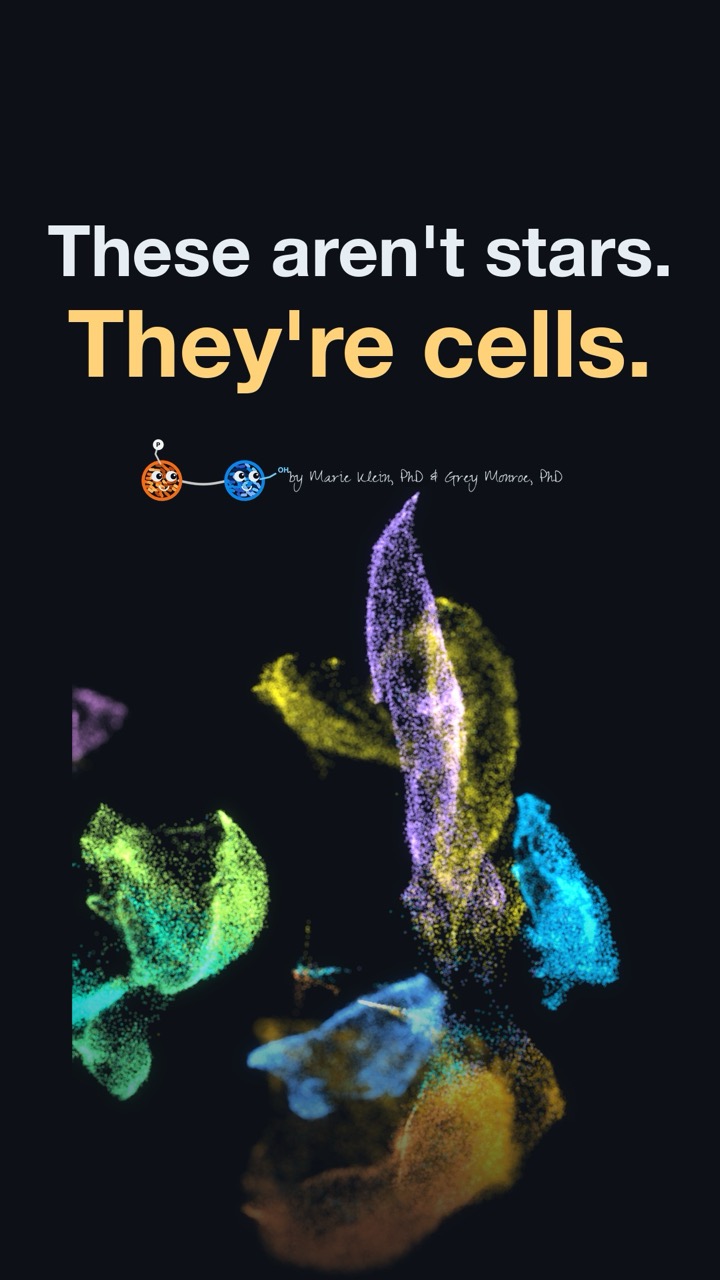
Nearly every cell in a plant carries the same genes; what makes one kind of cell different from another is which of those genes it is using, and a cell transcribes the genes it is using into RNA. Single-cell RNA sequencing reads the RNA from thousands of cells at once and keeps each cell's apart: each cell's RNA gets its own barcode, a short DNA tag, so each sequence can be traced back to its cell. That gives every cell thousands of numbers, a count of its RNA from each gene. A UMAP squeezes those numbers down to one point in 3D, and cells that use similar genes land next to each other. The data are 84,855 cells from the root tips of young Arabidopsis thaliana plants (Shahan et al. 2022): colour by the cell types the researchers named, and the types sort themselves out, from root-hair cells, the root cap, the xylem and the phloem to the stem cells near the middle of the map.
The video is coming soon to the channel.
Sources
4 sources. Each was checked against its record (Crossref, PubMed, the Protein Data Bank, or the textbook edition) and against the claim it supports.
- Shahan R, Hsu C-W, Nolan TM, Cole BJ, Taylor IW, Greenstreet L, Zhang S, Afanassiev A, Vlot AHC, Schiebinger G, Benfey PN, Ohler U (2022). A single-cell Arabidopsis root atlas reveals developmental trajectories in wild-type and cell identity mutants. Developmental Cell 57(4):543-560.e9. doi.org/10.1016/j.devcel.2022.01.008 (PMID 35134336; open access, CC BY 4.0). The data shown: root-tip cells (0.5 cm), barcoding, genes detected per cell, cell-type-specific genes. On screen: "Shahan et al. 2022 · Dev Cell".
- Zheng GXY, Terry JM, Belgrader P, et al. (2017). Massively parallel digital transcriptional profiling of single cells. Nature Communications 8:14049. doi.org/10.1038/ncomms14049 (PMID 28091601). The droplet method the atlas used: each cell's RNA carries its droplet's own barcode, then the barcoded molecules are pooled and sequenced together.
- Clark MA, Choi J, Douglas M (2018). Biology 2e. OpenStax, Rice University. ISBN 9781947172524 (ch. 16 introduction: cells share the same DNA but turn on different genes; ch. 25 and 30: the root cap, root hairs, xylem, phloem, the apical meristem). openstax.org/details/books/biology-2e
- Alberts B, Johnson A, Lewis J, Raff M, Roberts K, Walter P (2002). Molecular Biology of the Cell, 4th ed. New York: Garland Science (cell types arise because different sets of genes are expressed). Free on NCBI Bookshelf: www.ncbi.nlm.nih.gov/books/NBK21054/