 5 to 3
Show notes
How do scientists read mummy DNA? #Shorts
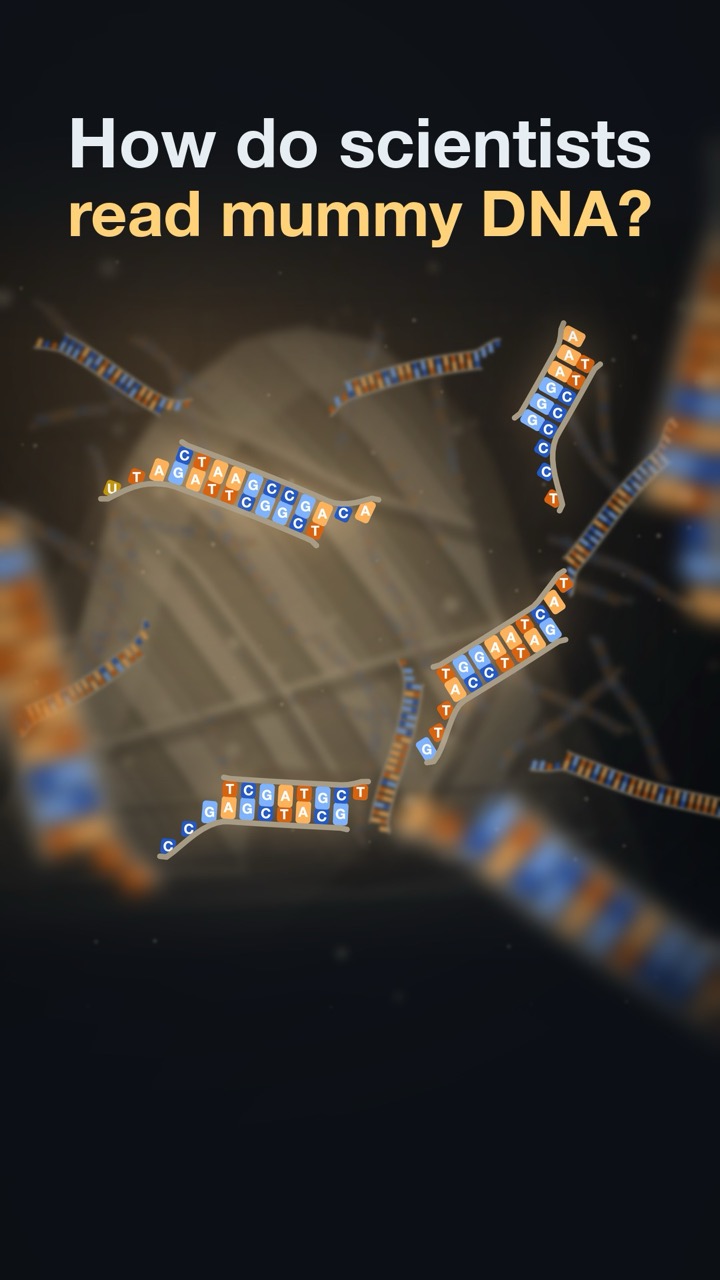
Over thousands of years, water knocks letters off a mummy's DNA and the chain breaks, leaving scraps just dozens of letters long. Scientists find where each scrap fits in a map of human DNA. To tell the mummy's scraps from DNA of living people, they look at the ends: there, over more than a thousand years, C decays into U, and after copying it is read as T. Ts piling up at the ends of the reads mark the DNA as ancient. In 2017 this let scientists read DNA from ninety Egyptian mummies, 1,600 to 3,400 years old, to trace their ancestry.
The video is coming soon to the channel.
Sources
8 sources. Each was checked against its record (Crossref, PubMed, the Protein Data Bank, or the textbook edition) and against the claim it supports.
- Schuenemann VJ, Peltzer A, Welte B, et al. (2017). Ancient Egyptian mummy genomes suggest an increase of Sub-Saharan African ancestry in post-Roman periods. Nature Communications 8:15694. doi.org/10.1038/ncomms15694
- Morez Jacobs A, Irish JD, Cooke A, et al. (2025). Whole-genome ancestry of an Old Kingdom Egyptian. Nature 644:714-721. doi.org/10.1038/s41586-025-09195-5
- Sawyer S, Krause J, Guschanski K, Savolainen V, Pääbo S (2012). Temporal patterns of nucleotide misincorporations and DNA fragmentation in ancient DNA. PLoS ONE 7:e34131. doi.org/10.1371/journal.pone.0034131
- Briggs AW, Stenzel U, Meyer M, Krause J, Kircher M, Pääbo S (2010). Removal of deaminated cytosines and detection of in vivo methylation in ancient DNA. Nucleic Acids Research 38:e87. doi.org/10.1093/nar/gkp1163
- Briggs AW, Stenzel U, Johnson PLF, et al. (2007). Patterns of damage in genomic DNA sequences from a Neandertal. Proceedings of the National Academy of Sciences 104:14616-14621. doi.org/10.1073/pnas.0704665104
- Lindahl T (1993). Instability and decay of the primary structure of DNA. Nature 362:709-715. doi.org/10.1038/362709a0
- Byrska-Bishop M, Evani US, Zhao X, et al. (2022). High-coverage whole-genome sequencing of the expanded 1000 Genomes Project cohort including 602 trios. Cell 185:3426-3440.e19. doi.org/10.1016/j.cell.2022.08.004 (added 2026-10-27 via cite-add, hub ByrskaBishop2022-pk: the source of the living person's reads in the damage graph, NA07000, ENA ERR3239279, study PRJEB31736 "30X whole genome sequencing coverage of the 2504 Phase 3 1000 Genome samples", NYGC).
- Alberts B, Johnson A, Lewis J, Raff M, Roberts K, Walter P (2002). Molecular Biology of the Cell, 4th ed. Garland Science, New York. Sections "DNA Repair" (www.ncbi.nlm.nih.gov/books/NBK26879/) and "From DNA to RNA" (www.ncbi.nlm.nih.gov/books/NBK26887/).