 5 to 3
Show notes
How Your Cells Divide: Mitosis in 5 Minutes
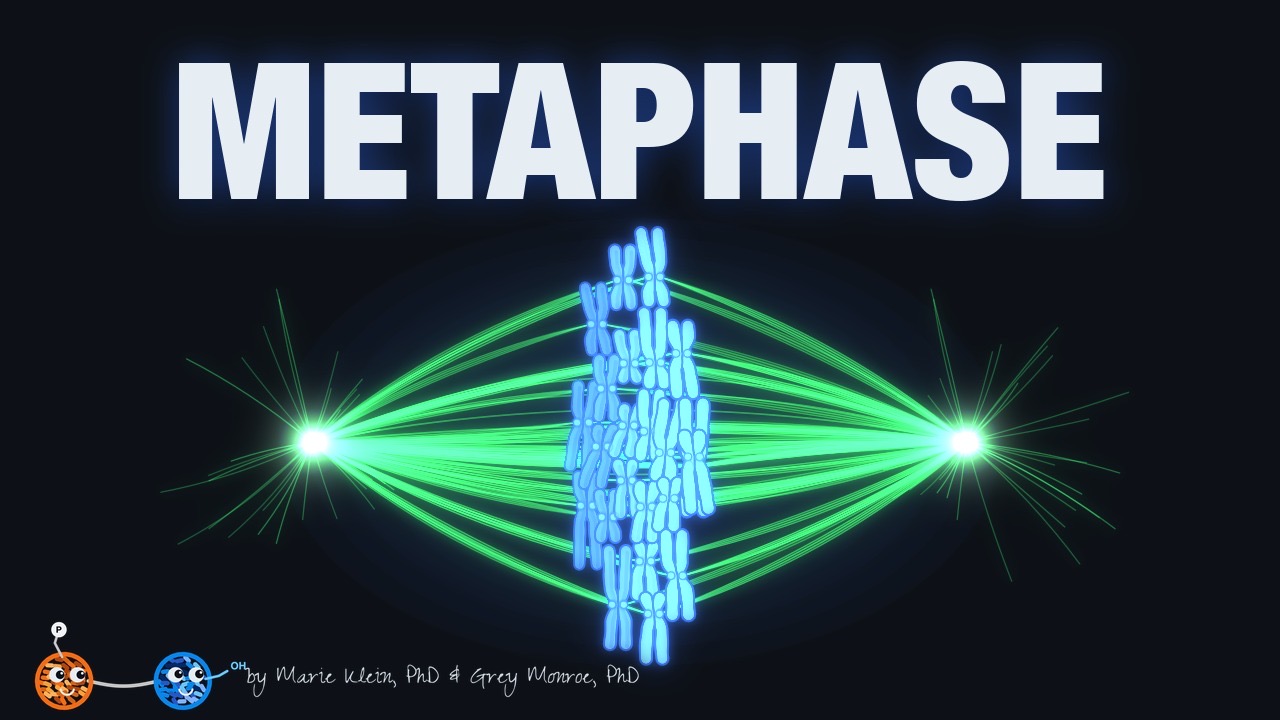
What is mitosis, and what happens in each of its stages? In mitosis, one cell divides into two new cells, each with a complete, identical set of chromosomes: it is how living things grow, and how they repair and replace their tissues. The video follows one cell of a green alga, Coleochaete orbicularis, with 24 chromosomes (your own cells have 46 and divide by the same steps). Before dividing, the cell copies its DNA, so each chromosome becomes two sister chromatids joined at the centromere. In prophase the chromosomes pack into short, thick rods while a spindle of microtubules grows from two poles. In prometaphase the nuclear envelope breaks apart and the fibers catch each chromosome at its kinetochore, each sister from the opposite pole. In metaphase the chromosomes line up across the middle, and a checkpoint holds the cell there until every kinetochore is attached. In anaphase the enzyme separase cuts the proteins holding the sisters together, and the kinetochores, holding on to shrinking microtubule tips, draw the chromatids to opposite poles. In telophase new nuclear envelopes form and the chromosomes loosen, and in cytokinesis the cell is split: by a cell plate in plants and algae, by a cleavage furrow in animal cells.
The video is coming soon to the channel.
Vocabulary
In the order the video explains them. Tap a term for its definition and every video it appears in.
Mitosis0:00
The division of one cell into two new cells, each with a complete, identical set of chromosomes. It is how living things grow, and how they repair and replace their tissues.
Appears in
- Why Does Sex Exist? Meiosis Explained0:00
- How Your Cells Divide: Mitosis in 5 Minutes this video0:00
Chromosome0:40
A long molecule of DNA, wrapped around proteins; in the video's alga each is tens of millions of base pairs long. The alga's cells hold 24, human cells 46.
Appears in
- Why Half Your DNA Is Copied Backwards (DNA Replication Animated)0:36
- The Mysterious Squares on Chromosome 10:00
- Complementation Test Explained Step by Step1:44
- Why Labs Are Abandoning ChIP-seq0:33
- cut_and_tag_plant4:14
- Why are calico cats almost always female? #Shorts0:05
- What is your DNA actually made of? #Shorts0:03
- What Is Fiber-seq? Fiber-seq Explained1:09
- What Actually Makes Up the Human Genome?0:08
- What Actually Makes Up the Human Genome?0:55
- What Is a Genome? Genome vs Chromosome vs Gene, Animated0:21
- Why Does Sex Exist? Meiosis Explained0:00
- How Your Cells Divide: Mitosis in 5 Minutes this video0:40
- The 10 Types of DNA Mutations Explained in 5 Minutes2:54
- What Is a Pangenome Graph? Pangenome Graphs Explained1:39
- Next Generation Sequencing Explained (NGS Animation)5:14
- Template Strand and Coding Strand: Sense vs Antisense DNA, Animated0:58
DNA replication1:01
Copying all of a cell's DNA before it divides. Copying starts at many places along each chromosome at once: the DNA opens into forks that run in both directions until the copies meet.
Appears in
- Why Half Your DNA Is Copied Backwards (DNA Replication Animated)0:23
- How Your Cells Divide: Mitosis in 5 Minutes this video1:01
Sister chromatids1:11
The two identical DNA molecules a chromosome is made of after copying, held together by proteins until anaphase.
Appears in
- Why Half Your DNA Is Copied Backwards (DNA Replication Animated)11:13
- Why Does Sex Exist? Meiosis Explained2:47
- How Your Cells Divide: Mitosis in 5 Minutes this video1:11
Centromere1:19
The pinched spot where sister chromatids are joined most tightly; the spindle fibers grab each chromosome there.
Appears in
- The Mysterious Squares on Chromosome 18:02
- What Actually Makes Up the Human Genome?4:55
- What Actually Makes Up the Human Genome?7:21
- Why Does Sex Exist? Meiosis Explained2:47
- How Your Cells Divide: Mitosis in 5 Minutes this video1:19
- What Is a Pangenome Graph? Pangenome Graphs Explained5:43
Prophase1:25
The first stage of mitosis: each chromosome packs tight, its long threads coiling up into short, thick rods, the X shape seen in pictures, while the spindle starts to form.
Appears in
- How Your Cells Divide: Mitosis in 5 Minutes this video1:25
Spindle (microtubules)1:43
Fibers of protein, called microtubules, growing out from two poles on opposite sides of the cell; they catch the chromosomes and pull them apart.
Appears in
- Why Does Sex Exist? Meiosis Explained6:14
- How Your Cells Divide: Mitosis in 5 Minutes this video1:43
Prometaphase1:53
The stage when the nuclear envelope breaks apart and the spindle fibers grab each chromosome at its kinetochore.
Appears in
- How Your Cells Divide: Mitosis in 5 Minutes this video1:53
Kinetochore1:53
A patch of protein at the centromere where the spindle fibers attach. It grips the end of a fiber and holds on as the fiber comes apart at that end, so the chromatid is drawn toward the pole.
Appears in
- The Mysterious Squares on Chromosome 18:22
- How Your Cells Divide: Mitosis in 5 Minutes this video1:53
Metaphase2:09
The stage when the fibers push and pull until the chromosomes line up across the middle of the cell.
Appears in
- How Your Cells Divide: Mitosis in 5 Minutes this video2:09
Spindle checkpoint2:16
The system that checks that every sister chromatid is attached to the spindle before the cell goes on. Any kinetochore still free sends out a signal to wait, which holds back the enzyme that would separate the sisters.
Appears in
- How Your Cells Divide: Mitosis in 5 Minutes this video2:16
Separase2:41
The enzyme that cuts the proteins holding each pair of sister chromatids together, starting anaphase once the wait signal stops.
Appears in
- How Your Cells Divide: Mitosis in 5 Minutes this video2:41
Anaphase2:41
The stage when the sister chromatids are separated and the fibers pull them to opposite ends of the cell; each chromatid is then a chromosome of its own.
Appears in
- How Your Cells Divide: Mitosis in 5 Minutes this video2:41
Telophase3:14
The stage when a new nuclear envelope forms around the chromosomes at each end and they loosen back into long threads.
Appears in
- How Your Cells Divide: Mitosis in 5 Minutes this video3:14
Cytokinesis3:23
The splitting of the cell in two after mitosis. Plant and algal cells build a new wall from a cell plate; animal cells pinch in two at a cleavage furrow.
Appears in
- How Your Cells Divide: Mitosis in 5 Minutes this video3:23
Cell plate3:23
The new wall a plant or algal cell builds between its two nuclei: vesicles gather and fuse into a plate that grows out until it meets the old walls.
Appears in
- How Your Cells Divide: Mitosis in 5 Minutes this video3:23
Cleavage furrow3:39
The groove where a ring of protein tightens around an animal cell's middle and pinches it in two.
Appears in
- How Your Cells Divide: Mitosis in 5 Minutes this video3:39
Meiosis4:14
A different division, the one that makes eggs and sperm.
Appears in
- Why Does Sex Exist? Meiosis Explained0:29
- How Your Cells Divide: Mitosis in 5 Minutes this video4:14
Review questions
What does mitosis produce, and what is it for?
Answer
Two new cells, each with a complete, identical set of chromosomes. Mitosis is how living things grow, and how they repair and replace their tissues.
Why does a copied chromosome look like an X in pictures?
Answer
After copying, each chromosome is two sister chromatids joined at the centromere; packed tight in prophase, the two short, thick rods joined at that pinched spot make the X.
Put the stages in order and say what happens in each: anaphase, metaphase, prophase, telophase, prometaphase.
Answer
Prophase (chromosomes pack tight; the spindle forms), prometaphase (the nuclear envelope breaks apart; fibers catch each chromosome at its kinetochore), metaphase (chromosomes line up across the middle), anaphase (sisters are separated and pulled to opposite poles), telophase (new nuclear envelopes form; chromosomes loosen). Cytokinesis then splits the cell.
What would go wrong if a cell started anaphase before every kinetochore was attached, and how does the cell prevent it?
Answer
A new cell could end up missing a chromosome. Any kinetochore still free sends out a signal to wait, which holds back separase, the enzyme that cuts the proteins holding the sisters together; only when the last kinetochore is caught does the signal stop.
How does the kinetochore pull a chromatid toward the pole?
Answer
It grips the end of a spindle fiber, and as the fiber comes apart at that end, the kinetochore holds on to the shrinking tip, so the chromatid is drawn toward the pole.
The alga's cell starts mitosis with 24 copied chromosomes. How many chromosomes does each daughter cell get?
Answer
Twenty-four: each sister chromatid becomes a chromosome of its own, so each end gets one copy of every chromosome, the same set as the cell they came from.
How is cytokinesis different in a plant or alga cell and an animal cell?
Answer
A plant or alga cell builds a new cell wall: vesicles gather between the two nuclei and fuse into a cell plate that grows out to the old walls. An animal cell has no wall to build; a ring of protein tightens around its middle and pinches it in two at the cleavage furrow.
Chapters
- 0:00 What is mitosis?
- 0:40 Before mitosis: copying the chromosomes (DNA replication)
- 1:29 Prophase: chromosomes condense, the spindle forms
- 1:57 Prometaphase: the kinetochore and spindle fibers
- 2:13 Metaphase and the spindle checkpoint
- 2:45 Anaphase: separase and the kinetochore pull
- 3:18 Telophase and cytokinesis: cell plate vs cleavage furrow
- 3:59 Stages of mitosis recap
Sources
0 sources. Each was checked against its record (Crossref, PubMed, the Protein Data Bank, or the textbook edition) and against the claim it supports.