 5 to 3
Show notes
Scientists found DNA building blocks on an asteroid #Shorts
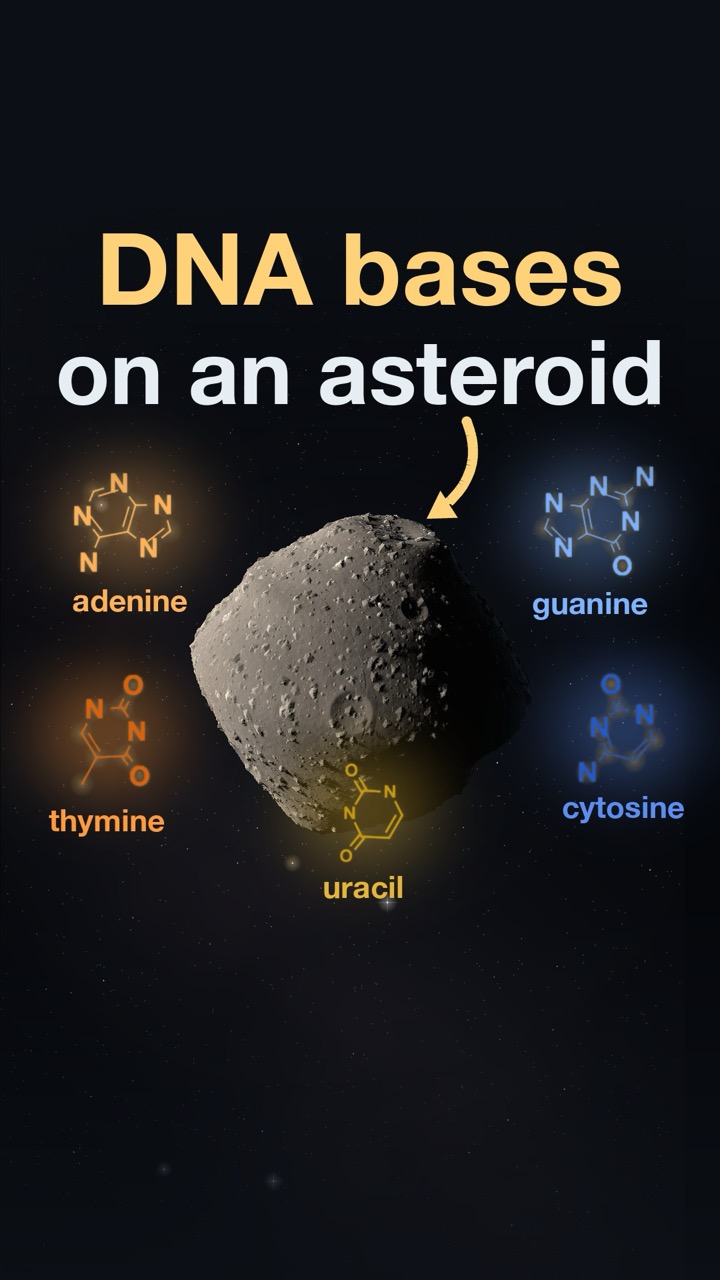
Japan's Hayabusa2 probe touched down on the asteroid Ryugu and flew its dust back to Earth. In that dust, chemists found all five bases of DNA and RNA: adenine, guanine, cytosine, thymine and uracil. In the DNA of living things, each base pairs with its partner, so the partners come in equal amounts, as Erwin Chargaff found in 1950. Ryugu's bases don't follow that rule: in one sample (C0370), about 558 picomoles of guanine per gram against 307 of cytosine, and 134 of thymine against 49 of adenine. That imbalance is one sign the bases were made by chemistry in space, not by life, and asteroids like Ryugu may have delivered some of the building blocks for life on Earth.
The video is coming soon to the channel.
Sources
3 sources. Each was checked against its record (Crossref, PubMed, the Protein Data Bank, or the textbook edition) and against the claim it supports.
- Koga T, Oba Y, Takano Y, Naraoka H, Ogawa NO, Sasaki K, Sato H, Yoshimura T, Ohkouchi N (2026). A complete set of canonical nucleobases in the carbonaceous asteroid (162173) Ryugu. Nature Astronomy 10:655-663. doi.org/10.1038/s41550-026-02791-z (all five bases in Ryugu's dust, the Hayabusa2 samples, and the amounts in sample C0370, its Table 1)
- Chargaff E (1950). Chemical specificity of nucleic acids and mechanism of their enzymatic degradation. Experientia 6:201-209. doi.org/10.1007/bf02173653 (equal amounts of each base and its partner in DNA)
- Alberts B, Johnson A, Lewis J, Raff M, Roberts K, Walter P (2002). Molecular Biology of the Cell, 4th edition. New York: Garland Science. www.ncbi.nlm.nih.gov/books/NBK21054/ (DNA, base pairing and uracil in RNA: section "The Structure and Function of DNA")