 5 to 3
Show notes
All the Building Blocks of Life Found in Space (So Far)
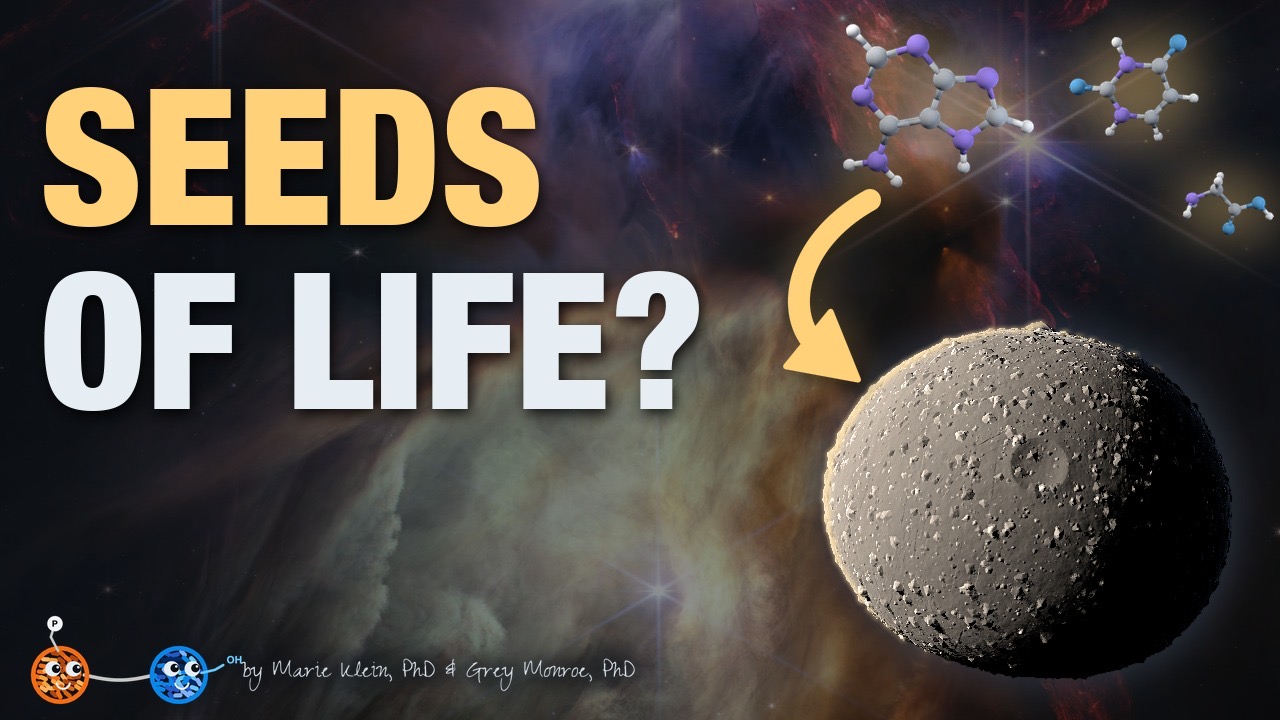
Which of life's building blocks have been found in space, and where? Scientists have found amino acids, all five bases of DNA and RNA, the sugar ribose, phosphate and lipid-like molecules that can form membranes: in meteorites, in comets, in dust brought home from the asteroids Ryugu and Bennu, in the spray of Saturn's moon Enceladus, in clouds of gas between the stars, and possibly on Mars. A molecule in a returned sample is identified two ways, by the time it takes to race through a column (liquid chromatography) and by its mass (mass spectrometry), each matched to a pure standard; rovers and spacecraft carry their own mass spectrometers, and telescopes match the radio fingerprints of molecules between the stars. Four kinds of clues show these molecules were made by chemistry, not left by Earth's life: handedness (left- and right-handed amino acids in nearly equal amounts in Bennu), the mixture (about ten thousand kinds of nitrogen-carrying molecules), the atoms (more of the heavy forms of carbon and nitrogen) and isomers that life rarely makes. No proteins, no DNA or RNA and nothing alive has been found: space shows that life's building blocks can form by chemistry alone, and that meteorites and comets could have delivered them to the young Earth.
The video is coming soon to the channel.
Vocabulary
In the order the video explains them. Tap a term for its definition and every video it appears in.
Meteorite2:13
A rock from space that fell to Earth. Living things can grow on it once it lands, so spacecraft have also brought dust straight home from asteroids.
Appears in
- ryugu_bases0:34
- All the Building Blocks of Life Found in Space (So Far) this video2:13
Asteroid2:13
A small rocky body that orbits the Sun. Ryugu and Bennu are dark, carbon-rich asteroids, little changed since the Solar System formed.
Appears in
- Scientists found DNA building blocks on an asteroid #Shorts0:01
- ryugu_bases0:00
- All the Building Blocks of Life Found in Space (So Far) this video2:13
Blank2:52
A run with no sample beside every step of the analysis, so anything that comes from the lab shows up there.
Appears in
- ryugu_bases1:37
- All the Building Blocks of Life Found in Space (So Far) this video2:52
Liquid chromatography3:01
Separating molecules by how long each takes to race through a column; a different shape clings to the column differently and comes out at a different time.
Appears in
- ryugu_bases1:46
- All the Building Blocks of Life Found in Space (So Far) this video3:01
Mass spectrometry3:01
Weighing molecules by their mass. A molecule is identified when both its mass and its time through the column match a pure standard of that molecule.
Appears in
- All the Building Blocks of Life Found in Space (So Far) this video3:01
Chromatogram3:13
The result of the test: time runs along the bottom, and a peak rises whenever molecules of one chosen mass come out.
Appears in
- All the Building Blocks of Life Found in Space (So Far) this video3:13
Amino acid5:01
Any molecule that carries an amino group (a nitrogen with its hydrogens) and an acid group (a carbon with two oxygens). Hundreds of kinds are known; proteins are built from twenty.
Appears in
- Why Does Life Need Both? (DNA vs RNA Animated)8:26
- What Turns a Gene On? (Transcription Animated)7:22
- How Does a Cell Read a Gene’s Message? (Translation Animated)5:37
- Point Mutations and Frameshift Mutations, Explained0:42
- How does death cap poison kill? (animated) #Shorts0:06
- What Actually Makes Up the Human Genome?2:06
- What Actually Makes Up the Human Genome?3:20
- All the Building Blocks of Life Found in Space (So Far) this video5:01
Nucleobase analog6:06
A base related to the five bases of DNA and RNA that life rarely uses; found in meteorites beside them.
Appears in
- All the Building Blocks of Life Found in Space (So Far) this video6:06
Purines and pyrimidines6:31
The two-ringed bases (adenine, guanine) and the one-ringed bases (cytosine, thymine, uracil). In DNA they come one to one; in space their balance varies from body to body.
Appears in
- ryugu_bases3:20
- All the Building Blocks of Life Found in Space (So Far) this video6:31
Ribose and deoxyribose6:52
RNA's sugar, and DNA's sugar, which is ribose with one oxygen missing. Ribose has been found in meteorites and Bennu; deoxyribose has not.
Appears in
- All the Building Blocks of Life Found in Space (So Far) this video6:52
Phosphate7:32
A phosphorus atom surrounded by oxygens; it links each sugar to the next in the backbone of DNA and RNA.
Appears in
- Why DNA Only Grows in One Direction (5′ to 3′ Explained)0:54
- Why Half Your DNA Is Copied Backwards (DNA Replication Animated)9:04
- Why Does Life Need Both? (DNA vs RNA Animated)1:35
- What Turns a Gene On? (Transcription Animated)5:00
- PCR Explained0:47
- All the Building Blocks of Life Found in Space (So Far) this video7:32
Lipid and membrane8:43
Every cell is wrapped in a membrane, a thin film of lipids: molecules with a head that mixes with water and an oily tail that doesn't. In water the tails pack together and the heads face out.
Appears in
- All the Building Blocks of Life Found in Space (So Far) this video8:43
Handedness (chirality)10:02
Amino acids come in left- and right-handed forms, mirror images of each other; life builds its proteins from the left-handed ones, so nearly equal amounts point to chemistry, not life.
Appears in
- All the Building Blocks of Life Found in Space (So Far) this video10:02
Isotopes (heavy carbon and nitrogen)10:46
Nitrogen and carbon each come in a light form and a slightly heavier one; molecules from space carry measurably more of the heavy form than Earth's organic matter does.
Appears in
- All the Building Blocks of Life Found in Space (So Far) this video10:46
Structural isomer11:02
A molecule with the same atoms arranged differently. Beside the bases life uses sit isomers that life rarely makes but chemistry makes just as easily.
Appears in
- All the Building Blocks of Life Found in Space (So Far) this video11:02
Panspermia11:40
The idea that life itself came to Earth from space. There is no evidence for it yet.
Appears in
- All the Building Blocks of Life Found in Space (So Far) this video11:40
Biosignature12:14
A pattern life could have left. A potential biosignature is one that chemistry might also explain.
Appears in
- All the Building Blocks of Life Found in Space (So Far) this video12:14
Review questions
Stardust's comet dust held glycine and aminocaproic acid. Why was only one of them counted as coming from the comet?
Answer
Glycine carried the comet's heavy carbon, so it came from the comet. Aminocaproic acid, the building block of nylon, carried Earth's carbon: it was picked up from nylon while the samples were handled.
A peak at adenine's mass came out of Ryugu's dust. Why was the mass alone not enough to call it adenine?
Answer
Another molecule, 2-aminopurine, has exactly the same atoms in a different shape. The chemists ran both pure molecules through the column, and the dust's peak came out at adenine's time.
How are molecules identified in gas between the stars, where no sample can be collected?
Answer
By their light: every molecule spins at its own set of speeds and gives off light, mostly radio waves, at its own set of frequencies, a fingerprint telescopes match against the same molecule measured in a lab.
Bennu held 33 named amino acids. What does it tell you that only fourteen of them are among the twenty life builds proteins from?
Answer
The mixture is not life's: life uses a fairly small set of molecules, while chemistry in space makes many kinds, including ones that are rare in living things.
Which parts of RNA have been found together in one asteroid's dust, and what has not been found?
Answer
Bennu's dust holds bases, ribose and phosphate, every part of RNA, but not joined together. No proteins, no DNA or RNA and nothing alive has been found anywhere in space.
Why do nearly equal amounts of left- and right-handed alanine in Bennu argue against contamination?
Answer
Life builds its proteins from left-handed amino acids, so contamination from Earth's life would tip the balance to the left; in Bennu the two hands came in nearly equal amounts.
Does finding life's building blocks in space show that life came from space?
Answer
No. It shows that the building blocks can form by chemistry alone and that meteorites and comets could have delivered them to the young Earth; there is no evidence yet that life itself came from space (panspermia).
Chapters
- 0:00 Life's building blocks found in space
- 1:27 How scientists identify a molecule from space (chromatography, mass spectrometry)
- 4:50 Amino acids in meteorites, asteroid Bennu and comets
- 6:06 All five DNA and RNA bases on asteroids Ryugu and Bennu
- 6:51 Sugars: ribose in meteorites and Bennu
- 7:31 Phosphate and phosphorus
- 8:42 Molecules that can build membranes
- 10:02 How we know Earth's life didn't put them there
- 11:14 What it means for the origin of life
Sources
67 sources. Each was checked against its record (Crossref, PubMed, the Protein Data Bank, or the textbook edition) and against the claim it supports.
Textbook
- Alberts B, Johnson A, Lewis J, Raff M, Roberts K, Walter P. Molecular Biology of the Cell, 4th edition. Garland Science, 2002. www.ncbi.nlm.nih.gov/books/NBK21054/
Molecules found in space
- Glavin DP, Dworkin JP, Alexander CMO’D, Aponte JC, Baczynski AA, Barnes JJ, et al. Abundant ammonia and nitrogen-rich soluble organic matter in samples from asteroid (101955) Bennu. Nature Astronomy 9:199-210 (2025). doi:10.1038/s41550-024-02472-9
- Koga T, Oba Y, Takano Y, Naraoka H, Ogawa NO, Sasaki K, et al. A complete set of canonical nucleobases in the carbonaceous asteroid (162173) Ryugu. Nature Astronomy 10:655-663 (2026). doi:10.1038/s41550-026-02791-z
- Furukawa Y, Sunami S, Takano Y, Koga T, Hirakawa Y, Oba Y, et al. Bio-essential sugars in samples from asteroid Bennu. Nature Geoscience 19:19-24 (2025). doi:10.1038/s41561-025-01838-6
- McCoy TJ, Russell SS, Zega TJ, Thomas-Keprta KL, Singerling SA, Brenker FE, et al. An evaporite sequence from ancient brine recorded in Bennu samples. Nature 637:1072-1077 (2025). doi:10.1038/s41586-024-08495-6
- Deamer DW, Pashley RM. Amphiphilic components of the murchison carbonaceous chondrite: Surface properties and membrane formation. Origins of life and evolution of the biosphere 19:21-38 (1989). doi:10.1007/bf01808285
- Elsila JE, Glavin DP, Dworkin JP. Cometary glycine detected in samples returned by Stardust. Meteoritics & Planetary Science 44:1323-1330 (2009). doi:10.1111/j.1945-5100.2009.tb01224.x
- Altwegg K, Balsiger H, Bar-Nun A, Berthelier J-J, Bieler A, Bochsler P, et al. Prebiotic chemicals—amino acid and phosphorus—in the coma of comet 67P/Churyumov-Gerasimenko. Science Advances 2 (2016). doi:10.1126/sciadv.1600285
- Postberg F, Sekine Y, Klenner F, Glein CR, Zou Z, Abel B, et al. Detection of phosphates originating from Enceladus’s ocean. Nature 618:489-493 (2023). doi:10.1038/s41586-023-05987-9
- Freissinet C, Glavin DP, Archer PD, Teinturier S, Buch A, Szopa C, et al. Long-chain alkanes preserved in a Martian mudstone. Proceedings of the National Academy of Sciences 122 (2025). doi:10.1073/pnas.2420580122
- McGuire BA. 2021 Census of Interstellar, Circumstellar, Extragalactic, Protoplanetary Disk, and Exoplanetary Molecules. The Astrophysical Journal Supplement Series 259:30 (2022). doi:10.3847/1538-4365/ac2a48
- Yada T, Abe M, Okada T, Nakato A, Yogata K, Miyazaki A, et al. Preliminary analysis of the Hayabusa2 samples returned from C-type asteroid Ryugu. Nature Astronomy 6:214-220 (2021). doi:10.1038/s41550-021-01550-6
- Leyva V, Robert M, Pepino R, Bocková J, Meinert C. Abiotic sugar enantiomers in the CI carbonaceous chondrite Orgueil. Nature Communications 17 (2026). doi:10.1038/s41467-026-68709-5
- Lauretta DS, Connolly HC, Aebersold JE, Alexander CMO’D, Ballouz R, Barnes JJ, et al. Asteroid (101955) Bennu in the laboratory: Properties of the sample collected by OSIRIS‐REx. Meteoritics & Planetary Science 59:2453-2486 (2024). doi:10.1111/maps.14227
- Kvenvolden K, Lawless J, Pering K, Peterson E, Flores J, Ponnamperuma C, et al. Evidence for Extraterrestrial Amino-acids and Hydrocarbons in the Murchison Meteorite. Nature 228:923-926 (1970). doi:10.1038/228923a0
- Koga T, Naraoka H. A new family of extraterrestrial amino acids in the Murchison meteorite. Scientific Reports 7 (2017). doi:10.1038/s41598-017-00693-9
- Furukawa Y, Chikaraishi Y, Ohkouchi N, Ogawa NO, Glavin DP, Dworkin JP, et al. Extraterrestrial ribose and other sugars in primitive meteorites. Proceedings of the National Academy of Sciences 116:24440-24445 (2019). doi:10.1073/pnas.1907169116
- Parker ET, McLain HL, Glavin DP, Dworkin JP, Elsila JE, Aponte JC, et al. Extraterrestrial amino acids and amines identified in asteroid Ryugu samples returned by the Hayabusa2 mission. Geochimica et Cosmochimica Acta 347:42-57 (2023). doi:10.1016/j.gca.2023.02.017
- Khawaja N, Postberg F, O’Sullivan TR, Napoleoni M, Kempf S, Klenner F, et al. Detection of organic compounds in freshly ejected ice grains from Enceladus’s ocean. Nature Astronomy 9:1662-1671 (2025). doi:10.1038/s41550-025-02655-y
- Millan M, Teinturier S, Malespin CA, Bonnet JY, Buch A, Dworkin JP, et al. Organic molecules revealed in Mars’s Bagnold Dunes by Curiosity’s derivatization experiment. Nature Astronomy 6:129-140 (2021). doi:10.1038/s41550-021-01507-9
- Callahan MP, Smith KE, Cleaves HJ, Ruzicka J, Stern JC, Glavin DP, et al. Carbonaceous meteorites contain a wide range of extraterrestrial nucleobases. Proceedings of the National Academy of Sciences 108:13995-13998 (2011). doi:10.1073/pnas.1106493108
- Oba Y, Takano Y, Furukawa Y, Koga T, Glavin DP, Dworkin JP, et al. Identifying the wide diversity of extraterrestrial purine and pyrimidine nucleobases in carbonaceous meteorites. Nature Communications 13 (2022). doi:10.1038/s41467-022-29612-x
- Cooper G, Kimmich N, Belisle W, Sarinana J, Brabham K, Garrel L. Carbonaceous meteorites as a source of sugar-related organic compounds for the early Earth. Nature 414:879-883 (2001). doi:10.1038/414879a
- Jørgensen JK, Favre C, Bisschop SE, Bourke TL, van Dishoeck EF, Schmalzl M. Detection of the simplest sugar, glycolaldehyde, in a solar-type protostar with ALMA. The Astrophysical Journal 757:L4 (2012). doi:10.1088/2041-8205/757/1/l4
- Jiménez-Serra I, García de la Concepción J, Cuppen HM, Rey-Montejo M, Sanz-Novo M, Rivilla VM, et al. Detection of a four-carbon sugar in interstellar space. Nature Astronomy 10:1353-1363 (2026). doi:10.1038/s41550-026-02905-7
- Cooper GW, Onwo WM, Cronin JR. Alkyl phosphonic acids and sulfonic acids in the Murchison meteorite. Geochimica et Cosmochimica Acta 56:4109-4115 (1992). doi:10.1016/0016-7037(92)90023-c
- Pasek MA, Lauretta DS. Aqueous Corrosion of Phosphide Minerals from Iron Meteorites: A Highly Reactive Source of Prebiotic Phosphorus on the Surface of the Early Earth. Astrobiology 5:515-535 (2005). doi:10.1089/ast.2005.5.515
- Pasek MA, Harnmeijer JP, Buick R, Gull M, Atlas Z. Evidence for reactive reduced phosphorus species in the early Archean ocean. Proceedings of the National Academy of Sciences 110:10089-10094 (2013). doi:10.1073/pnas.1303904110
- Gull M, Mojica MA, Fernández FM, Gaul DA, Orlando TM, Liotta CL, et al. Nucleoside phosphorylation by the mineral schreibersite. Scientific Reports 5 (2015). doi:10.1038/srep17198
- Eigenbrode JL, Summons RE, Steele A, Freissinet C, Millan M, Navarro-González R, et al. Organic matter preserved in 3-billion-year-old mudstones at Gale crater, Mars. Science 360:1096-1101 (2018). doi:10.1126/science.aas9185
- Postberg F, Khawaja N, Abel B, Choblet G, Glein CR, Gudipati MS, et al. Macromolecular organic compounds from the depths of Enceladus. Nature 558:564-568 (2018). doi:10.1038/s41586-018-0246-4
- Rivilla VM, Jiménez-Serra I, Martín-Pintado J, Briones C, Rodríguez-Almeida LF, Rico-Villas F, et al. Discovery in space of ethanolamine, the simplest phospholipid head group. Proceedings of the National Academy of Sciences 118 (2021). doi:10.1073/pnas.2101314118
- Engel MH, Macko SA, Silfer JA. Carbon isotope composition of individual amino acids in the Murchison meteorite. Nature 348:47-49 (1990). doi:10.1038/348047a0
- Cronin JR, Pizzarello S. Enantiomeric Excesses in Meteoritic Amino Acids. Science 275:951-955 (1997). doi:10.1126/science.275.5302.951
- Waajen AC, Lima C, Goodacre R, Cockell CS. Life on Earth can grow on extraterrestrial organic carbon. Scientific Reports 14 (2024). doi:10.1038/s41598-024-54195-6
Searching for life beyond Earth
- Hurowitz JA, Tice MM, Allwood AC, Cable ML, Hand KP, Murphy AE, et al. Redox-driven mineral and organic associations in Jezero Crater, Mars. Nature 645:332-340 (2025). doi:10.1038/s41586-025-09413-0
- Madhusudhan N, Constantinou S, Holmberg M, Sarkar S, Piette AAA, Moses JI. New Constraints on DMS and DMDS in the Atmosphere of K2-18 b from JWST MIRI. The Astrophysical Journal Letters 983:L40 (2025). doi:10.3847/2041-8213/adc1c8
- Luque R, Piaulet-Ghorayeb C, Radica M, Xue Q, Zhang M, Bean JL, et al. Insufficient evidence for DMS and DMDS in the atmosphere of K2-18 b: From a joint analysis of JWST NIRISS, NIRSpec, and MIRI observations. Astronomy & Astrophysics 700:A284 (2025). doi:10.1051/0004-6361/202555580
- Greaves JS, Richards AMS, Bains W, Rimmer PB, Sagawa H, Clements DL, et al. Phosphine gas in the cloud decks of Venus. Nature Astronomy 5:655-664 (2020). doi:10.1038/s41550-020-1174-4
- Villanueva GL, Cordiner M, Irwin PGJ, de Pater I, Butler B, Gurwell M, et al. No evidence of phosphine in the atmosphere of Venus from independent analyses. Nature Astronomy 5:631-635 (2021). doi:10.1038/s41550-021-01422-z
Protein structures in the 3D shots
- Bhaskar V, Graff-Meyer A, Schenk AD, Cavadini S, von Loeffelholz O, Natchiar SK, et al. Dynamics of uS19 C-Terminal Tail during the Translation Elongation Cycle in Human Ribosomes. Cell Reports 31:107473 (2020). doi:10.1016/j.celrep.2020.03.037 (PDB 6Y0G)
- Holm M, Natchiar SK, Rundlet EJ, Myasnikov AG, Watson ZL, Altman RB, et al. mRNA decoding in human is kinetically and structurally distinct from bacteria. Nature 617:200-207 (2023). doi:10.1038/s41586-023-05908-w (PDB 8G60)
- Shao S, Murray J, Brown A, Taunton J, Ramakrishnan V, Hegde RS. Decoding Mammalian Ribosome-mRNA States by Translational GTPase Complexes. Cell 167:1229-1240.e15 (2016). doi:10.1016/j.cell.2016.10.046 (PDB 5LZT)
- Bernecky C, Herzog F, Baumeister W, Plitzko JM, Cramer P. Structure of transcribing mammalian RNA polymerase II. Nature 529:551-554 (2016). doi:10.1038/nature16482 (PDB 5FLM)
- Unwin N. Refined Structure of the Nicotinic Acetylcholine Receptor at 4Å Resolution. Journal of Molecular Biology 346:967-989 (2005). doi:10.1016/J.JMB.2004.12.031 (PDB 2BG9)
- Shinoda T, Ogawa H, Cornelius F, Toyoshima C. Crystal structure of the sodium–potassium pump at 2.4 Å resolution. Nature 459:446-450 (2009). doi:10.1038/nature07939 (PDB 2ZXE)
- Sui H, Han B-G, Lee JK, Walian P, Jap BK. Structural basis of water-specific transport through the AQP1 water channel. Nature 414:872-878 (2001). doi:10.1038/414872a (PDB 1J4N)
- Doyle DA, Cabral JM, Pfuetzner RA, Kuo A, Gulbis JM, Cohen SL, et al. The Structure of the Potassium Channel: Molecular Basis of K + Conduction and Selectivity. Science 280:69-77 (1998). doi:10.1126/science.280.5360.69 (PDB 1BL8)
- Deng D, Xu C, Sun P, Wu J, Yan C, Hu M, et al. Crystal structure of the human glucose transporter GLUT1. Nature 510:121-125 (2014). doi:10.1038/nature13306 (PDB 4PYP)
- Okada T, Sugihara M, Bondar A-N, Elstner M, Entel P, Buss V. The Retinal Conformation and its Environment in Rhodopsin in Light of a New 2.2 Å Crystal Structure. Journal of Molecular Biology 342:571-583 (2004). doi:10.1016/j.jmb.2004.07.044 (PDB 1U19)
- Davey CA, Sargent DF, Luger K, Maeder AW, Richmond TJ. Solvent Mediated Interactions in the Structure of the Nucleosome Core Particle at 1.9Å Resolution. Journal of Molecular Biology 319:1097-1113 (2002). doi:10.1016/S0022-2836(02)00386-8 (PDB 1KX5)
- Vijay-kumar S, Bugg CE, Cook WJ. Structure of ubiquitin refined at 1.8 Å resolution. Journal of Molecular Biology 194:531-544 (1987). doi:10.1016/0022-2836(87)90679-6 (PDB 1UBQ)
- Chattopadhyaya R, Meador WE, Means AR, Quiocho FA. Calmodulin structure refined at 1.7 Å resolution. Journal of Molecular Biology 228:1177-1192 (1992). doi:10.1016/0022-2836(92)90324-d (PDB 1CLL)
- Müller CW, Schlauderer GJ, Reinstein J, Schulz GE. Adenylate kinase motions during catalysis: an energetic counterweight balancing substrate binding. Structure 4:147-156 (1996). doi:10.1016/S0969-2126(96)00018-4 (PDB 4AKE)
Agency and mission pages
- NASA. "NASA Says Mars Rover Discovered Potential Biosignature Last Year." News release 25-061, 10 September 2025. www.nasa.gov/news-release/nasa-says-mars-rover-discovered-potential-biosignature-last-year/
- NASA. Mars 2020 Perseverance mission page. science.nasa.gov/mission/mars-2020-perseverance/
- U.S. House of Representatives. Joint explanatory statement, H.R. 6938, Division A (Commerce, Justice, Science), p. 54 (Public Law 119-74, 23 January 2026). docs.house.gov/billsthisweek/20260105/Division%20A%20Commerce%20Justice%20Science.pdf
- JAXA. Martian Moons eXploration (MMX). www.mmx.jaxa.jp/en/
- ESA. "ExoMars Rosalind Franklin rover will have a European landing platform." 30 March 2025. www.esa.int/Science_Exploration/Human_and_Robotic_Exploration/ExoMars_Rosalind_Franklin_rover_will_have_a_European_landing_platform
- NASA. Europa Clipper mission page. science.nasa.gov/mission/europa-clipper/
- NASA. "Webb Unveils Dark Side of Pre-stellar Ice Chemistry." 23 January 2023. science.nasa.gov/missions/webb/webb-unveils-dark-side-of-pre-stellar-ice-chemistry
- NASA. "What is a biosignature?" science.nasa.gov/astrobiology/learning-resources/alp/what-is-a-biosignature/
Images
- Curiosity rover, traced from "Mars Rover Curiosity, Right Side View" (PIA14257): NASA/JPL-Caltech, public domain. commons.wikimedia.org/wiki/File:Mars_Rover_Curiosity,_Right_Side_View.JPG
- Rosetta spacecraft, traced from "Rosetta fly-by", a frame from the DLR film "Chasing A Comet - The Rosetta Mission": DLR, CC BY 3.0 DE. commons.wikimedia.org/wiki/File:Rosetta_fly-by.jpg
- Cassini spacecraft, traced from "Diagram of the Cassini Spacecraft": NASA/JPL, public domain. commons.wikimedia.org/wiki/File:Cassini_spacecraft.jpg
- Gale crater and Mount Sharp, drawn from "Mount Sharp Panorama in Raw Colors" (PIA16769) and "Rover Panorama Taken Amid Murray Buttes on Mars" (PIA20840), Curiosity Mastcam: NASA/JPL-Caltech/MSSS. photojournal.jpl.nasa.gov/catalog/PIA16769 · photojournal.jpl.nasa.gov/catalog/PIA20840
- Cheyava Falls rock ("leopard spots"), traced from "Perseverance Finds a Rock With 'Leopard Spots'" (PIA26368), WATSON camera: NASA/JPL-Caltech/MSSS. photojournal.jpl.nasa.gov/catalog/PIA26368


